
Scientific Evidence for Using Hypnosis for Sex Problems
This page on my professional training website gives examples of numerous studies investigating and supporting hypnosis as a valid and effective method of helping people improve their sex lives. You can also see some related study links below.
Definitions and Terms
Some of the terminology I use in my practice may be new to you, and you may wonder why I use some of these methods in my practice.Here are some definitions and references.
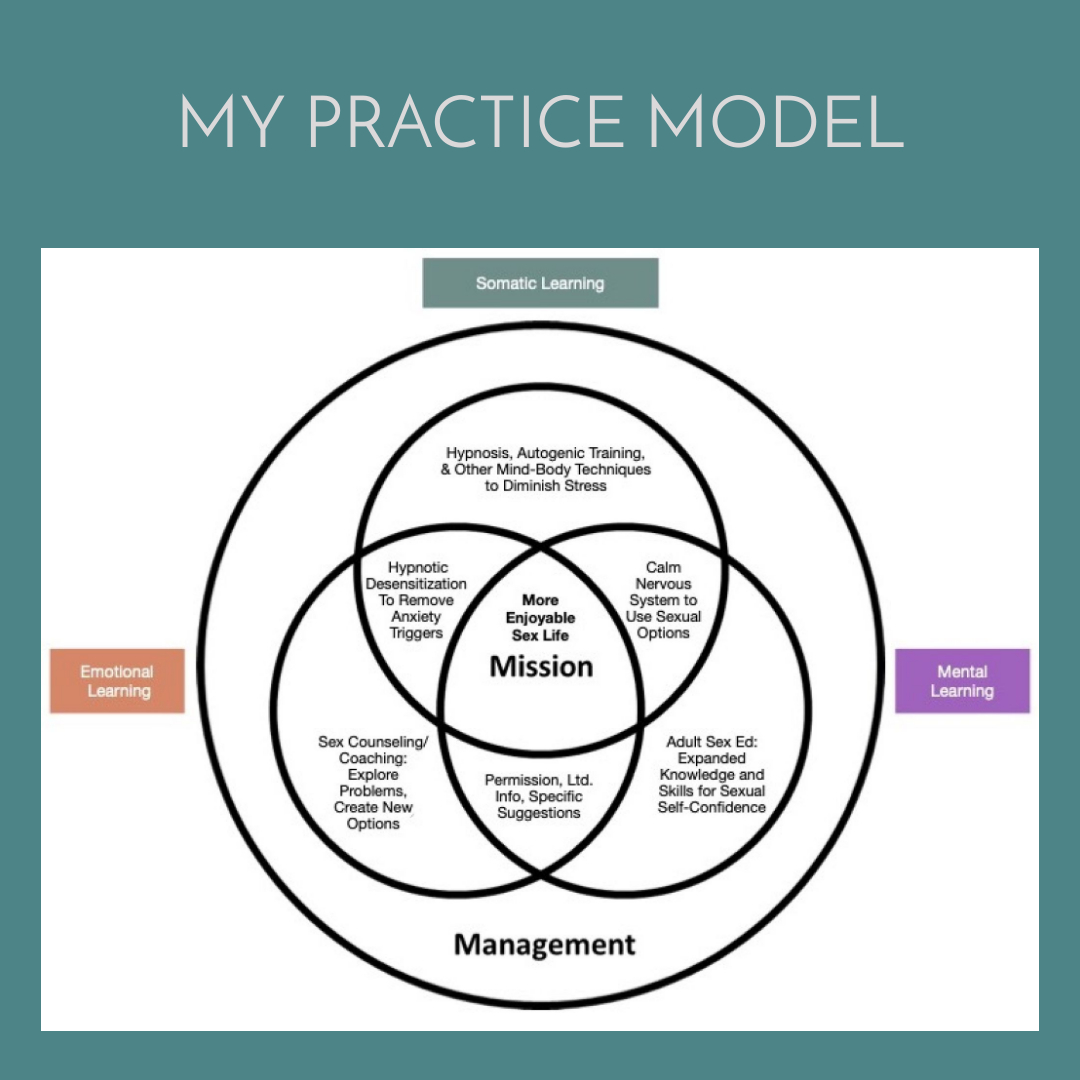
Adult Sex Education
I use this phrase to include books, media, websites, internet streaming services, and other sources of accurate, up-to-date information about human sexuality and gender, sexual skills, sexual preferences, etc. It’s not always easy to know what’s really good information and what’s not so great so I try to provide the best resources I know of, at any given time.
Affirmations
How we talk to ourselves matters. The Meyerson study below shows that affirmations given in the third person, using first and last names, are more successful at countering and replacing negative self-talk than “I statements.” They may be used within and/or in addition to hypnosis and self-hypnosis, to begin flipping the internal scripts that might be holding you back. [See Negative Self-Talk/Negative Self-Hypnosis, below.]
Meyerson, J. (2017) Self-talk monitoring and utilization for enhancing hpnotic induction. American Journal of Clinical Hypnosis, 60:2, 149-158. Retrieved from: DOI: 10.1080/00029157.2017.1289465
Weintraub, P. (May/June 2015). The voice of reason. Psychology Today.
Autogenic Training
An autonomic self-regulation therapy in wide use, developed as an offshoot of self-hypnosis by Dr. Johann H. Schultz, a German neurologist, in the mid-1920s. Decades of studies have demonstrated its efficacy in self-regulation of the autonomic nervous system and return to homeostasis. In other words, it’s extremely effective for relaxation, though it has other uses as well. Because of this, I often use autonomic training language in my hypnosis inductions.
Takaishi, N. (2000). A comparative study of autogenic training and progressive relaxation as methods for teaching clients to relax.Sleep and Hypnosis, 2(3),132-136. Retrieved from: https://sleepandhypnosis.org/wp-content/uploads/2024/07/9b2c38fd8dcc47fa926a99323f88627a.pdf
Coaching, Sex
A coaching speciality described as using “a results-focused approach” to help clients “reach their sexual potential” (P. Britton, The Art of Sex Coaching, 2005).
Counseling, Sexuality
Sexuality counselors, as defined by AASECT (American Association of Sexuality Educators, Counselors, and Therapists), “assist the client to realistically resolve concerns through the introduction of problem solving techniques of communication as well as providing accurate information and relevant suggestions of specific exercises and techniques in sexual expression. Sexuality counseling is generally short-term and client-centered, focusing on the immediate concern or problem.”
AASECT-certified sexuality counselors (CSC) must meet educational standards for core knowledge about human sexuality, have counseling experience, and a certain number of supervision hours to qualify.
Ego-Strengthening Hypnosis
A method developed by Dr. John Heywood Hartland, a British psychotherapist, in the 1960s. It is based on the work of Émile Coué, a French pharmacist, hypnotist, and psychotherapist famed for his pioneering work on the power of suggestion. Promotes self-esteem, resilience, self-acceptance, and self-love. May be adapted to promote sexual self-confidence and self-esteem.
The National Guild of Hypnotists’s World of Hypnosis Book 2 instruction manual includes Ego-Strengthening in (pp. 206-209).
There are many studies of the merits of ego-strengthening hypnosis. Here is a dissertation chronicaling a simple experiment:
Herber, T. J. (2006). The effects of hypnotic ego strengthening on self-esteem (Doctoral dissertation, Washington State University).
Erotic Hypnosis
A form of recreational, fantasy hypnosis used to enhance sexual experiences, bonding, sensations, and fantasy play. This is not hypnosis that I “do” with clients, but I do teach a structured course for clients who are interested in enjoying this with each other.
You may find more information in my book, Entrancing: Hypnotizing Your Way to More Pleasure, Romance, and Sex (2023).
Homework and “Homeplay”
It’s often helpful for clients to engage in certain activities between sessions, as a way to get more value from the insights that arise in sessions, and/or to practice certain techniques I recommend, such as listening to a hypnosis recording, watching a video, learning self-hypnosis, breathwork, self-pleasure, etc.
Hypnosis (also called hypnotism, clinical hypnosis, and hypnotherapy, depending on context)
Most people are familar with the idea that hypnosis is a way to deliver positive suggestions that support a desired change, such as qutting smoking, getting more sleep, improving sports performance, improving health and wellness, etc. However most people are not aware of the enormous amounts of literature that support uses of hypnosis for assisting with sexual problems and shifting mental/emotional attitudes that impede sexual enjoyment.
The definition of hypnosis has changed over the years, and may vary with practioners and researchers. Dr. Daniel Araoz, a psychotherapist and early pioneer in using hypnosis for sexual problems–and the author of many books and papers on the topic–once gave s a simple description of hypnosis as a “goal directed daydream.” Hypnosis studies have found that hypnotized subjects exhibit a shift to slower brainwaves, from Alpha to delta.
The American Psychological Assocation’s Division 30 (Society of Psychological Hypnosis) defines it “a state of consciousness involving focused attention and reduced peripheral awareness characterized by an enhanced capacity for response to suggestion” (Elkins, G. R., et al., International Journal of Clinical and Experimental Hypnosis, Vol. 63, No. 1, 201) (Quote source: Weir, 2024).
Araoz, D. (2005). Hypnosis in human sexuality problems. American Journal of Clinical Hypnosis, 47(4), 229-242.
Weir, K. (Apr.-May, 2024). Uncovering the new science of clinical hypnosis. Monitor on Psychology, 55(3), 47.
Hypnotic Desensitization
A hypnotic adaptation of the systematic desensitization methods created by Joseph Wolpe, MD. Wolpe first published in the late 1950s-early 1960s. The National Guild of Hypnotists’ World of Hypnosis Book 2 instruction manual includes hypnotic desensitization (pp. 187-194).
A recent article (below) describes the hypnotic use as “the standard graduated approach method is modified so that each event in an established hierarchy is presented under guided imagery from a vantage point of assumed task mastery. A case report is presented along with two brief clinical vignettes to illustrate the method. The method is in keeping with a cognitive approach to psychotherapy directed toward issues of self-mastery and control” (Surman, 1979).
Surman, O. S. (1979). Postnoxious desensitization: Some clinical notes on the combined use of hypnosis and systematic desensitization. American Journal of Clinical Hypnosis, 22(1), 54-60.
Wolpe, J. (1961). The systematic desensitization treatment of neuroses. The Journal of nervous and mental disease, 132(3), 189-203.
Hypnotic Relaxation Therapy (HRT)
A system of clinical hypnosis developed by Dr. Gary Elkins (Hypnotic Relaxation Therapy: Principles and Applications (2011). Simply put, it advocates using relaxation hypnosis as a first stage in a series of sessions, prior to addressing presenting concerns directly. (The theory and use of HRT is much more complicated than this, naturally.)
Mind-Body Techniques
A general term for a collection of practices such as EFT “tapping” (Emotional Freedom Technique), breathwork, Limbic Release, “Power Posing,” and other short and simple techniques for creating immediate change or relief while under duress.
Negative Self-Talk/Negative Self-Hypnosis
Inner messages of hopelessness, brokenness, despair, lack of self worth, etc. that a person might give themselves, consciously or unconsciously. Such messages impede or prevent self-growth and satisfaction. It is common for people with sexual difficulties to experience a number of persistent negative messages. Some clinicians have even referred to this as a form of self-hypnosis. [See Affirmations, above.]
Self-Hypnosis
Learning and practicing basic hypnosis techniques to deliver positive self-suggestions and affirmations, improve relaxation, diminish stress, promote wellness, etc.
Sexological Hypnosis
A term I coined for my doctoral project, Intimate Hypnosis: Sexological Hypnosis Skills (2011), to refer to uses of hypnosis for sexual concerns, within the context of sexology. For more information see my book, Sexological Hypnosis: Overview, History, & Techniques (2022).
Sexology
A wide-ranging, multi-disciplinary study of human sexual behavior, also sometimes known as “the study of what people do and how they think about it.” Clinical sexology is the application of this knowledge to a clinical practice of counseling, coaching, or therapy.
Sexual Enrichment
A general term that includes learning and enjoying new techniques and forms of pleasure, such as erotic massage, erotic hypnosis, tantra, BDSM and other kinky activities, sex toy use, fantasy play, etc., as a way to bring variety and experimentation into intimate relationships.