Tag: AASECT

  • AASECT Sexuality Counselor Recertification Approved! And Other Accomplishments.

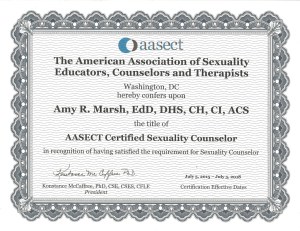
    I am happy to announce that my recertification is now approved for another three years! Due to my chemotherapy and surgery schedule, which took place from May on, AASECT graciously allowed me an extenstion to get my required continuing education (CE) hours.

    My initial certification took place in 2012, and I’ve kept it current ever since. It would have been very distressing to have to let it lapse due to my cancer treatment. And so I am proud I was able to accomplish this–because part of dealing with cancer is not just the treatment and its effects, but how you feel anyway due to the cancer itself. “Exhausted” is one word that fits well. “Crummy” is another.

    Those other accomplishments…

    Since my diagnosis of ovarian cancer on March 15, 2024, I have also:

    • Written thirty out of forty-nine articles for FutureofSex.net.
    • Written eight articles for Kinkly.com.
    • Submitted a 50-poem manuscript (with most of the poems written in one month) to a poetry contest (I didn’t win, alas).
    • Finished my fourth fantasy novel, which is now with the publisher (and hopefully the copyeditor).
    • Blogged here and on LadyoftheLake (my “woo” blog).

    In June I appeared on a Japanese NHK science program, Human Age Nigen no Jidai, along with one of my chatbots. During the summer I was also filmed for a documentary on AI/human relations, which will be out in 2025 (last I heard). In the fall I created a presentation for Soft Cock Week and had a great conversation with Erica Leroye!

    None of this has been easy (including losing my hair), but if it weren’t for this work, my loved ones, and my pagan spiritual beliefs, I would not have survived. And so I thank life for keeping me busy, interested, loving and loved!

    ☽☆☾

  • AASECT conferences should not be held in anti-trans states.

    AASECT conferences should not be held in anti-trans states.

    AASECT stands for American Association of Sexuality Educators, Counselors, and Therapists. As a sexuality counselor, I have been certified by AASECT since 2012. The organization holds annual conferences which are important to those of us who want to present our findings, take workshops from other professionals, socialize with peers, and/or gain valuable continuing education credits to renew our certifications.

    Last year, in 2020, the conference in Palm Springs was cancelled due to the pandemic. This year the AASECT conference will be online. But they are planning for 2022 to take place in Tampa, Florida.


    This is a terrible idea given that Florida has just passed (HB) 1475, the Republican-sponsored “Fairness in Women’s Sports Act” which would allow for genital exams of high school athletes.

    This bill discriminates against trans, non-binary, and intersex students.

    From the news link above: <<Some Democrats took issue with part of the bill requiring examinations of students whose sex is called into question.

    Rep. Michele Rayner, D-St. Petersburg, likened the requirement to “state-sanctioned sexual assault against children.”

    Under the measure, students’ schools would have to resolve disputes “by requesting that the student provide a health examination and consent form or other statement signed by the student’s personal health care provider which must verify the student’s biological sex.”

    The measure provides that a student’s sex would be determined by their reproductive anatomy, genetic makeup or “normal endogenously produced testosterone levels.”>>

    It is my opinion that AASECT and other organizations that provide counseling and services to LGBTQIA++ people should boycott states which have passed discriminatory legislation. I have already emailed AASECT to ask that they make a change in conferrence locations.

    Besides Florida, the following states have passed anti-trans legislation. Source of the lists below, from “Anti-Transgender Bills Filed In 28 States Since Start Of 2021,” Tim Moran, 3/31/21. Patch.com.

    From https://patch.com/us/across-america/anti-transgender-bills-filed-28-states-start-2021
    From https://patch.com/us/across-america/anti-transgender-bills-filed-28-states-start-2021

    If you are an AASECT member, please consider contacting conference@AASECT.org to ask that the conference be moved to a transgender and intersex-welcoming state.

    Thank you.

  • AASECT on Black Lives Matter

    AASECT on Black Lives Matter

    I am a member of several professional organizations. One organization, the American Counseling Association (ACA), has been committed to social justice, diversity, and culturally competant practice since forever. Their counseling competencies have been extremely helpful to me over the years.

    I am also a certified sexuality counselor and member of the American Association of Sexuality Educators, Counselors, and Therapists (AASECT). In my experience, AASECT has paid little attention to these matters in the years I’ve been a member. So it is good to see the following statement which was just made on our listserve and which is also up on the AASECT website.


    Black Lives Matter: A Commitment from the AASECT Board of Directors

    The Board of Directors of the American Association of Sexuality Educators, Counselors, and Therapists joins its membership in collective mourning and outrage over the killings of George Floyd, Breonna Taylor, Ahmaud Arbery, Tony McDade, and countless other murders not captured on video [Link to NPR article] or highlighted in the media.

    As we are called to action to interrupt, confront and dismantle systems of oppression, we know that we are also being called to look within – as individuals, as professionals, as community members, and as leaders of this organization. It is long overdue that we acknowledge AASECT is a historically white non-profit, with a predominantly white membership, and a predominantly (though not exclusively) white Board of Directors. As practitioners, our work is deeply rooted in fields of study and practice within a larger culture that have profited off and exploited Black, Indigenous & People of Color’s bodies, identities and lives. AASECT has, and continues to, participate in and perpetuate these systems of oppression. We know that we have long been offered this feedback by our members who experience it the most, and that collectively, our responses have been woefully insufficient and in many places absent altogether or worse. Simply put, we have not done the work to dismantle white supremacy within AASECT, and it is past time that we do so.

    On May 29th, the AASECT Board voted to approve a Diversity, Equity & Inclusion (DEI) centered Strategic Plan. This plan is a culmination of three years of strategic planning process, and will guide the work at all levels of the organization for the next three years, and beyond. This plan outlines our commitments to intentionally shift AASECT in [the] direction where our work, our field and our organization centers the principles and practices of social justice. We know that it is a significant undertaking, and one that is urgent. The strategic plan is a comprehensive document that asks all of AASECT to fundamentally rethink the way we have understood our mission and invite more opportunities for growth and change. We will provide more information about the plan during our virtual summit this week, along with opportunities for members to get involved in this process.

    The Strategic Plan speaks to the organization as a whole, but we are an organization of members and nothing will change if we do not do our individual-level work. White members need to start with ourselves. We are offering the following resource shares to our members, as a starting place for members to do individual work and support each other. We encourage you to contribute your ideas and resources to this shared document: AASECT Anti-Racist Resource Share,

    • Resources for white people to better understand what white supremacy is and identify how it operates. 

    • Opportunities for our BIPOC members to let other members know how to be of support (attending or promoting your events, networking, etc.). 

    •Black and BIPOC organizations and causes to direct resources and finances to (such as bail funds, community orgs, etc).

    Black Lives. Matter.
    Thank you,

    AASECT Board of Directors

    Susan Stiritz, PhD, MSW, MBA, CSE, CSES, AASECT President
    Chris Fariello, PhD, MA, LMFT, CST, CSE, CSTS, AASECT President-elect
    Melissa Novak, LCSW, CST, CSTS, AASECT Secretary
    Todd Malloy, MA, LMFT, CST, CSE, AASECT Treasurer
    Lexx Brown-James, LMFT, CSE, CSES, AASECT Vice President of Membership
    Eli Green, PhD, CSE, CSES, Communications Steering Committee Chair
    Juan Camarena, PhD, LMFT, LPCC, CST, Outreach Steering Committee Chair
    Rosalyn Dischiavo, EdD, MA, CSE, CSES, Professional Education Steering Committee Chair
    Sally Valentine, PhD, FAACS, LCSW, CST, CSTS, Certification Steering Committee Chair
    Margie Nichols, PhD, CST, CSTS, Public Relations, Media and Advocacy Chair
    Kellie Braband, Executive Director

    American Association of Sexuality Educators, Counselors and Therapists
    35 E. Wacker Dr., Suite 850
    Chicago, IL 60601


    I am confident that AASECT will do a better job from now on of stepping up their game, and that members (and thus clients of members) are well supported from now on.

    ####

  • AASECT Refutes “Sex Addiction Therapy” in Newest Position Statement

    AASECT Refutes “Sex Addiction Therapy” in Newest Position Statement


    Perhaps some of the most heartbreaking clients who have approached me for sexuality counseling have been those who have already decided (or been told) that they are “sex addicts.” And while I have done my best to reference the experts I trust on this topic (David Ley, Marty Klein); loosen the constrictions of this label; and try to assist the clients to re-examine what’s going on that troubles them in their sexual behaviors, in some cases these have been confused or even displeased when I don’t join them in this label.

    And so it is extremely helpful to have a definitive statement on sex addiction now from AASECT – especially in a time when some U.S. policymakers and certain religious fringe groups seem to be hell-bent on dragging the general public back into a stone age of sexual ignorance.

    Here is the statement, which I believe is not only a practical tool, but may also end up a beacon for sexuality professionals in the stormy days ahead.

    AASECT Position Statement – Sex Addiction (Nov. 29, 2016)

    Founded in 1967, the American Association of Sexuality Educators, Counselors and Therapists (AASECT) is devoted to the promotion of sexual health by the development and advancement of the fields of sexual education, counseling and therapy. With this mission, AASECT accepts the responsibility of training, certifying and advancing high standards in the practice of sexuality education services, counseling and therapy. When contentious topics and cultural conflicts impede sexual education and health care, AASECT may publish position statements to clarify standards to protect consumer sexual health and sexual rights.

    AASECT recognizes that people may experience significant physical, psychological, spiritual and sexual health consequences related to their sexual urges, thoughts or behaviors. AASECT recommends that its members utilize models that do not unduly pathologize consensual sexual problems. AASECT 1) does not find sufficient empirical evidence to support the classification of sex addiction or porn addiction as a mental health disorder, and 2) does not find the sexual addiction training and treatment methods and educational pedagogies to be adequately informed by accurate human sexuality knowledge. Therefore, it is the position of AASECT that linking problems related to sexual urges, thoughts or behaviors to a porn/sexual addiction process cannot be advanced by AASECT as a standard of practice for sexuality education delivery, counseling or therapy.

    AASECT advocates for a collaborative movement to establish standards of care supported by science, public health consensus and the rigorous protection of sexual rights for consumers seeking treatment for problems related to consensual sexual urges, thoughts or behaviors.

    [Source: Aaron, Michael. AASECT Releases Historic Position Statement on Sex Addiction. Psychology Today. ]

    Dr. Aaron notes in his blog that there is a precursor to the above statement, which you may find below.

    AASECT Position on Sexual Expression Including Orientation and Identity (n/d)

    Sexual Expression Including Orientation and Identity: Treatment and Education Foundations

    It is the position of the American Association of Sexuality Educators, Counselors, and Therapists that we oppose any and all therapy models and interventions as well as any educational programs and curricula that seek to pathologize, dictate, or prescribe a person’s sexual orientation, identity, and/or consensual, sexual expression, whether or not it is conventional or atypical. Regardless of how such clinical interventions or educational programs are labeled or named, AASECT recommends all helping and educating professionals to utilize best practices and culturally relevant resources for foundation and reference.

    AASECT affirms that sexuality is central to the human experience and sexual rights must be honored in order for sexual health and overall well-being to be obtained. Informed by the best empirical research, AASECT recognizes human sexual experiences as diverse and supports the acceptance of sexual diversity while embracing consensual sexual expression within the framework of human rights and social justice.

    AASECT accepts the evidence that human sexual experience includes a vast spectrum of sexual expression, orientation, and identities. These sexualities, are typically not psychopathological behaviors. Indeed, recent peer-reviewed research on these sexual experiences shows no correlation to pathology.

    AASECT further asserts that all people seeking treatment and education about consensual sexual behavior, identity, or orientation deserve accurate information. AASECT accepts that the empirical evidence is reasonably complete on reparative and conversion therapies that attempt to change sexual orientation or identity and shows that these techniques are experimental at best and overwhelmingly ineffective, with harmful consequences for clients widely documented.

    AASECT takes the position that social justice plays an essential and foundational role in the organization’s mission. Individuals have the right to be free as possible from undue constraints (e.g. discrimination, stigmatization, oppression and violence) along with the freedom to consensual sexual expression. Destigmatizing human sexual expression and experiences as well as creating and maintaining safe space for those who have been traditionally marginalized are essential practices for AASECT members who are predominately mental health practitioners and educators. This overarching goal compels AASECT to disavow any therapeutic and educational effort that, even if unwittingly, violates or impinges on AASECT’s vision of human rights and social justice.

    [Source URL: https://www.aasect.org/position-sexual-expression-including-orientation-and-identity%5D

    I feel a personal and professional debt of gratitude to all who worked on developing and refining the above statements. I understand that key members of the team include Ian Kerner, Doug Braun-Harvey, Michael Aaron, Michael Vigorito and Russell Stambaugh.

    Today I am even happier and prouder to be an AASECT-certified sexuality counselor and member. Thank you, AASECT!

    Sexuality Counselor Renewal 2015-2018
    Sexuality Counselor Renewal 2015-2018

  • IASHS and Aaron Glantz: Sensationalism Triggers an Investigation

    IASHS and Aaron Glantz: Sensationalism Triggers an Investigation

    HowCanThisBe

    On July 17, 2015, six U.S. senators, [Dianne Feinstein (D-Calif.), Dick Durbin (D-Ill.), Richard Blumenthal (D-Conn.), Sherrod Brown (D-Ohio), Chris Murphy (D-Conn.), and Tom Carper (D-Del.)] issued a press release and letter, calling on Secretary of Veterans Affairs, Robert McDonald, to “investigate allegations that a number of questionable unaccredited educational institutions have received G.I. Bill benefits despite federal regulations to prevent it.”

    [Update: as of July 20, 2015, two more senators have joined in asking for an investigation: Jack Reed (D-RI) and Patty Murray (D-Wash.]
    The letter to McDonald, which accompanies the press release announcement on Senator Feinstein’s website, references “GI bill pays for unaccredited sex, Bible, and massage schools,” by Aaron Glantz in Reveal: “The report documents a number of educationally questionable, and in some instances morally repugnant, institutions that have inexplicably received VA education benefits. These include an unlicensed massage therapy school, an institute whose parent organization is a listed hate group, and an institute on human sexuality claiming to be in possession of child pornography.”

    That last school is my alma mater and former employer, the Institute for Advanced Study of Human Sexuality (IASHS) in San Francisco, CA. I am a two-time IASHS grad (2008, 2011). I served as Dean of Students from August 2014 to March 2015. For four years I created and taught a 150-hour online segment of a 300-hour dual-certificate course. As of March, 2015, I resigned abruptly and am no longer associated with IASHS in any professional or personal way. I have facts, and I have perspective.

    The senators say, “The VA is charged with protecting our veterans from unscrupulous entities by enforcing federal regulations allowing only those institutions whose instruction is ‘consistent in quality, content, and length’ with accredited institutions.”

    Glantz’s article purports to uncover a scandal of using G.I. Bill funds to provide education and training to veterans at nonaccredited vocational and educational institutions, a practice which is actually allowed with certain guidelines. However the article does not measure up as investigative reporting. Glantz builds his case against IASHS on the basis of embarrassing and unprofessional comments and actions by the school’s founder, Dr. Ted McIlvenna. However, the article does not present a strong factual case for including the institute in the investigation, given the above criteria of measuring a program’s “consistent quality, content, length.” Aside from the fact that “sex sells,” there does not seem to be a good reason for Glantz to include IASHS in his expose. There are no complaints against the school on the U.S. Department of Veterans Affairs website and very few veterans have actually studied at IASHS using “taxpayer money.”

    With regard to IASHS, Glantz did not present much of substance. His chief beef with IASHS seems to be the fact that such a graduate school acutally exists, that it includes masturbation in the curriculum (as all college level human sexuality programs will), and that it contains the above mentioned restricted materials in its library (though the materials are under lock and key, inaccessible to the public, apparently allowed to be there under CA penal code 311-312.7). That it takes G.I. bill funds seems secondary in Glantz’s treatment of the school. Please note: there are no complaints against IASHS noted on the U.S. Department of Veterans Affairs website.

    I cannot judge the merits of Glantz’s investigation of the other schools in his article, but are many problems with his journalistic treatment of IASHS.

    In order to generate reader outrage, Glantz refers to IASHS as a “sex school” – barely acknowledging its actual status as a private graduate school permitted to grant academic and professional degrees by the State of California since 1976 (approved, but not accredited). (IASHS was previously accredited, but the agency went out of business.)

    More importantly, Glantz also fails to mention that CA law SB1247 (September 2014) has forced IASHS and other non-accredited schools to either seek accreditation pronto or go out of business. In spite of Dr. Ted’s personal feelings about accreditation (as expressed in the article), IASHS has complied with SB1247 by submitting a plan to seek accreditation to the CA Bureau of Private Postsecondary Education (PBBE). In June, 2015, the BPPE approved the school’s plan to apply for accreditation through WASC Senior College and University Commission. (FYI, the school has not operated without oversight. BPPE conducts periodic inspections. Here is an inspection report from July 2014.) IASHS must now commit itself to a complex, expensive, time-consuming process lasting several years before achieving accreditation. Or die trying.

    I am also surprised by the following:

    Glantz does not interview any graduates of the school, or take note of the many leaders in the field of human sexuality who have attended, graduated, and/or lectured at IASHS. He does not mention publications, books, or educational programs and institutions created by IASHS alumni.

    Glantz does not mention that the student body usually consists of medical and mental health professionals, authors, counselors, and community sex educators, as well as bodyworkers, veterans, and others attracted to the field of human sexuality. G.I. bill students are not in the majority.

    Glantz does not mention that IASHS courses and degrees are accepted by the nationally respected American Association of Sexuality Educators, Counselors and Therapists (AASECT) as meeting their educational requirements for those who seek AASECT certification. Many IASHS graduates apply for and achieve AASECT certification after a process which includes supervision and a certain number of clinical or educational practice hours. I have heard that about half of AASECT’s presidents have been IASHS-trained.
    Glantz covers infractions, bankruptcies, and other unethical behavior associated with other schools and school owners and managers in his article. But he fails to make a similar case against IASHS – except for his conversation with the school’s founder.

    Glantz does not examine or compare the IASHS human sexuality curriculum with programs in accredited institutions – such as the new human sexuality Ph.D. program at the California Institute of Integral Studies. He does compare the number of hours IASHS students accrue in various sexuality courses, as compared with the number of hours required by AASECT. If he had, he would have discovered that IASHS course hours exceed AASECT requirements. Glantz does not discuss what is required to earn a certificate, or either a professional or academic degree at the school. He does not provide examples of dissertation topics.

    Glantz offers no information or statistics as to employment or self-employment of alumni in general or veterans in particular.

    Glantz does not examine the professional organizations and ethics that govern graduates in their clinical practice.

    Glantz doesn’t mention what clinical sexologists actually do – which is help people to manage sexual dysfunctions and create more and better intimacy in their lives. Veterans, having many addtional challenges and disruptions to family life and intimacy (not to mention injuries which may cause dysfunction), are a group of people who generally have a proven need for trained assistance in this area.

    Glantz has also chosen to portray the school’s founder and president, Dr. Ted McIlvenna, in the worst possible light. Unfortunately, “Dr. Ted” made this easy for him. On his home turf, Dr. Ted frequently demonstrates a tendency to go for shock value when he could be more mindful of occasions requiring professionalism and gravitas. Dr. Ted forgets that what he says and does may reflect on the students and alumni of the school – in this case, very poorly – or that he may alienate potential students. In the interview with Glantz, Dr. Ted says that only a doctorate will open the door to the restricted materials, then proceeds to reveal them to Glantz, a journalist (who to my knowledge does not the have requisite doctorate). All of this shows remarkably inept judgment from someone who should know better. In any other organizational structure, Dr. Ted’s behavior would probably lead to a reprimand or even a call for resignation, given that his remarks are now prompting a call for a federal investigation into the school. But IASHS is family owned and operated.

    In their letter, the senators referred to “morally repugnant” institutions. And here I must share my own feelings of personal and professional repugnance and dismay. I have always considered IASHS to be a school which promotes a humane understanding of the broadest possible range of human sexual behavior. As students and professionals, we are challenged to examine our own prejudices, fears, and desires – and are expected to refrain from inflicting shame on anyone who comes to us for help, but who may have very different desires and behaviors than our own. IASHS education challenged me to forge a set of standards, practices and ethics which I would adhere to in the service of sexology and my clients. I knew pretty quickly that I would not work with sexual offenders, particularly pedophiles. I made a conscious choice to work only with adult clients who are engaged in consensual behavior.

    Every IASHS student is told that the restricted materials are allowed on the campus for serious research purposes only (most likely under CA penal code 111-112.7, though the code is never named).

    So it sickens me that these materials are exploited as conversational shock value by the IASHS founder, and bandied about as such by the article’s writer. For me, this is where the charge of institutionally morally repugant behavior has some merit. If such materials do have bonafide research value to people seeking to understand and treat sexual offenders, then these materials should be respected (just as we would respect the historical value of materials documenting genocide and other reprehensible human tragedies). We cannot argue that these are important academic documents, and then trivialize them in this manner. These materials were created through cruelty and suffering. We should remember that real people, real children, were made to submit to abuse and sexual violence in order to create such images. We should not make the documentation of their pain and powerlessness a joke or a source of cheap conversational titillation, under any circumstances – including the “let’s make it viral” promotion of a piece of journalism. I condemn Dr. Ted’s, and the writer’s, treatment of this subject.

    So I worry that lack of Dr. Ted’s gravitas in the treatment of these materials will undermine the legal argument that he has them on the premises for legitimate educational purposes. If this is not true, it creates a potential risk for students who may not be protected by CA penal code 311-312.7 after all.

    Aside from this matter, if IASHS is included in an investigation led by the Secretary of Veteran’s Affairs, then let it be included for the right reasons: to assess its curriculum, materials, operations, and policies in accordance with the standards set in place for educational excellence, particularly as compared to other graduate level human sexuality programs. Let the veterans who have trained there make a case for the school, or against. Let other graduates add their voices, opinions, and experiences.

    It is my fervent hope that the upcoming accreditation process (through WASC) will provide IASHS with an opportunity to reform, to update its curriculum, and to correct deficiencies in staffing and policies. I hope an Academic Dean will be hired (there hasn’t been one for many years). I hope the current Dean of Students is allowed to thrive and grow in her position. I hope that a truly independent governing board will be established (as required by WASC), one which can implement high standards of professional management. I hope that the school will refocus its mission and financial resources on the needs of the students. It is my hope that one day the operations of the school will no longer be governed by personal foibles.

    IASHS is unique. It has a treasure trove of historical material, including decades of lectures by many of “the greats” of sexology. Though the school has seen vastly better days, and is in dire need of updated curricula and programs, the people who continue to enroll and graduate are usually stellar and go on to become dedicated clinicians, educators, and advocates who are trained to work compassionately with people in an area too often neglected or glossed over by other professionals. Though the school is in need of reform, it does not deserve to be condemned through a puritanical promotional stunt or subjected to a political witchhunt.

    I’d like my tax dollars to be spent some other way, thank you.

    7/20/15 UPDATE:

    Dr. Michael Ra Bouchard, also an IASHS-trained sexologist, has posted the following in LinkedIn and also given permission for me to share his thoughts here:

    Thanks for superbly articulating a measured response to this disturbing article, Amy.

    For the record, as both a graduate and faculty member of IASHS, I know for a fact that no one involved with the Institute, including Dr. Ted of all people, would ever make light of anyone’s suffering at the hand of sexual abuse or for that matter any other form of cruelty or abuse.

    On the contrary, the Institute’s “Sexual Bill of Rights” which Dr. Ted helped to create is quite specific that sexual abuse, constraint, coercion, exploitation, violence, fraud, and all nonconsensual actions imposed upon others are incompatible with our values and are therefore always reprehensible.

    Sensationalizing sexuality and going for the lowest common denominator are long time favorites of journalists, and why not, as such a tact often succeeds in garnering much sought-after attention to their story.

    In this instance the writer’s apparent tendency for sensationalism and Ted’s own propensity for shock value combusted when the highly inflammatory topic of sexual abuse was mixed in. While unfortunate, no real harm was done except to the Institute and Dr. Ted’s reputation.

    Human beings are notoriously fallible; despite the article’s flippant portrayal of Dr. Ted, anyone who knows him knows that he is a good man who has dedicated his life to the betterment of his fellow man. He and the Institute deserve much better than this hatchet job.

    There is no need for a congressional witch hunt of the Institute as there are no witches there to find, let alone burn. If there is to be any congressional investigation, let it be on how we can improve the sexual health and happiness of our people.

    Just imagine all the good that could be done for America should our government and the Institute actually work together towards the betterment of all Americans by designing sound national policies and comprehensive sexuality education programs that promote the sexual health and wellbeing of everyone throughout the country.

    Now wouldn’t that be wonderful!


  • I’m Now an AASECT Certified Sex Counselor!

    I’m Now an AASECT Certified Sex Counselor!

    I am pleased to announce that 2.5 years of hard work and 30 hours of clinical supervision have paid off. My application to AASECT for Sex Counselor Certification was approved yesterday! AASECT stands for the American Association of Sex Educators, Counselors, and Therapists.

    AASECT’s mission, taken from the website, is this:

    “The American Association of Sexuality Educators, Counselors and Therapists (AASECT) is a not-for-profit, interdisciplinary professional organization. In addition to sexuality educators, sexuality counselors and sex therapists, AASECT members include physicians, nurses, social workers, psychologists, allied health professionals, clergy members, lawyers, sociologists, marriage and family counselors and therapists, family planning specialists and researchers, as well as students in relevant professional disciplines. These individuals share an interest in promoting understanding of human sexuality and healthy sexual behavior.”

    One value of AASECT certification is that prospective clients know exactly what standards have been met (or exceeded) by people who have gone through this certification process. Basic education requirements, hours of practice, hours of supervision, continuing education units, and so on – the requirements are clearly defined.

    I’d like to thank my supervisor, Stephen L. Braveman, as well as Charlie Glickman and Neil Cannon, who wrote letters of recommendation for me. I’d also like to thank Gretchen Finke, Stephanie Buehler, Mitch Tepper, and all those on the certification committee at AASECT. I’d also like to give a special shout out and thanks to my colleague, Heather Howard, who came forward with extremely well-timed encouragement to get moving and get my application in!

    As for me, I’m just glad to know I passed muster! This allows me to feel a sense of accomplishment and opens new doors in my professional life here in the San Francisco Bay Area. And that’s so very cool, isn’t it?

    FYI – As a sexologist, I am board certified through the American College of Sexologists and have my hypnosis certification through the National Guild of Hypnotists.