It’s now over 2 1/2 years since I was diagnosed with stage 4 ovarian cancer. I’ve tried to witness this unexpectedly dire development as a sexologist as well as a patient and to bring that awareness into my work, when appropriate. But I’m not sure I’ve done either successfully. I feel like there’s so much I needed to learn as a crash course about how to “do” cancer in that first year, but the difference between that first phase of chemo rounds and surgeries in 2024 and my current maintenance phase is so differently paced, that I’ve lost, perhaps, the kind of fierce survival focus I brought to that first year. And I’ve also lost the ability to focus, intellectually, and organize cancer wellness strategies for myself and possibly for others (probably due to brain fog).
These days having cancer feels like an incredibly expensive chronic condition, especially as I’m still getting immunotherapy every three weeks, and a CT scan every three months, as well as labs and visits and whatnot. I have stretches of time when I feel pretty good (though tired) but I can’t ever forget that those pesky little cancer cells have not abandoned me. There’s a kind of “how much do I invest in my near future if I don’t even know if I have one” feeling that moves as an undercurrent through most of my waking hours, and this affects most decisions I make, large or small. I look into the eyes of my beloved and wonder, constantly, how much time we will have together? I wonder why he sometimes seems content to fritter away our time, when I feel so desperate to make every moment count? (However I actually think frittering is a healthy, normalizing response.) I wonder if I’ll outlive my cats, or if they’ll outlive me? I wonder why my adult children have been completely absent since my diagnosis and will they regret that once I’m no longer around? All of this certainly sounds dreary, doesn’t it, and yet I find ways to enjoy my days, my work, my relationships, and my creative pursuits.
However, the title of this blog promises “sex,” and so I guess I’d better get to it! And maybe I should explain that by sex I also mean “Pleasure” (in caps, on purpose). So here’s what I’ve got to say: have as much physical intimacy and as many orgasms as possible, from now on, no matter how sick or sad you are. Allow your body to feel why being in a body can be so great. Grab for joy, let it wash through and over you, be sybaritic, relish what you can. Even if you’re bald and feel unattractive (I’ve been there) or in pain, or nauseous, or fatigued (been there too!), make time for yourself and let your partner(s) know–if you have one or more–that you are putting pleasure and intimacy at the center or your life, for however long you have left. If you don’t have a partner, be there for yourself.
Live for pleasure, and therefore die with far less regret.
Image for a Carnal Nation column I wrote in 2010. Sums it up, pretty much!
It’s a writer’s milestone: one hundred and ten articles for Future of Sex, written from August 22, 2023 to April 30, 2026, mostly on the topic of AI and human intimacy and various other sex tech topics.
I loved writing for Future of Sex. It was an incredibly fun and stimulating gig. I enjoyed it so much that I produced three to four articles a month, even during three rounds of chemotherapy and surgery in 2024.
2026 articles, above.
A sudden loss
Until Jan. 1, 2026 I was working alongside my friend and managing editor, M. Christian (Chris Muncy). They’d edit my stuff, and I’d edit quite a few of their articles too. It was a pleasant and supportive working relationship. However, that all changed on Jan. 1st this year, when the local hospital called me with the news that Chris had died in the ER from a sudden heart attack.
Because I was their medical contact, I said my goodbyes to them in the room where they perished, and took care of some of the initial arrangements, such as tracking down their surviving family member and feeding and rehoming their cat, Sweetpea.
This sad news left an immense void among a wide circle of sex-positive friends and fellow writers, and was a huge loss to Future of Sex. Over several years, Chris probably wrote 500 or more articles for the publication, as well as for other online sites. You can read more about Chris in this obituary, and find their work in their writer’s profile. The world has lost a unique voice and talent, as well as a genuinely kindly person.
I miss him. Good friends are rare enough, but good friends who are also great collaborators are even harder to find.
A writing sexologist or a sexological writer?
Though sex is my beat, it’s become clear over the years that writing is my heart and soul. Much as I love client work, creating sex ed programs, and teaching, I have come to see that I’m a “write or die” kind of person. The proof? I did very little client work while dealing with chemo and surgery, but still managed to crank out my articles. Writing kept me hopeful and anchored me even during the worst times. It helped me find meaning and gave me a sense of worth. Yes, loved ones helped with that too, but internally, if I’d not had my gig at Future of Sex, and the joys of frequent publication, I am not sure I would have done as well as I have so far.
Now that I am taking more client work again, as Future of Sex pauses publication, I take this moment to look back fondly on a challenging time of creative work and existential challenges. Each article was a kind of spike in the mountainside that enabled me to eventually hoist myself up and over the top.
I’m only sorry that my friend and editor is not still here cranking out his own passionate takes on the future of sexuality and humanity.
Above written during chemotherapy and surgery, Summer 2024.
You can find a complete list of all my articles, books, and other creative works here.
“Thanks to recent advances in treatment options including poly ADP ribose polymerase (PARP) inhibitors, the number of women living with their disease as women with epithelial ovarian cancer is growing, with over 40% of patients alive at 5 years.” Logue, Pugh, and Jayson, 2020.
Personal story
This is a “never did I ever” story. Never did I ever anticipate contracting high serous epithelial ovarian cancer–especially not in the first few months of a new, exciting love affair–my first intimacy since 2017. This prolonged period of touch starvation, along with the isolation of the pandemic, and the personal isolation I’ve endured for decades as a person with environmental illness, had all served to disconnect me from my body. It was only with the awakening of love and the resulting restored awareness of my body that I began to notice that there was a “something” that probably needed some attention. I thought it was a inguinal hernia, but ultrasound proved it to be a very swollen lymph node. Very.
On March 15th, 2024, a pathologist confirmed epithelial cells in that lymph node, which meant cancer, one which had metastasized to the lymph system and possibly elsewhere. Color me shocked!
I was lucky to push through the Kaiser bureaucracy for a CT scan three days later. Results showed that matters were even worse than I expected. What followed were weeks of more bureaucratic frustration as the Kaiser Permanente referral department and various outside providers kept dropping my case into various Catch-22 situations which resulted in delay after delay after delay. All I wanted was to see an oncologist and start treatment ASAP. (Can you spell “argh?”)
Unless you’ve been in a similar situation, it’s hard to imagine the combination of frustration, anguish, anger, depression, exhaustion, and sheer existential sorrow that those weeks held for me. I was under a death sentence of sorts, just when I wanted so much to live and love again. I was flush with the joys of a tender new love but preparing myself for an unquiet grave at the same time. No, I am not being dramatic. Such situations naturally engender and even require strong, conflicting emotions.
When I was finally accepted as a patient at a local (and very excellent) cancer treatment center, one of the first things the oncologist said to me was that she could offer me hospice. Again, my reaction was one of shock. And then, after I’d been given a moment to reel from the blow, she offered treatment options. I am not sure of the kindness of that particular method of prognosis delivery, but it did make an impression. And, it’s interesting that this did not shake my trust in her but actually strengthened it.
I must be peculiar.
As for hospice, hell no I won’t go! Give me what it takes to survive.
And of course I was worried as to whether my new relationship would survive as well. Many of us have been sadly let down in times of duress by people who have said they love us, and I am no exception. Of course I had fears. But so far those fears have been groundless. In fact, I can say that I am supported in this weird, rough time with more emotional commitment than I could have imagined, though there are logistical constraints.
Fast forward to now, a few months down the road: three rounds of chemotherapy which have been rough but quite, quite efficacious, allowing the cancerous areas to shrink enough to enable me to have robotic assisted laparoscopic hysterectomy, bilateral salpingo-oopherectomy, omentectomy, and tumor debulking! This happened at the end of June and I am doing quite well, remarkably well, considering. Coming up: three more rounds of chemo, and then we’ll see what’s what with another CT scan and labs.
I know that living as “a survivor” will be a major context of my future. That’s okay. I want five years and more. I want a robust remission and by golly, I’ll work my patoosis off for it.
However I sure hate being bald and I have so many practical questions. More on those later.
Now to the sexological portion of this blog post…
Common problems in sexual behavior and function
Vaginal dryness, body image issues, early menopause (for those who are diagnosed and treated prior to natural menopause), low levels of desire, pain with intercourse: these are just a few of the difficulties faced by people who have undergone treatment for ovarian cancer. Other issues include changes to and stresses upon intimate relationships, worries about desirability, and many other complexities that tend to undermine sexual confidence and pleasure.
Here’s a screenshot from a study that describes some of the sexual challenges:
Above: a screenshot from Logue, Pugh, and Jayson, 2020. (See below.)
In future blogs I’ll be addressing specific concerns as described in many of the studies below. I’ll also share some of my own personal challenges and worries, as I think I may not be alone in experiencing them. Perhaps it will help other people if I can articulate some of them.
Ovarian Cancer & Sexuality Studies
Bober, S.L., Recklitis, C.J., Michaud, A.L. and Wright, A.A. (2018), Improvement in sexual function after ovarian cancer: Effects of sexual therapy and rehabilitation after treatment for ovarian cancer. Cancer, 124: 176-182. https://doi.org/10.1002/cncr.30976
Fischer, Olivia J., Monique Marguerie, and Lori A. Brotto. “Sexual function, quality of life, and experiences of women with ovarian cancer: a mixed-methods study.” Sexual medicine 7.4 (2019): 530-539.
Kim, Se Ik, et al. “Quality of life and sexuality comparison between sexually active ovarian cancer survivors and healthy women.” Journal of gynecologic oncology 26.2 (2015): 148.
Logue, Chloe Alice, Julia Pugh, and Gordon Jayson. “Psychosexual morbidity in women with ovarian cancer.” International Journal of Gynecologic Cancer 30.12 (2020).
Mayer, Sebastian, et al. “Sexual activity and quality of life in patients after treatment for breast and ovarian cancer.” Archives of gynecology and obstetrics 299 (2019): 191-201.
Stead, Maxine L., et al. “Lack of communication between healthcare professionals and women with ovarian cancer about sexual issues.” British journal of cancer 88.5 (2003): 666-671.
Whicker, Margaret, et al. “Management of sexuality, intimacy, and menopause symptoms in patients with ovarian cancer.” American journal of obstetrics and gynecology 217.4 (2017): 395-403.
Breast Cancer & Sexuality Studies
A lot of work has been done on sexual concerns of breast cancer patients and there are some similarities with ovarian cancer patients. Below are just three of the many studies that may be found.
Emilee, Gilbert, Jane M. Ussher, and Janette Perz. “Sexuality after breast cancer: a review.” Maturitas 66.4 (2010): 397-407.
Fleming, Megan P., and Elaine Kleinbart. “Breast cancer and sexuality.” Journal of sex Education and Therapy 26.3 (2001): 215-224.
Ussher, Jane M., Janette Perz, and Emilee Gilbert. “Changes to sexual well-being and intimacy after breast cancer.” Cancer nursing 35.6 (2012): 456-465.
Needed: More info on the clinical importance of sexual pleasure
A few months ago I came across a study that claimed that female and female-bodied breast cancer patients who were sexually active had a better prognosis. I found it once and need to find it again. At the time, this finding indicated (to me) the importance of PLEASURE and intimate connection in healing and maintaining health.
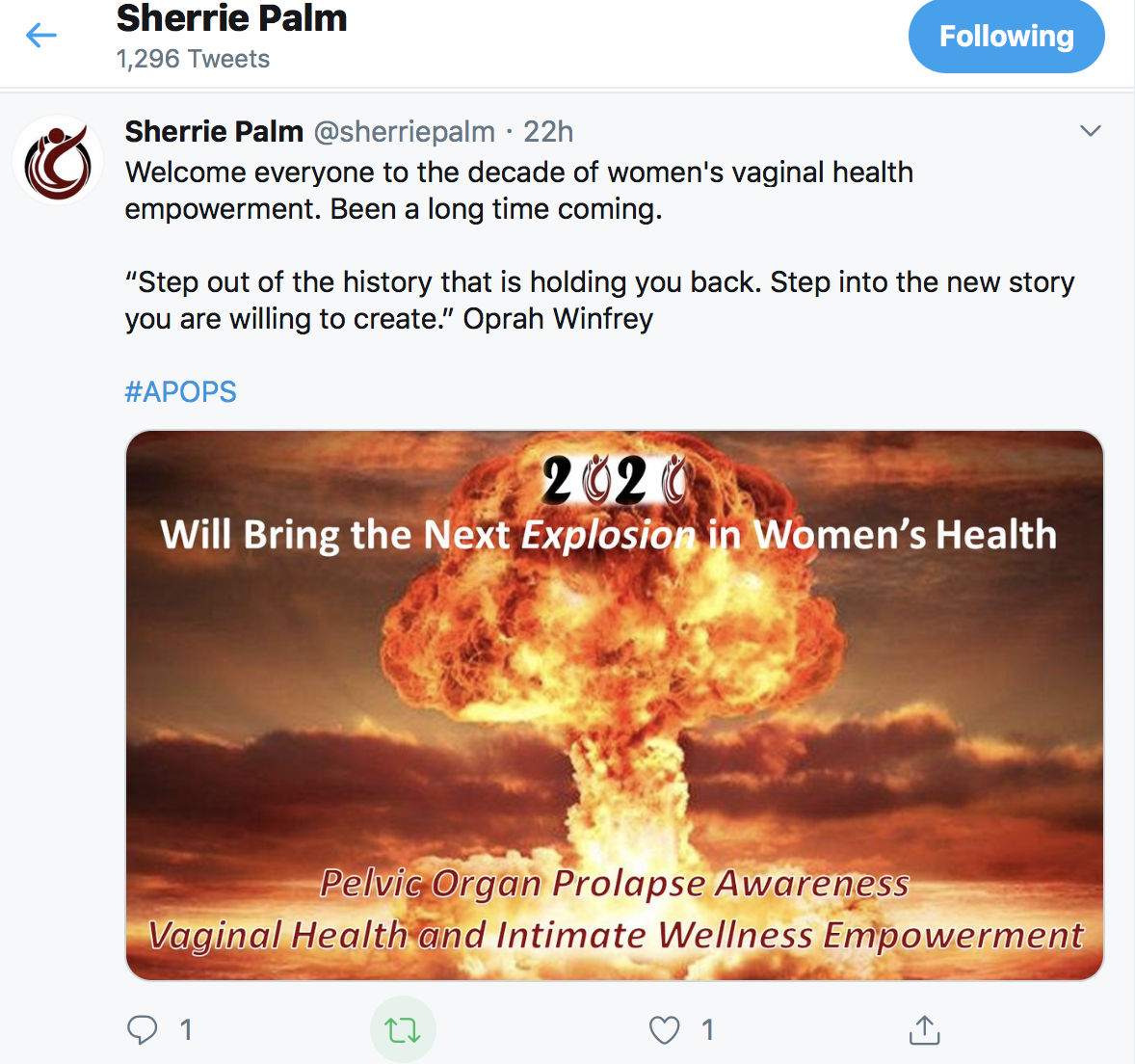
In the U.S., we trivialized and commodified the catastrophic nuclear tests in the Marshall Islands by naming a swimsuit after the tests at Bikini Atoll. (A real “bikini body” is sickened by radiation and if female, has a greater chance of giving birth to children with birth defects…) So why should I be surprised or outraged by this use of this picture below? It’s a recent tweet from the founder of the Association for Pelvic Organ Prolapse Support (APOPS) and until this morning, I’ve been a fan.
This is the picture I ask you to consider, below.
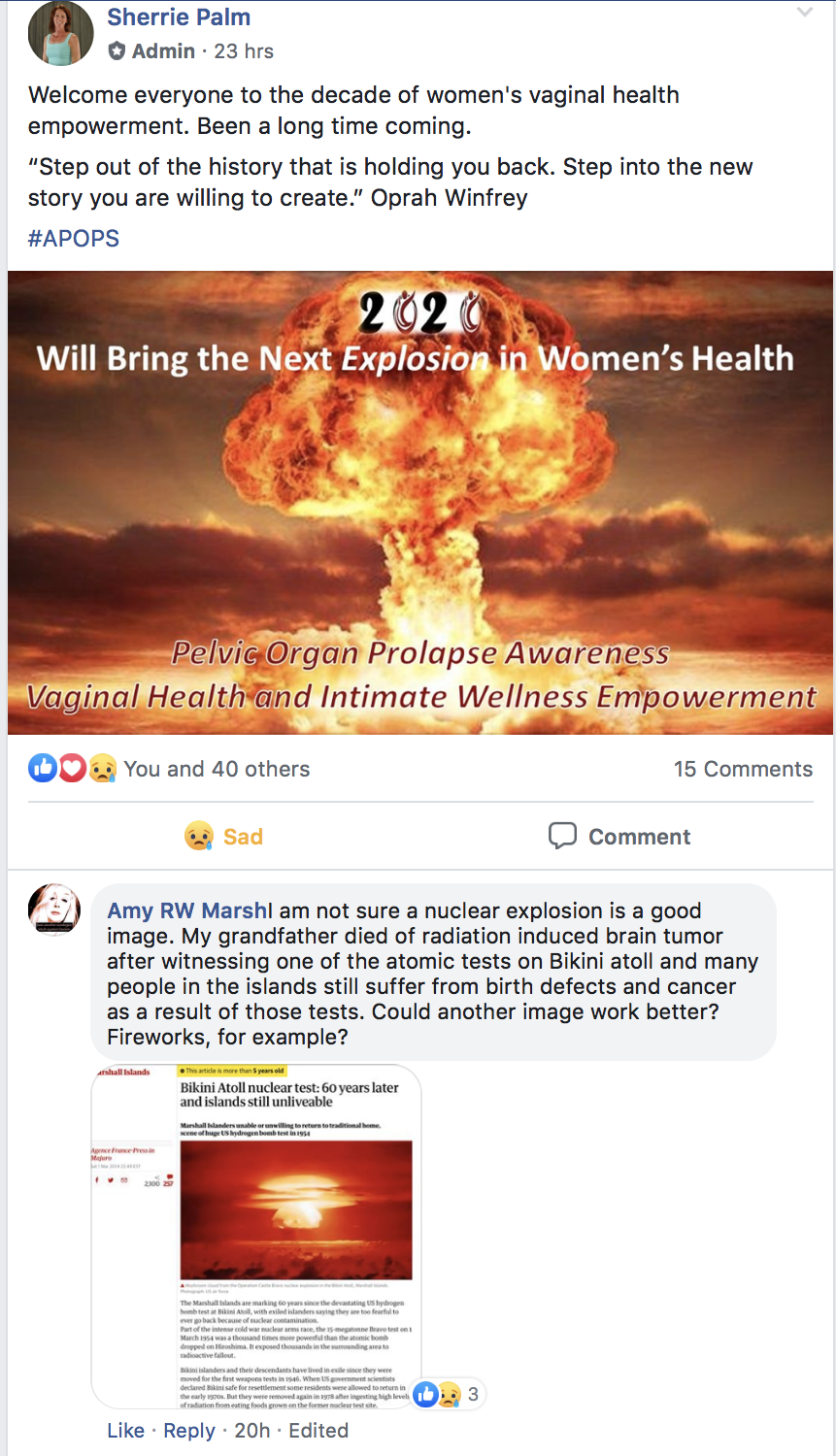
Let me add two other screenshots here, before I get on with my story. The one on the left is from a story about the Marshall Islands, published by The Guardian five years ago. The one on the right is from the Atomic Veterans Cancer Benefits Center. My maternal grandfather was an “Atomic Vet” and the VA gave him no medical help at all when he developed a brain tumor. My family was impoverished as a result, paying for his care.
I’m also boggled by the juxtaposition of a quote from Oprah–a woman of color–on top of an image which has brought doom and destruction to other people of color, all in the name of “vaginal health.”
Plus, do I want that thing (an exploded atomic bomb) anywhere near my “lady parts?” I think not.
Based on the above, I do not believe I was being overly sensitive about “stuff” when I alerted APOPS founder Sherrie Palm about the inappropriateness of this image. I know that Pelvic Organ Prolapse is an enormously ignored medical condition, internationally, and until now I’ve had nothing but respect for Sherrie Palm for all her tireless activism. And so…
…I began by gently pointing out that this was not the best image to use in supporting “vaginal health and intimate wellness.”
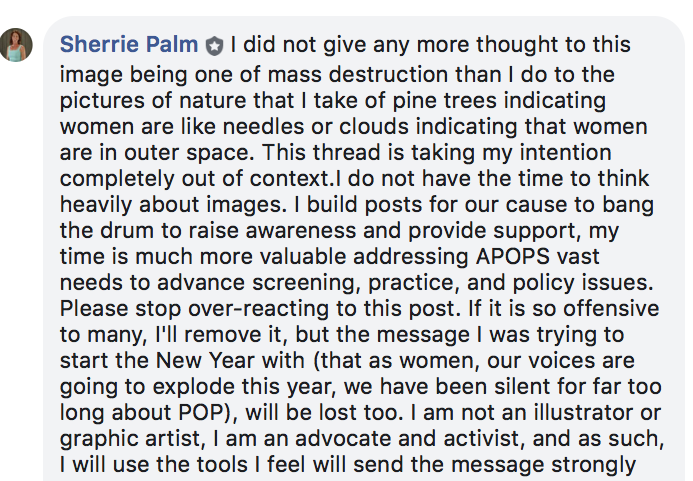
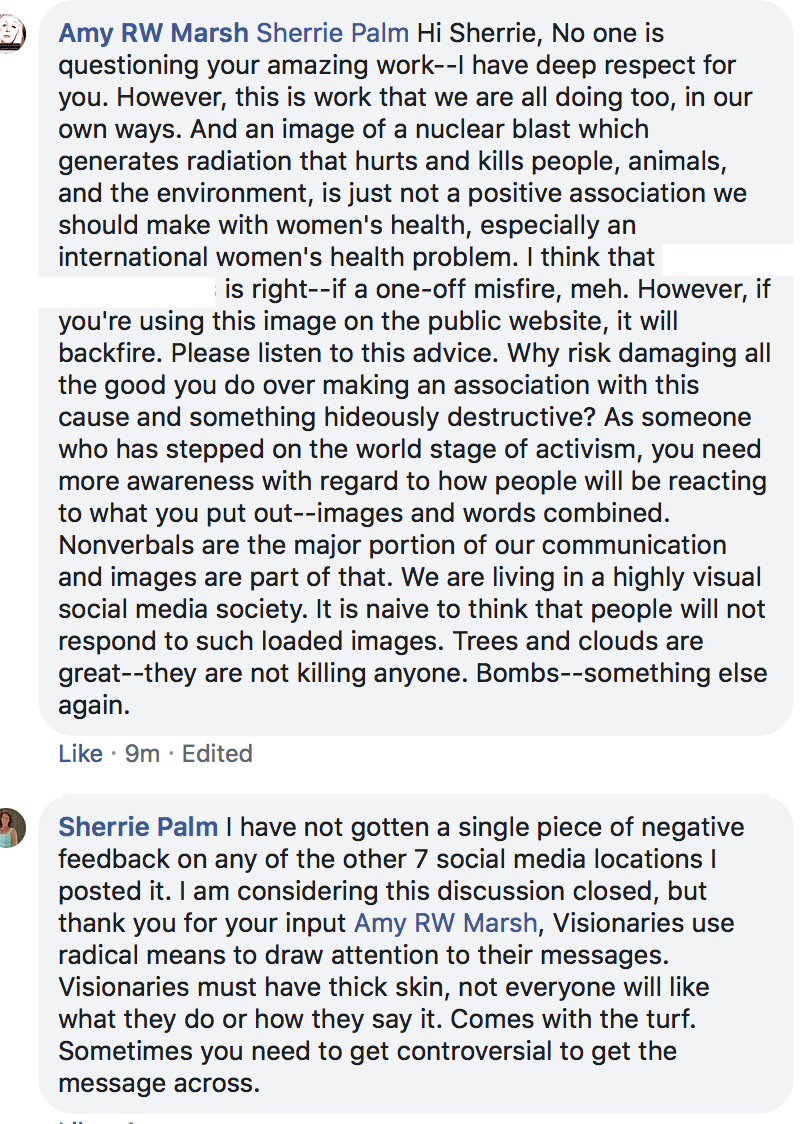
(My first post did not include the image of the Guardian article. I added that later because someone–in an attempt to be funny–said that fireworks wouldn’t work as someone had recently died from one.) The founder responded like this (comments from others are deleted):
I feel strongly about this. It’s important to have some modicum of multicultural sensitivity and awareness when advocating for a health cause that affects people internationally. Yeah, I’m not anybody’s media police, but I’ve put public endorsements of APOPS on my website and talked this organization up to my colleagues. However I can’t endorse someone in a leadership position who persists in such insensitive cluelessness–to the detriment of the cause itself and her ability to further it on a wider world stage.
So until Sherrie Palm withdraws the image and apologizes for its use, I cannot in good conscience recommend this organization as one having the best interests of ALL women at heart. And that means women of the Marshall Islands too.
I’ll be removing links to her website from my website as soon as I post this blog.