I initially resigned due to the lack of an Ipsalu public statement on this matter. Ipsalu Tantra International has now issued a statement (below). However, my resignation is still final as there are several reasons I am no longer in alignment with the organization’s mission and approach.
5/10/18:
From Bodhi Avinasha ~ Founder of Ipsalu Tantra International
Namaste
I have just learned of a matter that makes me feel nauseated – news of child abuse at the Satyananda Ashram in Australia, and also in his main ashram in Bihar India. Ipsalu finds these reports disgusting, the behaviors reprehensible.
We have mentioned Satyananda in our line of lineage, as Sunyata’s guru, but this part of his nature could not be further from the few techniques we have extracted from his teachings. We absolutely condemn involving children in tantric work. Ipsalu has even refused teenagers who wanted to attend our courses. Only responsible adults are involved with this work, and our only goal is to deepen their connection to the Divine.
Satyananda was a brilliant scholar, who brought to our generation valuable insights into ancient wisdom. But he was seriously lacking in handling emotional and heart energy. He sent Sunyata to Osho for training in those areas.
Sunyata studied at the Bihar Ashram from 1961-64, and then was told to go out into the West and spread the knowledge he had gathered. The history of abuse goes back to 1967, long after Sunyata had left Bihar.
The main teacher in Australia, a classmate of Sunyata, was seriously demented. I spoke with his Executive Secretary as she was about to leave her involvement there, as she poured out her stories of his abusive nature. It was clear he was a perfect example of what can happen working with powerful energies but not doing emotional clearing. The energies can pull one into the dark side. By the way, stories of abuse in Australia were from the period 1978-84. I met Sunyata in late 1985, so there was no overlap. Sunyata had been teaching for years, but never involving children.
The Saraswati Order is very mental, and that was Sunyata’s comfort zone. My insistence on doing emotional release and heart opening exercises was the reason we split in 1992.
Please don’t hold Ipsalu accountable for the weakness of some of our sources. Ipsalu is dedicated to maintaining safety and the highest ethical and spiritual standards, always coming from a place of love.
Bodhi Avinasha
The above statement pertains to the Australian Royal Commission into Institutional Responses to Child Sexual Abuse, which investigated reports of child sexual abuse at the Satyananda Yoga Ashram at Mangrove Mountain, New South Wales, and against Swami Akhandananda Saraswati and others (as well as a rape allegation against Satyananda himself). Testimonies and findings will be found at the above link.
Though the Australian inquiry took place in 2014 and findings were published in 2016, an Ipsalu newsletter published today mentions its connection to the teaching lineage of Satyananda (through Sunyata Saraswati, Ipsalu co-founder). Please be clear, however, that there are absolutely NO organizational links to the Bihar/Satyananda ashrams or ITI and never have been. But the teaching lineage exists.
Prior to Ipsalu’s statement today, other organizations with links to the Satyananda teachings have made public statements acknowledging the issue and expressing concern and support for the survivors. Some people have called for boycotts of Satyananda methods until reparations are paid to the abuse victims. I believe these and other actions demonstrate good citizenship on the part of such organizations, and lets the public know that these organizations believe in, and practice, accountability.
Ipsalu Tantra International (ITI) is a reputable organization that holds very high ethical standards for its teachers and certainly does not condone sexual abuse and coercion. It has a written policy of ethical standards and takes breaches seriously. Its spiritual practices are very effective and the community is a loving one. Now that ITI has made a statement on this matter, I am much relieved.
But I still can’t feel comfortable remaining with the organization. There are the reasons I expressed in an earlier blog (link above). Another big reason is that ITI is now emphasizing Osho (formerly Rajneesh) teachings in addition to its other practices. Therefore I am no longer in alignment with the organization or its mission. I wish ITI well, however, and have good feelings about the teachers that I know personally.
Note: ITI’s website is “broken” and cannot be edited right now. My teacher profile is likely to remain up until they can fix it and take it down.
Since moving to Hawai’i I’ve gotten a fair number of calls from men (cisgendered*) who are concerned about the size of their penises and worry that they are “too small.” In some cases, these men have told me that this worry has blighted, and even prevented, their pursuit of sexual relationships. This makes me feel sad. No one should suffer from body shame.
Detail from Michaelangelo’s David.
Popular culture is unfortunately a major conduit for delivering body shame. Smaller sized penises are objects of scorn and curiosity. Donald Trump’s portrait with a “micropenis” is a staple of this year’s political humor. Vogue, Cosmopolitan, and other magazines and websites routinely publish articles about men with smaller penises, and tips for dating them. When I wrote the “penis slang and invective” entry for the Cultural Encyclopedia of the Penis(Kimmel, Milrod & Kennedy), I did include a number of derogatory terms for smaller penises. And I hate to admit that I did snicker at a few, including “hung like a cashew.”
However, the anguish of the men who contact me about such matters makes me a little ashamed of this. And I wish I had more positive resources to offer them.
Large penises weren’t always the rage. Consider the modest members immortalized on classical Greek and Roman statues (and later works such as Michaelangelo’s David, above). Most writers agree that the Ancient Greeks (and Romans too) considered smaller penises to be more desirable and refined than larger ones, and of course, such statues are also quite wonderful examples of male beauty (unlike the Trump portrait mentioned above).
But none of this matters to contemporary men who must cope with the “Supersize Me” standards of pop culture and porn. Just as many women feel compelled to surgically alter their breasts and labia, many men feel desperate to measure up, and miserably anticipate rejection and ridicule based on their genitals when they think they don’t.
There isn’t that much positive information for men with smaller penises. An article called All the Good Things About Having a Small Penis was mostly sarcastic, though it did mention two real-life benefits:
better for receiving oral sex (a smaller penis can be easier and more fun to suck).
less reliance on penis penetration as the main (or only) way to please a partner – in other words, motivation to become a better, more versatile lover.
I would also suggest the following possible advantages:
Some women with uterine prolapse might have less discomfort if they have sexual intercourse with a smaller penis partner.
Anal sex may be more comfortable with a smaller penis partner.
While many articles and documentaries focus on heterosexual men, worries about penis size also affect men who are gay, bisexual, and/or queer or who simply have sex with other men. Gay men may experience “life with a small penis” as “a debilitating source of shame, anger, displeasure, and resentment” (Is Small Beautiful, Erik Piepenburg, OUT Magazine, 4/17/2005).
At least two men have made documentaries about coping with a smaller penis: Brian Spitz released UnHung Hero (trailer) in 2013, and Lawrence Barraclough released My Penis and I(entire movie) in 2005. I’ve watched both, and they’re both good.
But what I’d really like to see is a documentary that’s an all-out, sex-positive celebration of the possibilities and advantages of the smaller penis, something that includes classical statues AND rave reviews from lovers.
Suggestions for men with smaller penises: if you haven’t already done so, please consider exploring:
tantra or Healing Tao practices to ramp up your sexual/spiritual energy and connection with your partners;
the wide world of sex toys, for your own pleasure as well as your partner’s;
and any other erotic interests that seem fun (e.g. aphrodisiac cooking, cosplay, etc.)
For partners, I’d like to suggest enthusiasm, tact, and even erotic worship of your partner’s penis – as well as the above. Yep, that’s right! Become a phallus whisperer and tell that penis how wonderful it is. You can even incorporate this into an erotic hypnosis session! Such words of affirmation and appreciation could become a gift of sexual healing, as well as a creative exercise in pillow talk.
I’m also launching the #SmallisSexy hashtag as a sexological crusade to promote acceptance and end the shaming of people with smaller cocks. The men who have called me, and others like them, deserve more chances at love and sexual pleasure than they’ve gotten and I frankly just can’t stand the fear and sorrow they are living with. It’s so unnecessary. So wrong.
Here are just a few articles and resources. I’d love to find more. If you know of any, please do send in the comments section!
Measurection.com is a helpful site for people discussing smaller penises.
Erotic hypnosis workshops taught by Dr. Amy Marsh.
I predict that erotic hypnosis will be the hot new erotic trend of 2014. There are so many great things you can do with it, for yourself and with your lovers.
Consenting adults use personal erotic hypnosis to enhance and enrich their sexual relationships. Erotic hypnosis is so versatile you can adapt it to any scenario: romantic; tantric; edgy; and even kinky. Erotic hypnosis can help you increase (or decrease) all kinds of sensations, boost your fantasy life, and add multiple dimensions to any sexy role play. Use erotic hypnosis as foreplay or to intensify the hottest parts of your sexual encounters. Use it alone (erotic self-hypnosis), with a partner, or in a group. Like a trusty vibrator, erotic hypnosis can go just about anywhere…
Here are just five of the many great ways you can use erotic hypnosis:
1. Getting in the Mood. If you’re too stressed to even think about sex, ask your partner to indulge you with a long, soothing progressive relaxation induction that gradually shifts into sensual, arousing imagery. This is as simple as reading a script, though you can certainly ad lib as you learn more about basic hypnotic techniques.
2. Getting in the Groove. In order to become aroused and sustain that loving feeling, you need to stay on the right side of your parasympathetic nervous system (until you’re close to orgasm, which is when your sympathetic nervous system kicks into high gear). You can use hypnotic relaxation techniques to increase your sexual self-confidence and banish performance anxiety.
3. Getting in Touch. When you’re “entranced,” it’s easy to experience an increase in sensual awareness and sensation by simply listening to your lover’s suggestions and succumbing to the power of your imagination. Trust me, your body will respond. Hypnosis plus touch is also a potent combination.
4. Getting Hot! Deepen your sexual experiences on all levels – sensations, fantasies, variety, role play, and even hypnotic orgasms. Basic hypnotic skills can take you there.
5. Getting Kinky. You can create wild and elaborate fantasy scenarios without spending a dime on equipment and toys. Use hypnosis to imagine and rehearse something you might want to try in the future, or to provide an extra dimension for your present fun and games.
Erotic hypnosis also has a lot to offer people who have chronic illnesses and/or physical impairments that might make some sexual activities difficult. With erotic hypnosis, you can take your mind – and your sexual responses – where you body might not physically follow.
Of course, erotic hypnosis should only be used in a responsible way, with a lot of trust and a lot of talking beforehand – working out most of what you want to try and experience, in advance, and getting clear consent for every part of it. There’s much more to be said on this topic – and about the basic hypnosis skills you must acquire – but for now, this is a glimpse into the benefits and uses of recreational, erotic hypnosis.
The short answer is: it’s another part of my sexological “bag of tricks.” But I think this question also requires a longer explanation.
All sexologists, sex counselors, sex coaches, and sex therapists develop a menu of therapeutic strategems, tips, techniques, and recommended products, books, and media to share with our clients. Most of us give classes and workshops on everything from orgasms, oral sex, erotic massage, tantra, coping with pelvic pain, aging and sexuality, and so on. We’re always looking for new, effective ways to assist our clients and students with their sexual concerns.
We also often give our clients “homeplay” exercises to do between sessions. For couples, there may be a sensate focus series, non-demand touch exercises for building trust and somatic awareness, first used by sex therapy teams like Masters & Johnson and Hartman & Fithian, and still in wide use today. For a man with rapid ejaculation, there may be a program of mindful masturbation exercises designed to build his capacity for “lasting longer.”
As a sexologist, I often use hypnosis in my practice, and I teach self-hypnosis and other mind-body skills to my clients. And this is good. But there’s more that can be done!
For the last couple of years I’ve envisioned a well-designed mini-course in erotic hypnosis techniques which could be just as helpful as many of my other sex counseling staples. I’ve been working on the design of this course and have now refined it so that it is user friendly, based on wisdom culled from both the hypnotic world as well as the sexological one.
I am convinced of the value of this endeavor. Hypnosis is so versatile! For example, lovers could use hypnosis to:
• help each other relax before lovemaking (especially helpful in dropping the stresses of the work day or family life);
• restore and renew that new relationship sensation of being entranced with a lover; and
• to shower each other’s subconscious with ego-strengthening, affirmative, appreciative suggestions that promote confidence in each other and in the relationship. Can you imagine anything more nourishing than relaxing in a light trance state while being showered on a daily basis with words of love and appreciation, pouring right into your mind and heart?
I suggest that these are great additions to an expanded erotic hypnosis repertoire – which includes the ability to heighten sensation, enjoy “hypno-gasms,” create variety through hypnotic fantasy, explore power play, and so on. In other words, lovers can empower themselves and their relationships through the skillful, consensual use of erotic hypnosis.
Erotic hypnosis can also be a valuable tool for people who have some kind of physical impairment or disability, but who’d like to enjoy the fullest possible sex life. Think about it!
I believe too that erotic self-hypnosis is a powerful tool for understanding one’s own erotic nature and core themes. Too often people are as disconnected from this awareness as they are from their own, and their lover’s, bodies. Why not explore your own eroticism through a combination of self-hypnosis and self-pleasure, for example?
This is the potential I see – and I would like to alert my colleagues in the sexology field about this. I am launching my extended Erotic Hypnosis for Lovers courses (first one on August 17th), and am hopeful that people will realize their value. Yes, there are plenty of people exploring and enjoying erotic hypnosis and doing very well on their own – but I’d also like this modality, as a structured program, to make its way into the hands of sexologists, counselors, and therapists – as well as clients.
Why is this so hard to understand? Toxic chemicals damage the body, sometimes to the point of dysfunction, and people who live with this as a chronic condition are often significantly impaired in how they are able to perform their activities of daily living. Furthermore, they lack access to “safe (i.e. nontoxic) paths of travel” into and out of stores, clinics, schools, hospitals, churches, recreational facilities, yoga studios, cafes and restaurants, public restrooms, government offices – you name it!
Participating in community, attending a civic meeting, or simply hanging out in hopes of conversing with someone who is NOT a solvent-based life form is often next to impossible! Even playgrounds can be hazardous. When my kids were little, I had to haul them off the climbing structures and away from the fragrance wafting moms more times than I can count. Mass transit can be a disaster. Mass anything with people in it can cause me to lose (1) airway function, (2) energy, (3) my ability to use words or think clearly, (4) coordination, (5) one or more days of being able to do much of anything. I cannot consider simple actions like attending a business networking meeting, taking classes at the local city college, getting my hair cut, going to the doctor, shopping for groceries, giving a bunch of teenagers a ride in my car, going to a job interview, or participating in civil disobediance without first considering how much it will cost me and how much am I willing to pay.
Why? Because common consumer, personal care, and industrial toxins are ubiquitous in our modern environment and they form a significant, real, physical barrier to people like me – who may crumble at any contact with their molecules. And because the average consumer has been gulled and lured into participating in their own internal poisoning – and that of others! – by using and wearing products which are NOT proven to be safe. And doing this in public spaces. The commons of our air (not to mention food, soil, water, etc.) is profoundly polluted.
We hear a lot of talk about food justice. It’s important. But I also want AIR JUSTICE. I’d like to go somewhere – anywhere – and not be at risk.
As for sex – finding and keeping sexual partners who are willing to give up their cherished signature fragrances or hair products is easier said than done. A polite request for accommodation is often perceived as an offer to violate constitutional rights! No ma’am – these folks will give up their Obsession and Eternity bottles only when you can pry them from their cold, dead hands! Three cheers then for the Chemical Manufacturers Association and the flavors and fragrances industries for the ultimate in recycling: adding hazardous chemical wastes to perfumes, cosmetics, and food additives and getting away with it! When it comes to pricey, relentless lobbying, the NRA ain’t got nuthin’ on them!
Oh, but I was talking about sex. What got me to this rant – erm, blog! – today was that once again I encountered a respected colleague addressing the topic of disability and sex who had no interest whatsoever in including people with environmental illness/multiple chemical sensitivity (EI/MCS) in her disability views.
Sigh.
Dismissed. Invisible. Denied. And dissed. The EI/MCS crew has been fighting this battle for years, on every front you can imagine. Even the disability community was against us for quite a long time as we often appear to be perfectly fine – unless we’re wearing a mask, respirator, or oxygen tank. Acceptance of EI/MCS as a disability (also called TILT – toxin induced lack of tolerance, thanks to Dr. Claudia Miller – or chemical injury) has been slow, grudging, and is still woefully incomplete in just about every area you can name. Part of the problem is not just that we fall into the “invisible disability” category, but that we also need something quite different from many other people in the disability movement.
We don’t need integration into society – we actually need a profound systems change in which these toxic chemicals are no longer manufactured or at the very least are not allowed into public spaces (like cigarette smoke) before we can even consider inclusion! And because we are not likely to get this, at the very least, we need our own toxin-free housing, clinics, classrooms, jobs, grocery stores, dance clubs, hula classes, art museums, laundry facilities, etc. And we are not likely to get those either. (I have been more active in the past on these issues, as a former president and board member of the Environmental Health Network of Northern CA.)
And we are not even likely to get SSI – as the condition of TILT or EI/MCS or whatever you call it is still debated in public assistance circles. My chemically injured mom – because she can still actually work – only gets a 10% disability rating. Yeah, even after her occupational injury she can work fine! But only in a toxin free workspace! That’s my problem too. I can work brilliantly, as long as I am not exposed to junk in the air. “Junk” being fragrances, air fresheners, hair care products, synthetic carpet, paint, cleaning products, particle board furniture, pesticides… da kine! Non-toxic jobs – and job settings – are all but impossible to find. They don’t exist. Even in a bastion of non-toxicity, like a health food store, you’re always going to find some nitwit hooked on organic, biodynamic produce who is also wearing more volatile petrochemicals on her skin than you’d ever spread on a strawberry patch – and is mindlessly off-gassing all over the entire store.
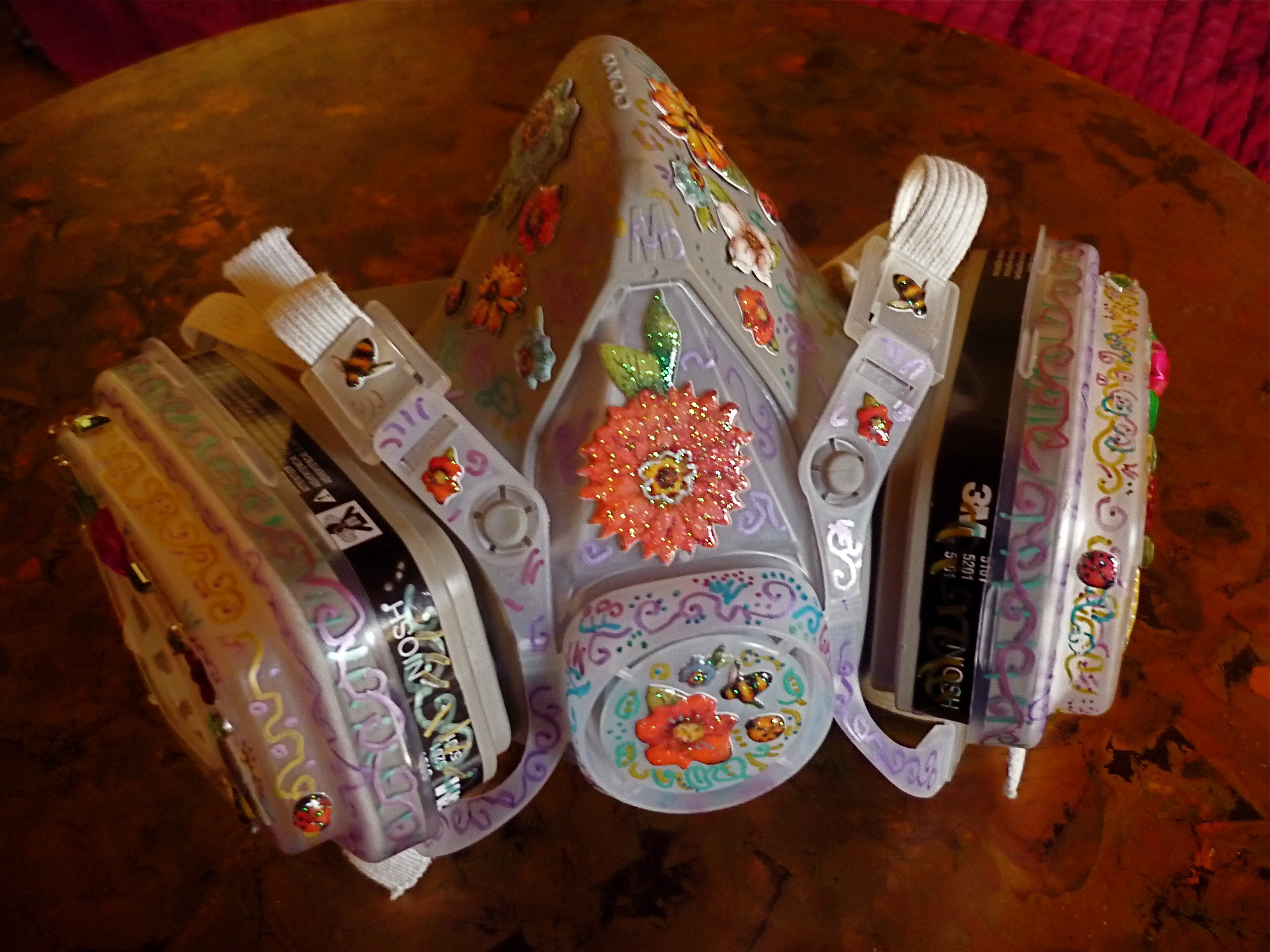
My adaptive technology.
Oh, but I was talking about sex… So, the disability activism mantra used to be, maybe still is, “self-advocacy.” Yeah. Easier said than done when you’re brainfogged from a sudden toxic onslaught and can’t even put a sentence together or contain your chemically-triggered rage response. So, just picture some enchanted evening. You see a stranger across the room. You catch his/her/zir eyes and you begin to move forward, hearts beating as one… Then, it hits you! It’s no longer love at first sight – it’s chemical warfare at 50 paces! You have no choice but to get away as fast as you can. You can’t even get close enough to say why you can no longer afford to be interested, assuming you’d even retain the power of coherant speech. No one, I don’t care how georgeous or charismatic they are, is worth the risk of a fatal asthma attack.
I recently took my own sweetheart, who is wonderfully non-toxic, to a tantric puja at a temple with a strong, fragrance-free policy. I even booked accommodations for the night, a room in a guest cottage with a shared bathroom. I felt safe, secure, healthy – ready for a wonderful evening with my love. Wouldn’t you know, but in the 45 minutes allowed for dressing up puja style, a man I’d never seen barged into the shared bathroom as I was sprinkling myself with body glitter, and began to apply strongly scented hair gel! I said something like “fragrance, help!,” staggered to the door, slammed it shut, and fell gasping into our room (okay, I am exaggerating slightly…but not much!). Later, this man did nothing but give me stink eye over breakfast. For heaven’s sake! He’s the one violating temple policy and I’m the one to get the dirty looks?
Sadly, I no longer feel safe at the temple. And I’m not yet up to talking to the tantra teacher (a person I adore). It’s just too painful. But I will, after I process my feelings more completely.
I remember another time, enroute to another tantra retreat, when a fellow “goddess” wanted to carpool with me. When I explained that she’d have to be willing to ride unscented, she decided her scented haircare products were just too much a part of her life to give up, even for a couple of hours with me and the promise of a free ride. I was so sad to find I was much less important than a bottle of shampoo.
I am not exaggerating. As a person with EI/MCS I see a sort of madness in this world. People are so addicted to their cosmetics, personal care products, and other inhalants that they chose them over the people in their lives. If this is not a chemcial dependency, what is? In fact, inhalants – common household products huffed by teenagers – can be deadly. Really – deadly!
People who have experienced the lasting effects of toxin-induced loss of tolerance can see this clearly. They experience the heartbreak of suddenly being disbelieved and dissed by spouses, lovers, family members, co-workers, bosses, teachers, medical and mental health professionals, social service agencies (ad infinitim), and becoming social pariahs, deviants, outsiders unworthy of love, friendship, or the ordinary necessities of human life.
Even the “ecosexuality” movement leaves us behind – preferring instead to talk about “green sex” on undyed cotton sheets, with tempered glass dildos and eco-friendly lubes. The sexual health and difficulties of people who desperately need to benefit from this kind of sensitivity are simply not considered to be of interest. Perhaps it is easier to talk about eco-products with other yoga buffs while sipping a non-GMO almond milk vegan protein shake, than it is to meet the glance of an uncool freak in a respirator. The environmental justice communites don’t quite get it either – they haven’t yet put consumer toxins, and their effects, into the mix.
Is it any wonder that suicide rates are high among the chemically injured? Though we do our best to maintain and create relationships and community, our energy is often low, our ability to commit and follow through may be spotty, and we are wounded to the core by being treated as pariahs, freaks, hypochondriacs, and worse. But if someone seems to understand our strange plight, they become golden in our eyes!
Finally, I want to mention a mass event I did attend this last weekend. Moana Nui, an event organized by and for Pacific peoples in collaboration with the International Forum on Globalization, Pua Mohala I Ka Po, and the Oceanic Coalition of Northern California. I sat at the back, or far away from others, as I usually do – in search of fragrant-free “air space” – but stayed the whole time. I was deeply exhausted by Sunday evening, but I did stay. It was a life transforming experience. And this is what I learned.
The people of Pacific nations and islands are my kin in the struggle against toxic exposure. I knew this already, of course, being the granddaughter of an atomic veteran who had witnessed the tragedy of the bombing of Bikini Atoll and died of a radiation-induced brain tumor. And I knew it, of course, being the partner of a man who fights against GMOs and depleted uranium and other toxic conditions in Hawai’i. But at Moana Nui I began to understand just how widespread toxic activities are in some of the most beautiful and fragile places on the planet – thanks to factors like colonization, globalization, American military base building and activities, and environmentally destructive resource extraction by multi-national corporations. As a result, every Pacific Islander is at risk for toxin-induced loss of tolerance – not to mention the dangers of radiation exposure – as the people of the Marshall Islands know so well and so tragically.
They already know – and will know still more – the corrosive effects that toxic chemicals have on their bodies, families, and lives. I hope that their societies are more merciful, more loving, and less inclined to cast out the sick than this one is. I know this madness has to stop.
I thought I was talking about sex… but I guess this blog is really all about love.
I used to have a hat with this logo, purchased from the Environmental Health Network of CA
P.S. As a clinical sexologist, here are classes and information I’ve produced which may be of interest: