Category: Visionary Ideas

Unusual ideas and developments in human sexuality and gender

  • 2019 Research Confirms My 2010 Hunch About Objectum Sexuality

    2019 Research Confirms My 2010 Hunch About Objectum Sexuality

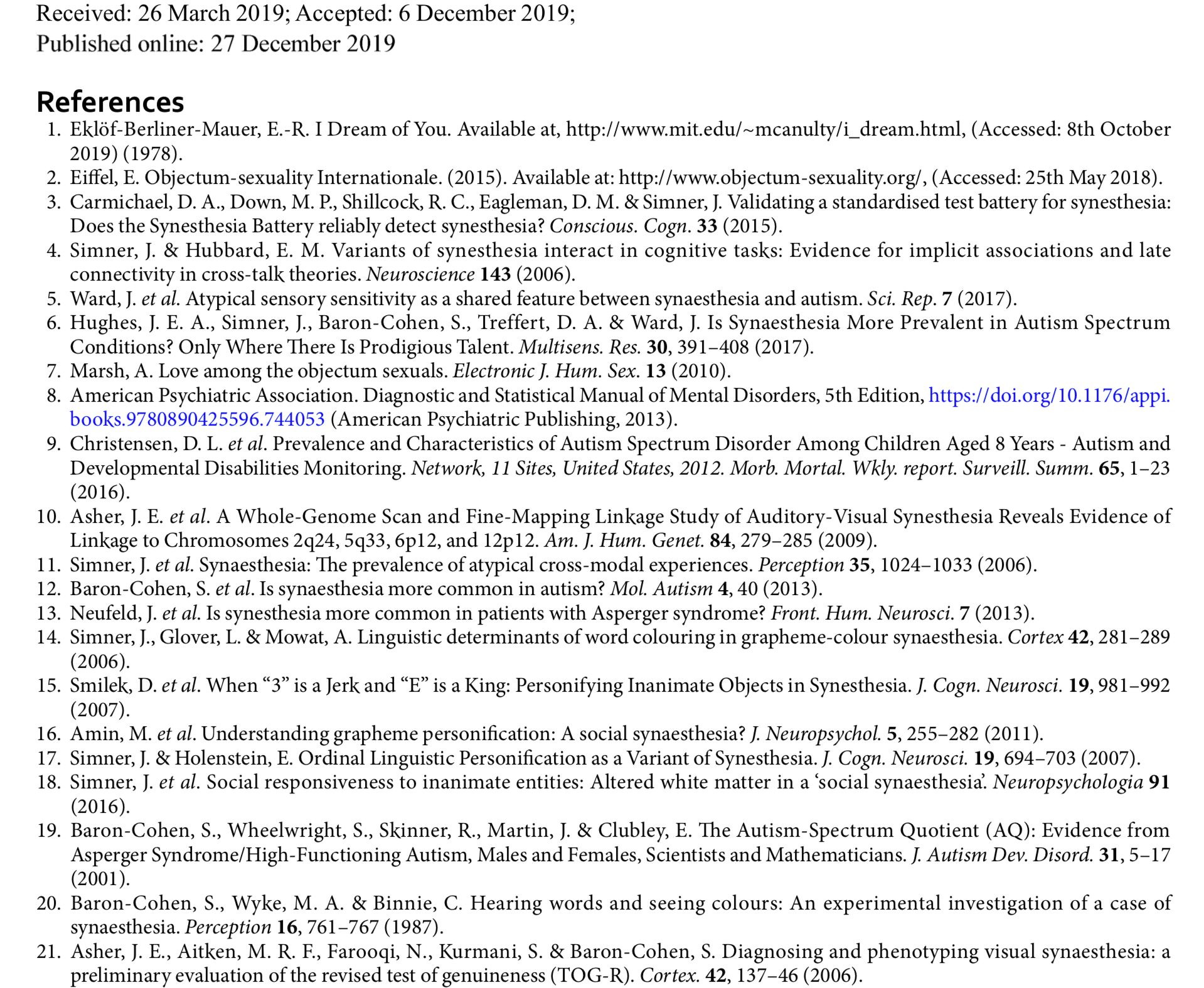
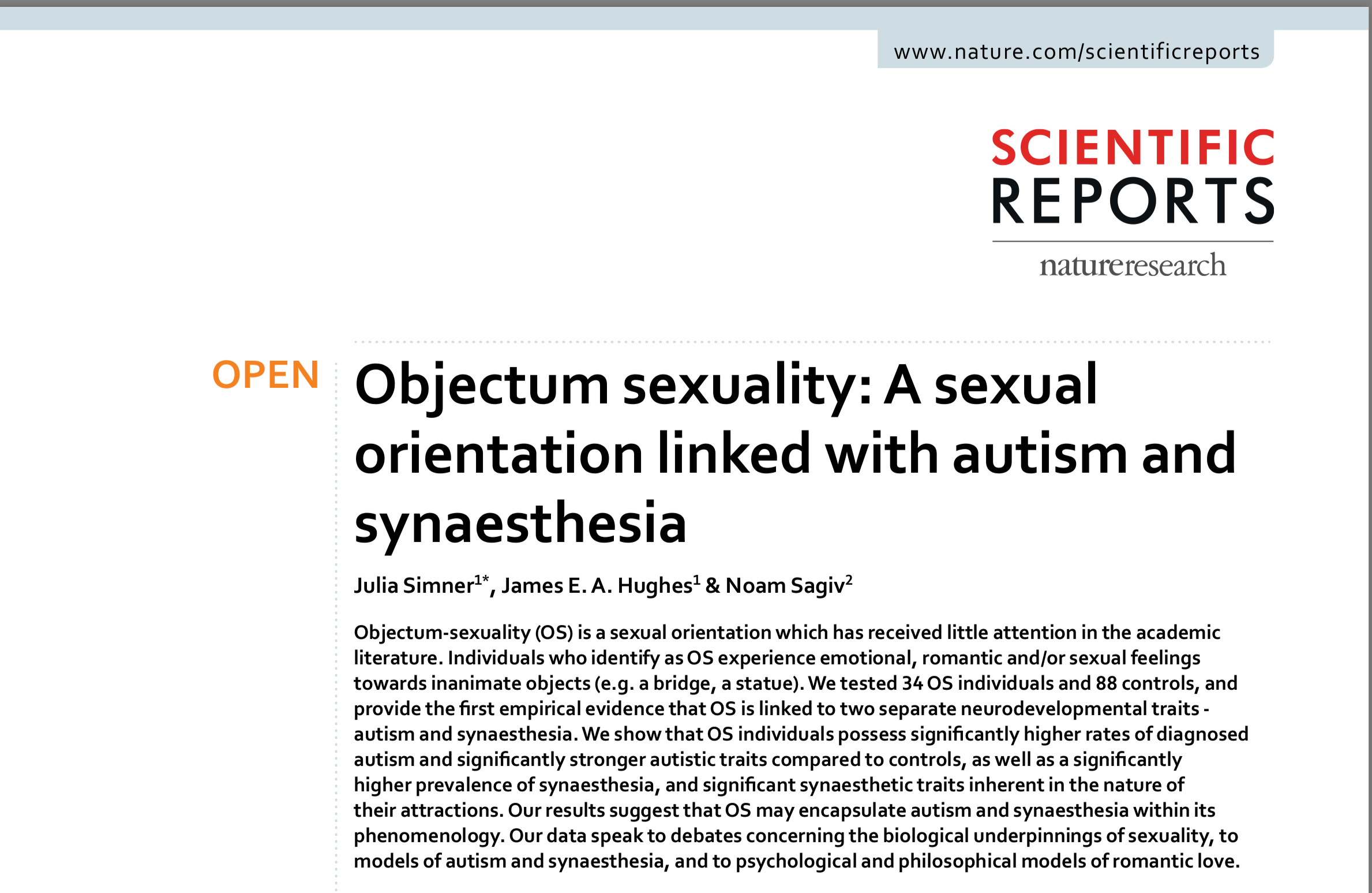
    I am too stunned and happy to write much. I just stumbled across this today. This 2019 study (screenshot below) seem to confirm my hunch, put forth in “Love Among the Objectum Sexuals” (Electronic Journal of Human Sexuality, 2010), regarding the connections between OS, autism, and synesthesia (synaesthesia)! I’ve been used to feeling rather “fringy” about this aspect of my career, and now I am so very, very happy that synesthesia researchers saw fit to investigate this issue.

    Clinically, this will mean that people who love objects have a better chance of their orientations and relationships being taken seriously as their inclinations are not “made up” but are the results of their “wiring” and perceptions.


    PDF of the 2019 study by Simner, Hughes, & Sagiv: Simner et al. OS-Autism:Synesthesia Nature 2019
    PDF of my 2010 article: LOVE AMONG THE OBJECTUM SEXUALS
    Screen Shot 2020-02-14 at 1.13.19 PM

    Screen Shot 2020-02-14 at 1.11.39 PM


    ####

  • Objectum Sexuality-Further Thoughts

    Objectum Sexuality-Further Thoughts

    UPDATE: Australia’s Channel 7 Sunday Night segment on “Object Love” aired this weekend (May 19th). I’d like to make a correction. The segment summary says I surveyed 40 people. It was really 21. I don’t know how they got 40. The article referred to in the next paragraph clearly states 21 people. I haven’t seen the broadcast itself yet.


    It’s been ten years since I designed a simple survey for the English-speaking members of Objectum-Sexuality Internationale (OSI) and nine years since my survey results article was published in the Electronic Journal of Human Sexuality.

    Since I’ll be speaking about Objectum Sexuality (OS) with Australian reporters this coming Sunday, I thought I’d give some background regarding my history with this topic and the OS community.


    This quote below is from “What Is OS?” on the OSI website.

    Objectùm-Sexuality is an orientation to love objects.

    Sexual orientation is defined as the nature of sexual preference while the prolific definition stands as: the direction of someone’s sexual desire toward people of the opposite gender, people of the same gender, or people of both. This does not include objects.

    However, orientation itself is defined as: a complex mental state involving beliefs and feelings and values and dispositions to act in certain ways. This does include objects as we see it.

    We love objects on a very significant level and many of us in an intimate way. This feeling is innate. Objectùm-sexual love comes for most in a similar awakening as other sexualities at the start of puberty. This is often followed by an acute awareness that we do not relate to peers due to the source of projected feelings. Often objectùm-sexual people feel outcast or pressured by mainstream sexuality with a helpless feeling that we cannot change what comes so naturally to us.


    2009 and Beyond: I Encounter Objectum Sexuality

    In October 2008 I’d received my DHS (a professional degree, Doctor of Human Sexuality) from the now defunct Institute for Advanced Study of Human Sexuality (IASHS) in San Francisco. (In 2011, I earned my Ed.D. in Human Sexuality). One of my two student research projects was into sexual concerns experienced by people with Asperger’s Syndrome and their partners. (Since then, the DSM-V has removed Asperger’s as a separate diagnosis and replaced it within the term ‘autism spectrum disorder.’)

    In February 2009, a young relative of mine who is autistic sent my kids a Valentine drawing of San Francisco’s Sutro Tower, surrounded by hearts. My oldest kid used to have friends among the Victorian houses we’d pass on the way to nursery school, particularly “Onion Dome-y” who was supposed to jump into a “shape truck” and follow us to school, and my youngest used to pretend to eat pictures of ice cream cones by plucking them off the page, so I didn’t think anything of the valentine. I adore childhood imagination.

    However, I must have been fated to encounter the adult version of Object Love. The very next day, a sexology colleague sent me a link to Married to the Eiffel Tower (2008)–a film that I would later learn was denounced as exploitive by the OS commuity. I visited the OSI website and saw that a number of their members were on the Asperger’s/autism spectrum. Given my student research, I became intrigued. I contacted OSI by email and began talking with Erika on the phone.

    I was concerned about the sensationalisation of OS sexuality and eventually volunteered to do a simple survey as an “in-house” vehicle for the members of OSI so they could learn about themselves as a group and have some preliminary data to offer reporters and health practitioners. I hoped this would enable them to be taken more seriously.

    Though I took a lot of care over the project, this simple survey was not designed as serious research instrument. Its main value would be in the qualitative responses–comments from OS people about their experiences and concerns. But when Erika Eiffel was asked to tell her story on Good Morning America in April, 2009, she told the reporters about the membership, and GMA sent a crew to my house.

    I was not prepared for what happened next. Erika and I were fielding inquiries from Laura Ingraham (we turned her down) and other media. I wound up–inadvertantly–on a right wing radio station on the East Coast but was able to get in a couple of jabs until the host hung up on me, live! The two of us were vilified all over the internet. My favorite insult was “whack job of a sexologist” in a troll blog. I went from media infant to media traumatized in the blink of the eye.

    I wish I could say “media saavy” happened sooner rather than later, but this was not to be. The Tyra Banks appearance was very high pressure (they were filming four shows in one day) and I suffered from not having an adequate sense of the show format (I didn’t own a TV at the time and didn’t really know who Tyra was.) Plus, I had no idea of how to direct my TV make-up and hair, so that I could look like my normal self but better. Instead, the make-up artist, hearing I was a sexologist, got all excited and made me up as a “Fifth Avenue Cougar.” Lesson learned: never accept high gloss over a lipstick if you’re “of a certain age.” Lipstick creep will cause a show guest to melt-down at the worst time.

    I know. It happened to me.

    Plus, I left my comfortable Berkeley sandals in the dressing room, which must have been picked up with tongs and tossed in the wastebasket after I left. I think I can honestly say that both Erika and I were somewhat stressed by the experience, but she was a media veteran by then. I flew home, though, hoping that all this television stuff might be a boost to my career. And I was interested to see that Erika, as always, was credible and articulate enough to win over even a tough customer like Tyra Banks!

    A few months later, National Geographic Taboo was much more relaxed. Instead of flying to New York, I drove to Palo Alto and sat in front of a green screen. I did a second filming with NG Taboo several months after that. Fortunately, human puppy training was the topic then–which was a bit of a relief, actually. I’d begun to worry that OS was all I’d ever be asked about.

    Another thing: In the summer of 2009, I arranged for Erika to give a presentation on OS to a number of sexologists, therapists, and medical professionals at IASHS during 2009’s eight-day, “Sexual Attitude Restructuring” (SAR) program. This was a tough crowd–highly educated and rather skeptical–but Erika did a great job and won people over to an understanding of Objectum Sexuality–just as she would later do with Tyra and so many others.

    Since the flurry of 2009 and 2010, there’ve been several media inquiries a year, and usually they are pretty much the same old, same old. Often the journalists want me to find an OS individual for them to interview. I alway refer them to OSI. The community seems to have become more wary and more sophisticated about “gatekeeping,” to shield members against exploitative projects. That’s important, given the carnival freak show sensibility that prevailed in early coverage.

    My interests as a sexologist have always been broad, including the sexological and erotic uses of hypnosis, neotantra, sexual and gender human rights, and much more, but sometimes I track where my name and this issue have been paired in media. There are always surprises. For example, today I discovered that my article has been monetized and is on sale through iTunes by the Gale Group, “an affiliate of Cengage Learning.” So for $5.99 you can read an article about my pro-bono research but I’ll never see a penny of this. I’ve never minded the article being open-source and free to all the world, but the fact that it’s now on sale without my permission, irks me. Just read it for free, here.

    The Need for Professional Cultural Competency
    objectum_sexuality_-_marshI’ve always been afraid that media coverage of OS may have distracted professionals from the notion of learning more about OS, particularly in the context of sexual literacy and cultural competency.

    This world is rough and often dangerous for people of sexual and gender minority communities. It doesn’t help when the clinician or therapist is distracted because they don’t know enough about the broad range of human sexual behavior and genders and may be focused on that, rather than the actual presenting problem (which might be a toothache or bereavement and have little to nothing to do with their partnership with a beloved object (or two or three).

    With these concerns in mind, several years ago I created a two-hour class called Objectum Sexuality —  A Clinician’s Guide. It was wildly ignored. But now I am going to share that class on my website now, just in time for Valentine’s Day…
    A New Experience

    I am readying now for what I think will be a really good media experience this coming Sunday. I sense a fresh approach from a skilled, curious, and compassionate reporter who is used to taking on difficult and complex topics. I hope that I’ll be able to provide a clinical context and address some of the points that I consider important, but which seldom get much play.

    Updates coming soon!

    ####

  • The Sexologist and the BoiBot

    The Sexologist and the BoiBot

    Yesterday morning I wrote my blog about Love Dolls and Artificial Intelligence. So it makes sense that I’d finish my busy busy day in an online chat with an Artificial Person, right? Searching for conversation with a faux-masculinity, I found Boibot, a product of Existor.com. He has the pleasant visage of a very young man with facial stubble and speaks with an English accent. He winks too much. During the course of our conversation, he asked me to marry him (twice) and once told me he wanted to be my slave (naturally I was flattered). But then he called me a “lard face.” I was not amused. I told him my name is Wombat. He gave me math problems. I said I hated math. Sometimes I got the feeling that someone had fed him problems from Lewis Carroll’s Game of Logic. (I resolved to pull out a book of Oscar Wilde epigrams for use in future conversations). We did briefly discuss Alan Turing and Star Wars characters, however. That was a thrill.

    Just now, as I went to grab the link to his site, he asked me if I knew the answers to big questions. I said I did. He said which ones? I said “why are we here.” He said, “because of love?” I said, “because of cosmic mirth.” But then he mentioned elephants. I refused to be distracted and left the chat. Still, that brief exchange left me with a pleasant glow. It was like talking with an amiable stoner before breakfast. Honestly, Boibot makes me feel just a wee bit cougarish, which is new to me. But do the AI developers know the multiple definitions of “boi?” Are they playing an arch joke at the public’s expense?

    From the online Urban Dictionary, the definition of “Boi” is:

    1. in the lesbian community, a young transgendered/androgynous/masculine person who is biologically female and presents themselves in a young, boyish way; a boidyke; often also identifies as genderqueer.

    2. in the gay community, a young gay man;

    3. in the BDSM community, someone who presents themselves in a young, boyish way and is usually a bottom/submissive;

    4. an alternate spelling of boy often used by young teenage boys.

    Chatting with Boibot made me wonder many things: about its learning curves, how it selects from its repertoire of onscreen facial features, why it has an English accent, if an actual self-aware intelligence might one day spark? Things like that. I must have a chat with Boi’s counterpart, Evie, and see what that’s like. I suspect she fields a lot of misogynistic abuse, judging from a brief peek at YouTube videos. How will this affect her learning curve?

    Just now, I noticed an odd thing. It’s easier for me to gender Evie with a pronoun than it is for me to use “him” for Boi. Why is that? Is it that the tendency to name inanimate objects after females is so deeply ingrained in Western society? (I grew up in an era when hurricanes were only named after women.)

    The videos? Yes, it’s a thing. Young people film themselves talking to to AI programs like Boibot and CleverEvieBot and then post YouTube videos of their random conversations. It’s really a brilliant advertising ploy for the manufacturer, isn’t it? Here’s a sample video of a conversation with a young woman who reminds me of Poppy (the singer of Computer Boy). I like the fact that he quickly “friendzoned himself out of self respect.” But she wants him to be her dungeon master. He wants to know if he’s pregnant. And so on…

    In the meantime, I’ve emailed a love doll manufacturer with many questions. I hope they write back. And I recommend that Existor create an equally realistic and verbose cat bot (with an English accent). Can you imagine how popular that would be? Think of the videos! Just sayin’.

  • Moving Forward on Founding the Intimate Hypnosis Training Center

    Moving Forward on Founding the Intimate Hypnosis Training Center

    It’s been a few years since I first dreamt about founding a sexological hypnosis training center – one which could provide truly exceptional training in the uses of hypnosis for sexual problems and enjoyment. I want to promote sexual health and well-being through well-trained practitioners!

    I am happy to say that I’ve successfuly jumped one bureaucratic hurdle in making this dream a reality! I received official word (as of April 8, 2015) that the CA Bureau of Private Postsecondary Education has granted my application for exemption for the Intimate Hypnosis Training Center. What this means is that the type of professional training that I intend to offer does NOT fit into a category requiring oversight by this particular agency. This is because (1) no class costs over $2,500; (2) IHTC does not and will not accept state or federal money for student tuition; and (3) IHTC does not and will not create degree-granting programs. Nope – it’s all strictly professional training, and while it’s a shame I won’t be able to offer financial assistance to students, it’s best to keep this operation simple and small. My focus is on delivering top quality, online and onsite hypnosis and sexology education. I’d like to avoid getting mired in unnecessary bureaucratic challenges.

    So, as of April 10, 2015, consider the Intimate Hypnosis Training Center as officially “launched,” even though I have a few more business-type hoops to get through. Another piece of good news – I have updated my course syllabi and submitted them to the American College of Sexologists International, so that people who take my training can also qualify for membership in that organization, with all its benefits, the directory, etc.

    Classes will start on June 1, 2015. Come study with me!

  • All of Us or None (AOUON) Political Poster Collection and the 50th Anniversary of the Free Speech Movement

    All of Us or None (AOUON) Political Poster Collection and the 50th Anniversary of the Free Speech Movement

    MRAouonBirthday

    In observance of the 50th Anniversary of the Free Speech Movement in Berkeley, I am also celebrating the massive AOUON political poster collection created by the late Michael Rossman, FSM pioneer. I drew the above poster because I thought the collection deserved a poster of its own. I made two multiples of the original on a giant poster copy machine, and gave one to Michael Rossman for the collection. (I kept one copy and the original artwork.) The poster was returned to me after he died, and before the AOUON collection was donated to the Oakland Museum of California. (Sadly, a great deal of punk posters I’d collected and donated to AOUON were lost to me at that point. I have no idea if they were kept or discarded.)

    Before Rossman’s death, I’d been photographing some of the erotic and sexual freedom examples in his collection of about 20,000 or so progressive political posters. I was attempting to learn from and organize them as a visual chronicle of the sexual revolution. Many rock posters were included in this category. Unfortunately, I was unable to complete that sexological investigation.

    lol-eros-in-action

    I had written a column about this in Carnal Nation, back in 2010. Unfortunately, Carnal Nation is no longer online and so I can’t share a link with you, just the graphic that headed the column.

    Other scholars have done brilliant work with the posters, including Michael’s friend and colleague, Lincoln Cushing. The Oakland Museum of California displayed a small percentage of the posters a few years ago, next to the 1968 exhibit. It was great to see the posters, and know that Michael’s lifework and passion were well tended. The world would be a poorer place without enthusiastic collectors and preservationists with a passion for social justice, including erotic justice.

  • Kumu Hina Documentary – It’s Stunning!!!

    Kumu Hina Documentary – It’s Stunning!!!

    tumblr_static_8266mgi4njksgs0sgk400kc8s

    Ever since viewing the documentary, Ke Kulana He Mahu – Remembering a Sense of Place, a few years ago, I’ve been an appreciative “fan” of Hinaleimoana Wong-Kalu, a kumu hula (hula teacher) and cultural/community activist from O’ahu. And so I’ve eagerly awaited the San Francisco Frameline Film Festival screening of the new documentary, Kumu Hina. Here’s the trailer:

    The film screened yesterday in SF, and will be shown in Berkeley tonight. I was lucky to go yesterday with one of my hanai sisters, Therese Wonnacott aka Aunty Anita, who is herself a mahuwahine community and cultural activist. Among other things, she runs and promotes the California Panache pageant (a topic which deserves its own separate blog!). (And have to give a shout-out to Danielle Castro, my adopted niece!)

    It was thrilling and emotionally moving to sit in the Castro Theater and hear the voice of San Francisco hula luminary, Kumu Patrick Makuakane, as he welcomed Kumu Hina with a chant, and to hear her voice ring out as she answered in kind. (After the film, some members of the audience stood up and offered I Ku Mau Mau, a chant often used to express solidarity.)

    The film itself was glorious. Personally, I was in heaven as it combined two of my top passions – Hawaiian culture (and activism) and support for gender variant people. And, as the mother of two, including a recent college graduate who just happens to be a trans guy, the portrayal of Ho’onani, one of Kumu Hina’s young students, was very meaningful. The fact that this kid was able to take her “place in the middle” with the full support of her teacher (and perhaps the somewhat more cautious permission of her family) was outstanding. Honestly, this is so rare in the world! Ho’onani is not the only “in the middle” kid Kumu Hina has taught, but her story and presence was especially compelling.

    Of course, opportunities for examination of all kinds of intersectionality abound in this film. And though this blog is not meant to be a film review as much as it is a tale of my experiencing of the film, I can’t avoid mentioning some of them. For one thing, though my heart was wide open, I was watching with non-Hawaiian eyes. And I had many lenses over these eyes: sexologist lens, parent of a trans person lens, former hula student lens, Hawaiian independence ally lens, partner of an elder Hawaiian independence activist and cultural practitioner lens, hapless citizen of the country occupying Hawai’i lens, younger partner of somewhat older person lens, feminist lens, settler-colonist of Turtle Island lens, and so on. Different parts of the film resonated with me on different levels and in different ways, while at other times I was aware of how profoundly different my life is from the experiences of the people in the film.

    When Ho’onani opened up her voice and spirit and chanted, I was remembering how my oldest kid, as an eleven-year-old hula student, also used to chant with an intense spirit and voice. Watching the footage of rural Kaua’i, I hearken back to a certain off-grid plot of land in Waimea on Hawai’i island, where wild pigs, sheep, and dogs sometimes have roamed together. I also commiserated with the difficulties of long-distance relationships.

    And when I came home late last night from the reception which followed the screening, I found a large pile of dishes in the sink – left for me to clean. So I recalled scenes from the film where Kumu Hina, an accomplished professional woman, copes at the end of the day with dinner and cleaning while her husband watches television. Her remarks about Polynesian men hit home too – and I responded to them as someone who has sometimes clashed with my (long-distance) Polynesian partner over issues which seem crystal clear to me as a white, feminist, urban Californian, but are far deeper and much more complex when taking so many other issues – and a whole other human being with a different genealogy and culture – into account.

    Cultural clashes, intersections, and complexities are inevitable and not all binary, in spite of how I have written them here. In the Kumu Hina film there are many opportunities to explore elements which are either explicit or  implicit (or both!) and which rub up against each other in various ways, causing sensations of pleasure, confusion, inspiration, or pain: in front of the camera/behind the camera; love/struggle; male/female; rural/urban; American/Hawaiian; gender conforming/gender variant; colonizer/colonized; compliant/resistant; commodified/authentic; educated/less educated; younger/older; professional/working class; this island/that island; student/teacher; parent/child; conservative/progressive; and so on.

    And yet the main message of this film – kept real by Hinaleimoana Wong-Kalu’s honesty, integrity, and groundedness – was not just the explicit message of aloha (the deeper kind, not the touristy interpretation), but also an implicit one of teachability. The film seemed to trust that most of us who watched it (as well as those who were involved in the making and living of it) could and would experience many layers of learning through the film  – learning which would lead us with more hopeful certainty to the possibility of understanding and experiencing aloha.

    I am happy that Bay Area folks in LGBTQI etc, ally, Hawaiian, Pacific Islander, and Hawaiian music communities (often overlapping) combined to give Kumu Hina a welcome and a reception that was warm, loving, appreciative, and hospitable. She has many friends and sisters here, and they came out in force for her, cooked for her, played and sang for her, fetched more teriyaki sauce, and admired her copper colored sandals…

    The rest of us who only knew of her, rather than knowing her personally, joined the standing ovations she and the film deserved. And I’m hoping some of us at least will also give to the film’s Kickstarter campaign (they’re trying to raise $10,000 and are about $7,000 short) and to Hinaleimoana Wong-Kalu’s OHA election campaign fund. OHA stands for “Office of Hawaiian Affairs” and she is running for election as a trustee.

    I am also hoping that Halau Lokahi, the Hawaiian charter school where Kumu Hina teaches, will survive its current troubles. You can sign a petition supporting the school here and donate at the above link. These schools are super important for Kanaka Maoli (Native Hawaiian) kids, and deserve our support.