Tag: Hawai’i

  • Kumu Hina Documentary – It’s Stunning!!!

    Kumu Hina Documentary – It’s Stunning!!!

    tumblr_static_8266mgi4njksgs0sgk400kc8s

    Ever since viewing the documentary, Ke Kulana He Mahu – Remembering a Sense of Place, a few years ago, I’ve been an appreciative “fan” of Hinaleimoana Wong-Kalu, a kumu hula (hula teacher) and cultural/community activist from O’ahu. And so I’ve eagerly awaited the San Francisco Frameline Film Festival screening of the new documentary, Kumu Hina. Here’s the trailer:

    The film screened yesterday in SF, and will be shown in Berkeley tonight. I was lucky to go yesterday with one of my hanai sisters, Therese Wonnacott aka Aunty Anita, who is herself a mahuwahine community and cultural activist. Among other things, she runs and promotes the California Panache pageant (a topic which deserves its own separate blog!). (And have to give a shout-out to Danielle Castro, my adopted niece!)

    It was thrilling and emotionally moving to sit in the Castro Theater and hear the voice of San Francisco hula luminary, Kumu Patrick Makuakane, as he welcomed Kumu Hina with a chant, and to hear her voice ring out as she answered in kind. (After the film, some members of the audience stood up and offered I Ku Mau Mau, a chant often used to express solidarity.)

    The film itself was glorious. Personally, I was in heaven as it combined two of my top passions – Hawaiian culture (and activism) and support for gender variant people. And, as the mother of two, including a recent college graduate who just happens to be a trans guy, the portrayal of Ho’onani, one of Kumu Hina’s young students, was very meaningful. The fact that this kid was able to take her “place in the middle” with the full support of her teacher (and perhaps the somewhat more cautious permission of her family) was outstanding. Honestly, this is so rare in the world! Ho’onani is not the only “in the middle” kid Kumu Hina has taught, but her story and presence was especially compelling.

    Of course, opportunities for examination of all kinds of intersectionality abound in this film. And though this blog is not meant to be a film review as much as it is a tale of my experiencing of the film, I can’t avoid mentioning some of them. For one thing, though my heart was wide open, I was watching with non-Hawaiian eyes. And I had many lenses over these eyes: sexologist lens, parent of a trans person lens, former hula student lens, Hawaiian independence ally lens, partner of an elder Hawaiian independence activist and cultural practitioner lens, hapless citizen of the country occupying Hawai’i lens, younger partner of somewhat older person lens, feminist lens, settler-colonist of Turtle Island lens, and so on. Different parts of the film resonated with me on different levels and in different ways, while at other times I was aware of how profoundly different my life is from the experiences of the people in the film.

    When Ho’onani opened up her voice and spirit and chanted, I was remembering how my oldest kid, as an eleven-year-old hula student, also used to chant with an intense spirit and voice. Watching the footage of rural Kaua’i, I hearken back to a certain off-grid plot of land in Waimea on Hawai’i island, where wild pigs, sheep, and dogs sometimes have roamed together. I also commiserated with the difficulties of long-distance relationships.

    And when I came home late last night from the reception which followed the screening, I found a large pile of dishes in the sink – left for me to clean. So I recalled scenes from the film where Kumu Hina, an accomplished professional woman, copes at the end of the day with dinner and cleaning while her husband watches television. Her remarks about Polynesian men hit home too – and I responded to them as someone who has sometimes clashed with my (long-distance) Polynesian partner over issues which seem crystal clear to me as a white, feminist, urban Californian, but are far deeper and much more complex when taking so many other issues – and a whole other human being with a different genealogy and culture – into account.

    Cultural clashes, intersections, and complexities are inevitable and not all binary, in spite of how I have written them here. In the Kumu Hina film there are many opportunities to explore elements which are either explicit or  implicit (or both!) and which rub up against each other in various ways, causing sensations of pleasure, confusion, inspiration, or pain: in front of the camera/behind the camera; love/struggle; male/female; rural/urban; American/Hawaiian; gender conforming/gender variant; colonizer/colonized; compliant/resistant; commodified/authentic; educated/less educated; younger/older; professional/working class; this island/that island; student/teacher; parent/child; conservative/progressive; and so on.

    And yet the main message of this film – kept real by Hinaleimoana Wong-Kalu’s honesty, integrity, and groundedness – was not just the explicit message of aloha (the deeper kind, not the touristy interpretation), but also an implicit one of teachability. The film seemed to trust that most of us who watched it (as well as those who were involved in the making and living of it) could and would experience many layers of learning through the film  – learning which would lead us with more hopeful certainty to the possibility of understanding and experiencing aloha.

    I am happy that Bay Area folks in LGBTQI etc, ally, Hawaiian, Pacific Islander, and Hawaiian music communities (often overlapping) combined to give Kumu Hina a welcome and a reception that was warm, loving, appreciative, and hospitable. She has many friends and sisters here, and they came out in force for her, cooked for her, played and sang for her, fetched more teriyaki sauce, and admired her copper colored sandals…

    The rest of us who only knew of her, rather than knowing her personally, joined the standing ovations she and the film deserved. And I’m hoping some of us at least will also give to the film’s Kickstarter campaign (they’re trying to raise $10,000 and are about $7,000 short) and to Hinaleimoana Wong-Kalu’s OHA election campaign fund. OHA stands for “Office of Hawaiian Affairs” and she is running for election as a trustee.

    I am also hoping that Halau Lokahi, the Hawaiian charter school where Kumu Hina teaches, will survive its current troubles. You can sign a petition supporting the school here and donate at the above link. These schools are super important for Kanaka Maoli (Native Hawaiian) kids, and deserve our support.

  • Environmental Illness & Chemical Sensitivity: The “Dissed” Disability

    Environmental Illness & Chemical Sensitivity: The “Dissed” Disability

    Toxins can eat your sex life too!
    Toxins can eat your sex life too!

    Why is this so hard to understand? Toxic chemicals damage the body, sometimes to the point of dysfunction, and people who live with this as a chronic condition are often significantly impaired in how they are able to perform their activities of daily living. Furthermore, they lack access to “safe (i.e. nontoxic) paths of travel” into and out of stores, clinics, schools, hospitals, churches, recreational facilities, yoga studios, cafes and restaurants, public restrooms, government offices – you name it!

    Participating in community, attending a civic meeting, or simply hanging out in hopes of conversing with someone who is NOT a solvent-based life form is often next to impossible! Even playgrounds can be hazardous. When my kids were little, I had to haul them off the climbing structures and away from the fragrance wafting moms more times than I can count. Mass transit can be a disaster. Mass anything with people in it can cause me to lose (1) airway function, (2) energy, (3) my ability to use words or think clearly, (4) coordination, (5) one or more days of being able to do much of anything. I cannot consider simple actions like attending a business networking meeting, taking classes at the local city college, getting my hair cut, going to the doctor, shopping for groceries, giving a bunch of teenagers a ride in my car, going to a job interview, or participating in civil disobediance without first considering how much it will cost me and how much am I willing to pay.

    Why? Because common consumer, personal care, and industrial toxins are ubiquitous in our modern environment and they form a significant, real, physical barrier to people like me – who may crumble at any contact with their molecules. And because the average consumer has been gulled and lured into participating in their own internal poisoning – and that of others! – by using and wearing products which are NOT proven to be safe. And doing this in public spaces. The commons of our air (not to mention food, soil, water, etc.) is profoundly polluted.

    We hear a lot of talk about food justice. It’s important. But I also want AIR JUSTICE. I’d like to go somewhere – anywhere – and not be at risk.

    As for sex – finding and keeping sexual partners who are willing to give up their cherished signature fragrances or hair products is easier said than done. A polite request for accommodation is often perceived as an offer to violate constitutional rights! No ma’am – these folks will give up their Obsession and Eternity bottles only when you can pry them from their cold, dead hands! Three cheers then for the Chemical Manufacturers Association and the flavors and fragrances industries for the ultimate in recycling: adding hazardous chemical wastes to perfumes, cosmetics, and food additives and getting away with it! When it comes to pricey, relentless lobbying, the NRA ain’t got nuthin’ on them!

    Oh, but I was talking about sex. What got me to this rant – erm, blog! – today was that once again I encountered a respected colleague addressing the topic of disability and sex who had no interest whatsoever in including people with environmental illness/multiple chemical sensitivity (EI/MCS) in her disability views.

    Sigh.

    Dismissed. Invisible. Denied. And dissed. The EI/MCS crew has been fighting this battle for years, on every front you can imagine. Even the disability community was against us for quite a long time as we often appear to be perfectly fine – unless we’re wearing a mask, respirator, or oxygen tank. Acceptance of EI/MCS as a disability  (also called TILT – toxin induced lack of tolerance, thanks to Dr. Claudia Miller – or chemical injury) has been slow, grudging, and is still woefully incomplete in just about every area you can name. Part of the problem is not just that we fall into the “invisible disability” category, but that we also need something quite different from many other people in the disability movement.

    We don’t need integration into society – we actually need a profound systems change in which these toxic chemicals are no longer manufactured or at the very least are not allowed into public spaces (like cigarette smoke) before we can even consider inclusion! And because we are not likely to get this, at the very least, we need our own toxin-free housing, clinics, classrooms, jobs, grocery stores, dance clubs, hula classes, art museums, laundry facilities, etc. And we are not likely to get those either. (I have been more active in the past on these issues, as a former president and board member of the Environmental Health Network of Northern CA.)

    And we are not even likely to get SSI – as the condition of TILT or EI/MCS or whatever you call it is still debated in public assistance circles. My chemically injured mom – because she can still actually work – only gets a 10% disability rating. Yeah, even after her occupational injury she can work fine! But only in a toxin free workspace! That’s my problem too. I can work brilliantly, as long as I am not exposed to junk in the air. “Junk” being fragrances, air fresheners, hair care products, synthetic carpet, paint, cleaning products, particle board furniture, pesticides… da kine! Non-toxic jobs – and job settings – are all but impossible to find. They don’t exist. Even in a bastion of non-toxicity, like a health food store, you’re always going to find some nitwit hooked on organic, biodynamic produce who is also wearing more volatile petrochemicals on her skin than you’d ever spread on a strawberry patch – and is mindlessly off-gassing all over the entire store.

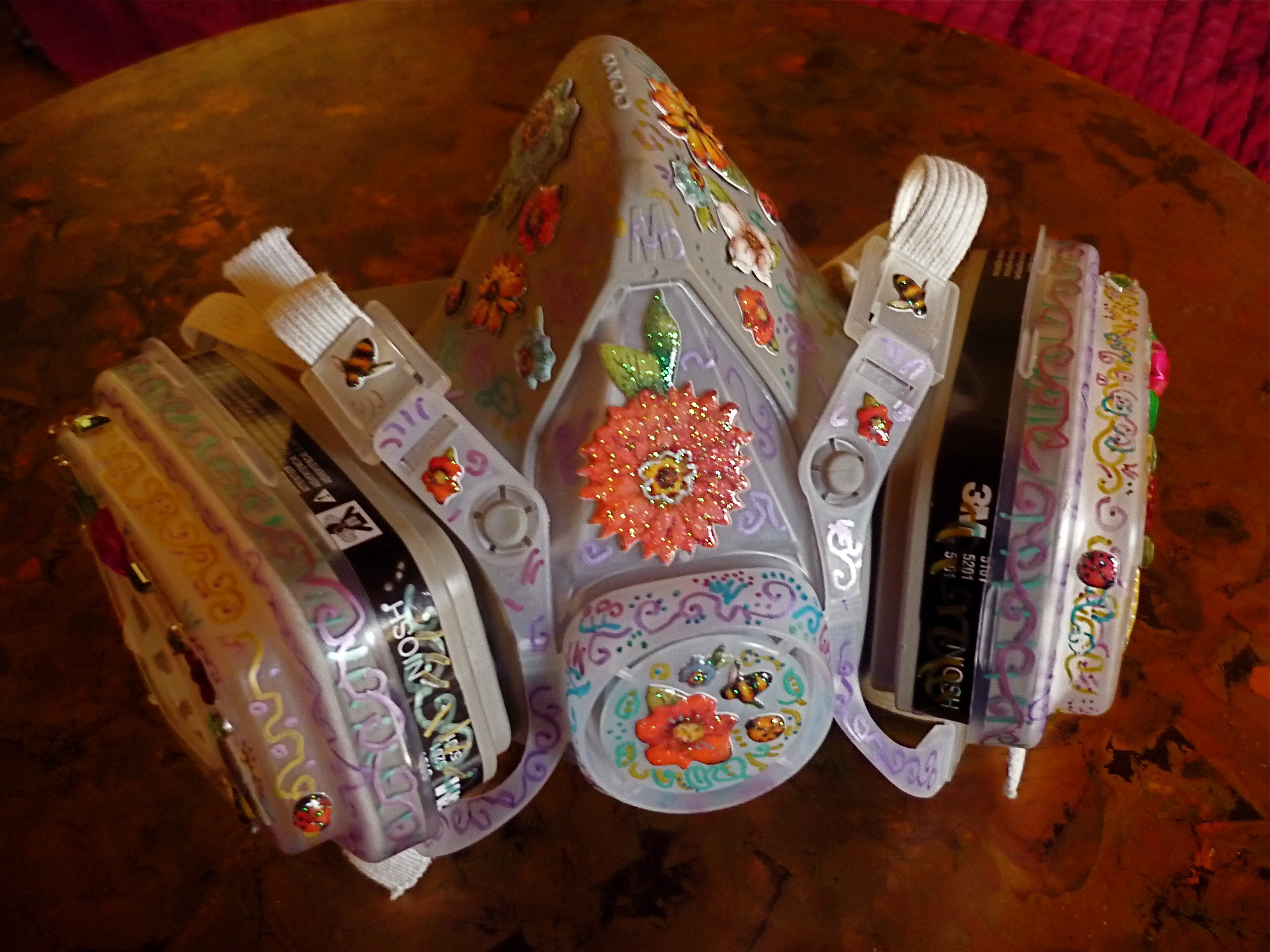
    My adaptive technology.
    My adaptive technology.

    Oh, but I was talking about sex… So, the disability activism mantra used to be, maybe still is, “self-advocacy.” Yeah. Easier said than done when you’re brainfogged from a sudden toxic onslaught and can’t even put a sentence together or contain your chemically-triggered rage response. So, just picture some enchanted evening. You see a stranger across the room. You catch his/her/zir eyes and you begin to move forward, hearts beating as one… Then, it hits you! It’s no longer love at first sight – it’s chemical warfare at 50 paces! You have no choice but to get away as fast as you can. You can’t even get close enough to say why you can no longer afford to be interested, assuming you’d even retain the power of coherant speech. No one, I don’t care how georgeous or charismatic they are, is worth the risk of a fatal asthma attack.

    I recently took my own sweetheart, who is wonderfully non-toxic, to a tantric puja at a temple with a strong, fragrance-free policy. I even booked accommodations for the night, a room in a guest cottage with a shared bathroom. I felt safe, secure, healthy – ready for a wonderful evening with my love. Wouldn’t you know, but in the 45 minutes allowed for dressing up puja style, a man I’d never seen barged into the shared bathroom as I was sprinkling myself with body glitter, and began to apply strongly scented hair gel! I said something like “fragrance, help!,” staggered to the door, slammed it shut, and fell gasping into our room (okay, I am exaggerating slightly…but not much!). Later, this man did nothing but give me stink eye over breakfast. For heaven’s sake! He’s the one violating temple policy and I’m the one to get the dirty looks?

    Sadly, I no longer feel safe at the temple. And I’m not yet up to talking to the tantra teacher (a person I adore). It’s just too painful. But I will, after I process my feelings more completely.

    I remember another time, enroute to another tantra retreat, when a fellow “goddess” wanted to carpool with me. When I explained that she’d have to be willing to ride unscented, she decided her scented haircare products were just too much a part of her life to give up, even for a couple of hours with me and the promise of a free ride. I was so sad to find I was  much less important than a bottle of shampoo.

    I am not exaggerating. As a person with EI/MCS I see a sort of madness in this world. People are so addicted to their cosmetics, personal care products, and other inhalants that they chose them over the people in their lives. If this is not a chemcial dependency, what is? In fact, inhalants – common household products huffed by teenagers – can be deadly. Really – deadly!

    People who have experienced the lasting effects of toxin-induced loss of tolerance can see this clearly. They experience the heartbreak of suddenly being disbelieved and dissed by spouses, lovers, family members, co-workers, bosses, teachers, medical and mental health professionals, social service agencies (ad infinitim), and becoming social pariahs, deviants, outsiders unworthy of love, friendship, or the ordinary necessities of human life.

    Even the “ecosexuality” movement leaves us behind – preferring instead to talk about “green sex” on undyed cotton sheets, with tempered glass dildos and eco-friendly lubes. The sexual health and difficulties of people who desperately need to benefit from this kind of sensitivity are simply not considered to be of interest. Perhaps it is easier to talk about eco-products with other yoga buffs while sipping a non-GMO almond milk vegan protein shake, than it is to meet the glance of an uncool freak in a respirator. The environmental justice communites don’t quite get it either – they haven’t yet put consumer toxins, and their effects, into the mix.

    Is it any wonder that suicide rates are high among the chemically injured? Though we do our best to maintain and create relationships and community, our energy is often low, our ability to commit and follow through may be spotty, and we are wounded to the core by being treated as pariahs, freaks, hypochondriacs, and worse. But if someone seems to understand our strange plight, they become golden in our eyes!

    Finally, I want to mention a mass event I did attend this last weekend. Moana Nui, an event organized by and for Pacific peoples in collaboration with the International Forum on Globalization, Pua Mohala I Ka Po, and the Oceanic Coalition of Northern California. I sat at the back, or far away from others, as I usually do – in search of fragrant-free “air space” – but stayed the whole time. I was deeply exhausted by Sunday evening, but I did stay. It was a life transforming experience. And this is what I learned.

    The people of Pacific nations and islands are my kin in the struggle against toxic exposure. I knew this already, of course, being the granddaughter of an atomic veteran who had witnessed the tragedy of the bombing of Bikini Atoll and died of a radiation-induced brain tumor. And I knew it, of course, being the partner of a man who fights against GMOs and depleted uranium and other toxic conditions in Hawai’i. But at Moana Nui I began to understand just how widespread toxic activities are in some of the most beautiful and fragile places on the planet – thanks to factors like colonization, globalization, American military base building and activities, and environmentally destructive resource extraction by multi-national corporations. As a result, every Pacific Islander is at risk for toxin-induced loss of tolerance – not to mention the dangers of radiation exposure – as the people of the Marshall Islands know so well and so tragically.

    They already know – and will know still more – the corrosive effects that toxic chemicals have on their bodies, families, and lives. I hope that their societies are more merciful, more loving, and less inclined to cast out the sick than this one is. I know this madness has to stop.

    I thought I was talking about sex… but I guess this blog is really all about love.

    I used to have a hat with this logo, purchased from the Environmental Health Network of CA
    I used to have a hat with this logo, purchased from the Environmental Health Network of CA

    P.S. As a clinical sexologist, here are classes and information I’ve produced which may be of interest:

    Creative Sexuality class – online: Clinical Ecosexology – An Introduction.

    Sex Coach U class – online: Eco-Sexology.

    Sex Without Solvents and Other Toxins – Professional and Personal Perspectives on Clinical Ecosexology – MagCloud publication. Contains Toxins Ate My Sex Life column, republished from Carnal Nation.)

    Fundamentals of Ecosexology – Part One (Carnal Nation).

    Fundamentals of Ecosexology – Part Two (Carnal Nation).

  • Glowing Testimonial!

    Glowing Testimonial!

    Last Thursday, Sept. 13th, I taught my Easy Mind-Body Skills workshop at Tutu’s House in Waimea, Hawai’i island.  This is a collection of several simple things that people can do to release stress in their lives. These techniques are so simple, parents can teach them to children. I originally created this workshop for the Gender Spectrum Conference held last summer in Berkeley, but realized that it could be helpful for any community. So I’m taking it on the road!

    A few days after the workshop I received the following glowing testimonial from the program director, who made it a point to take my class:

    “You are one of my all-time FAVORITE PRESENTERS! Absolutely the BEST at active listening & letting people “FEEL HEARD”, taking just enough time to let an individual’s comment resonate, be noticed, identified with by others, while bringing focus back to the material you intend to cover within perfect connection with your audience ! ! ! Really, you could do a Train-the-Trainers just on that skill that you have mastered & so graceful at it ! ! ! ! ! !  I… absolutely hope that you will return with ANYTHING you would like to share with the Community at Tutu’s House.”  Lorraine Urbic, Tutu’s House Program Leader, Kamuela-Waimea, Hawai’i Island.

    This is super-gratifying to me, as I have been spending a lot of time and energy in this last year, trying to be a better and more effective teacher and presenter. This was my second time doing a program at Tutu’s House, a community  health and education center. (A couple of years ago I presented an abbreviated version of my Secrets of Successful Couples course.) I particularly value Lorraine’s comments as her program relies on a constant stream of guest presenters, with new offerings every month, and so I know she has a good basis of comparison.

    You can bet that next time I come back to Hawai’i island that I’ll bring another workshop to Tutu’s House. I am truly grateful for the opportunity to offer something back to at least one community in Hawai’i!