Tag: IASHS

  • Objectum Sexuality-Further Thoughts

    Objectum Sexuality-Further Thoughts

    UPDATE: Australia’s Channel 7 Sunday Night segment on “Object Love” aired this weekend (May 19th). I’d like to make a correction. The segment summary says I surveyed 40 people. It was really 21. I don’t know how they got 40. The article referred to in the next paragraph clearly states 21 people. I haven’t seen the broadcast itself yet.


    It’s been ten years since I designed a simple survey for the English-speaking members of Objectum-Sexuality Internationale (OSI) and nine years since my survey results article was published in the Electronic Journal of Human Sexuality.

    Since I’ll be speaking about Objectum Sexuality (OS) with Australian reporters this coming Sunday, I thought I’d give some background regarding my history with this topic and the OS community.


    This quote below is from “What Is OS?” on the OSI website.

    Objectùm-Sexuality is an orientation to love objects.

    Sexual orientation is defined as the nature of sexual preference while the prolific definition stands as: the direction of someone’s sexual desire toward people of the opposite gender, people of the same gender, or people of both. This does not include objects.

    However, orientation itself is defined as: a complex mental state involving beliefs and feelings and values and dispositions to act in certain ways. This does include objects as we see it.

    We love objects on a very significant level and many of us in an intimate way. This feeling is innate. Objectùm-sexual love comes for most in a similar awakening as other sexualities at the start of puberty. This is often followed by an acute awareness that we do not relate to peers due to the source of projected feelings. Often objectùm-sexual people feel outcast or pressured by mainstream sexuality with a helpless feeling that we cannot change what comes so naturally to us.


    2009 and Beyond: I Encounter Objectum Sexuality

    In October 2008 I’d received my DHS (a professional degree, Doctor of Human Sexuality) from the now defunct Institute for Advanced Study of Human Sexuality (IASHS) in San Francisco. (In 2011, I earned my Ed.D. in Human Sexuality). One of my two student research projects was into sexual concerns experienced by people with Asperger’s Syndrome and their partners. (Since then, the DSM-V has removed Asperger’s as a separate diagnosis and replaced it within the term ‘autism spectrum disorder.’)

    In February 2009, a young relative of mine who is autistic sent my kids a Valentine drawing of San Francisco’s Sutro Tower, surrounded by hearts. My oldest kid used to have friends among the Victorian houses we’d pass on the way to nursery school, particularly “Onion Dome-y” who was supposed to jump into a “shape truck” and follow us to school, and my youngest used to pretend to eat pictures of ice cream cones by plucking them off the page, so I didn’t think anything of the valentine. I adore childhood imagination.

    However, I must have been fated to encounter the adult version of Object Love. The very next day, a sexology colleague sent me a link to Married to the Eiffel Tower (2008)–a film that I would later learn was denounced as exploitive by the OS commuity. I visited the OSI website and saw that a number of their members were on the Asperger’s/autism spectrum. Given my student research, I became intrigued. I contacted OSI by email and began talking with Erika on the phone.

    I was concerned about the sensationalisation of OS sexuality and eventually volunteered to do a simple survey as an “in-house” vehicle for the members of OSI so they could learn about themselves as a group and have some preliminary data to offer reporters and health practitioners. I hoped this would enable them to be taken more seriously.

    Though I took a lot of care over the project, this simple survey was not designed as serious research instrument. Its main value would be in the qualitative responses–comments from OS people about their experiences and concerns. But when Erika Eiffel was asked to tell her story on Good Morning America in April, 2009, she told the reporters about the membership, and GMA sent a crew to my house.

    I was not prepared for what happened next. Erika and I were fielding inquiries from Laura Ingraham (we turned her down) and other media. I wound up–inadvertantly–on a right wing radio station on the East Coast but was able to get in a couple of jabs until the host hung up on me, live! The two of us were vilified all over the internet. My favorite insult was “whack job of a sexologist” in a troll blog. I went from media infant to media traumatized in the blink of the eye.

    I wish I could say “media saavy” happened sooner rather than later, but this was not to be. The Tyra Banks appearance was very high pressure (they were filming four shows in one day) and I suffered from not having an adequate sense of the show format (I didn’t own a TV at the time and didn’t really know who Tyra was.) Plus, I had no idea of how to direct my TV make-up and hair, so that I could look like my normal self but better. Instead, the make-up artist, hearing I was a sexologist, got all excited and made me up as a “Fifth Avenue Cougar.” Lesson learned: never accept high gloss over a lipstick if you’re “of a certain age.” Lipstick creep will cause a show guest to melt-down at the worst time.

    I know. It happened to me.

    Plus, I left my comfortable Berkeley sandals in the dressing room, which must have been picked up with tongs and tossed in the wastebasket after I left. I think I can honestly say that both Erika and I were somewhat stressed by the experience, but she was a media veteran by then. I flew home, though, hoping that all this television stuff might be a boost to my career. And I was interested to see that Erika, as always, was credible and articulate enough to win over even a tough customer like Tyra Banks!

    A few months later, National Geographic Taboo was much more relaxed. Instead of flying to New York, I drove to Palo Alto and sat in front of a green screen. I did a second filming with NG Taboo several months after that. Fortunately, human puppy training was the topic then–which was a bit of a relief, actually. I’d begun to worry that OS was all I’d ever be asked about.

    Another thing: In the summer of 2009, I arranged for Erika to give a presentation on OS to a number of sexologists, therapists, and medical professionals at IASHS during 2009’s eight-day, “Sexual Attitude Restructuring” (SAR) program. This was a tough crowd–highly educated and rather skeptical–but Erika did a great job and won people over to an understanding of Objectum Sexuality–just as she would later do with Tyra and so many others.

    Since the flurry of 2009 and 2010, there’ve been several media inquiries a year, and usually they are pretty much the same old, same old. Often the journalists want me to find an OS individual for them to interview. I alway refer them to OSI. The community seems to have become more wary and more sophisticated about “gatekeeping,” to shield members against exploitative projects. That’s important, given the carnival freak show sensibility that prevailed in early coverage.

    My interests as a sexologist have always been broad, including the sexological and erotic uses of hypnosis, neotantra, sexual and gender human rights, and much more, but sometimes I track where my name and this issue have been paired in media. There are always surprises. For example, today I discovered that my article has been monetized and is on sale through iTunes by the Gale Group, “an affiliate of Cengage Learning.” So for $5.99 you can read an article about my pro-bono research but I’ll never see a penny of this. I’ve never minded the article being open-source and free to all the world, but the fact that it’s now on sale without my permission, irks me. Just read it for free, here.

    The Need for Professional Cultural Competency
    objectum_sexuality_-_marshI’ve always been afraid that media coverage of OS may have distracted professionals from the notion of learning more about OS, particularly in the context of sexual literacy and cultural competency.

    This world is rough and often dangerous for people of sexual and gender minority communities. It doesn’t help when the clinician or therapist is distracted because they don’t know enough about the broad range of human sexual behavior and genders and may be focused on that, rather than the actual presenting problem (which might be a toothache or bereavement and have little to nothing to do with their partnership with a beloved object (or two or three).

    With these concerns in mind, several years ago I created a two-hour class called Objectum Sexuality —  A Clinician’s Guide. It was wildly ignored. But now I am going to share that class on my website now, just in time for Valentine’s Day…

    A New Experience

    I am readying now for what I think will be a really good media experience this coming Sunday. I sense a fresh approach from a skilled, curious, and compassionate reporter who is used to taking on difficult and complex topics. I hope that I’ll be able to provide a clinical context and address some of the points that I consider important, but which seldom get much play.

    Updates coming soon!

    ####

  • IASHS and Aaron Glantz: Sensationalism Triggers an Investigation

    IASHS and Aaron Glantz: Sensationalism Triggers an Investigation

    HowCanThisBe

    On July 17, 2015, six U.S. senators, [Dianne Feinstein (D-Calif.), Dick Durbin (D-Ill.), Richard Blumenthal (D-Conn.), Sherrod Brown (D-Ohio), Chris Murphy (D-Conn.), and Tom Carper (D-Del.)] issued a press release and letter, calling on Secretary of Veterans Affairs, Robert McDonald, to “investigate allegations that a number of questionable unaccredited educational institutions have received G.I. Bill benefits despite federal regulations to prevent it.”

    [Update: as of July 20, 2015, two more senators have joined in asking for an investigation: Jack Reed (D-RI) and Patty Murray (D-Wash.]
    The letter to McDonald, which accompanies the press release announcement on Senator Feinstein’s website, references “GI bill pays for unaccredited sex, Bible, and massage schools,” by Aaron Glantz in Reveal: “The report documents a number of educationally questionable, and in some instances morally repugnant, institutions that have inexplicably received VA education benefits. These include an unlicensed massage therapy school, an institute whose parent organization is a listed hate group, and an institute on human sexuality claiming to be in possession of child pornography.”

    That last school is my alma mater and former employer, the Institute for Advanced Study of Human Sexuality (IASHS) in San Francisco, CA. I am a two-time IASHS grad (2008, 2011). I served as Dean of Students from August 2014 to March 2015. For four years I created and taught a 150-hour online segment of a 300-hour dual-certificate course. As of March, 2015, I resigned abruptly and am no longer associated with IASHS in any professional or personal way. I have facts, and I have perspective.

    The senators say, “The VA is charged with protecting our veterans from unscrupulous entities by enforcing federal regulations allowing only those institutions whose instruction is ‘consistent in quality, content, and length’ with accredited institutions.”

    Glantz’s article purports to uncover a scandal of using G.I. Bill funds to provide education and training to veterans at nonaccredited vocational and educational institutions, a practice which is actually allowed with certain guidelines. However the article does not measure up as investigative reporting. Glantz builds his case against IASHS on the basis of embarrassing and unprofessional comments and actions by the school’s founder, Dr. Ted McIlvenna. However, the article does not present a strong factual case for including the institute in the investigation, given the above criteria of measuring a program’s “consistent quality, content, length.” Aside from the fact that “sex sells,” there does not seem to be a good reason for Glantz to include IASHS in his expose. There are no complaints against the school on the U.S. Department of Veterans Affairs website and very few veterans have actually studied at IASHS using “taxpayer money.”

    With regard to IASHS, Glantz did not present much of substance. His chief beef with IASHS seems to be the fact that such a graduate school acutally exists, that it includes masturbation in the curriculum (as all college level human sexuality programs will), and that it contains the above mentioned restricted materials in its library (though the materials are under lock and key, inaccessible to the public, apparently allowed to be there under CA penal code 311-312.7). That it takes G.I. bill funds seems secondary in Glantz’s treatment of the school. Please note: there are no complaints against IASHS noted on the U.S. Department of Veterans Affairs website.

    I cannot judge the merits of Glantz’s investigation of the other schools in his article, but are many problems with his journalistic treatment of IASHS.

    In order to generate reader outrage, Glantz refers to IASHS as a “sex school” – barely acknowledging its actual status as a private graduate school permitted to grant academic and professional degrees by the State of California since 1976 (approved, but not accredited). (IASHS was previously accredited, but the agency went out of business.)

    More importantly, Glantz also fails to mention that CA law SB1247 (September 2014) has forced IASHS and other non-accredited schools to either seek accreditation pronto or go out of business. In spite of Dr. Ted’s personal feelings about accreditation (as expressed in the article), IASHS has complied with SB1247 by submitting a plan to seek accreditation to the CA Bureau of Private Postsecondary Education (PBBE). In June, 2015, the BPPE approved the school’s plan to apply for accreditation through WASC Senior College and University Commission. (FYI, the school has not operated without oversight. BPPE conducts periodic inspections. Here is an inspection report from July 2014.) IASHS must now commit itself to a complex, expensive, time-consuming process lasting several years before achieving accreditation. Or die trying.

    I am also surprised by the following:

    Glantz does not interview any graduates of the school, or take note of the many leaders in the field of human sexuality who have attended, graduated, and/or lectured at IASHS. He does not mention publications, books, or educational programs and institutions created by IASHS alumni.

    Glantz does not mention that the student body usually consists of medical and mental health professionals, authors, counselors, and community sex educators, as well as bodyworkers, veterans, and others attracted to the field of human sexuality. G.I. bill students are not in the majority.

    Glantz does not mention that IASHS courses and degrees are accepted by the nationally respected American Association of Sexuality Educators, Counselors and Therapists (AASECT) as meeting their educational requirements for those who seek AASECT certification. Many IASHS graduates apply for and achieve AASECT certification after a process which includes supervision and a certain number of clinical or educational practice hours. I have heard that about half of AASECT’s presidents have been IASHS-trained.
    Glantz covers infractions, bankruptcies, and other unethical behavior associated with other schools and school owners and managers in his article. But he fails to make a similar case against IASHS – except for his conversation with the school’s founder.

    Glantz does not examine or compare the IASHS human sexuality curriculum with programs in accredited institutions – such as the new human sexuality Ph.D. program at the California Institute of Integral Studies. He does compare the number of hours IASHS students accrue in various sexuality courses, as compared with the number of hours required by AASECT. If he had, he would have discovered that IASHS course hours exceed AASECT requirements. Glantz does not discuss what is required to earn a certificate, or either a professional or academic degree at the school. He does not provide examples of dissertation topics.

    Glantz offers no information or statistics as to employment or self-employment of alumni in general or veterans in particular.

    Glantz does not examine the professional organizations and ethics that govern graduates in their clinical practice.

    Glantz doesn’t mention what clinical sexologists actually do – which is help people to manage sexual dysfunctions and create more and better intimacy in their lives. Veterans, having many addtional challenges and disruptions to family life and intimacy (not to mention injuries which may cause dysfunction), are a group of people who generally have a proven need for trained assistance in this area.

    Glantz has also chosen to portray the school’s founder and president, Dr. Ted McIlvenna, in the worst possible light. Unfortunately, “Dr. Ted” made this easy for him. On his home turf, Dr. Ted frequently demonstrates a tendency to go for shock value when he could be more mindful of occasions requiring professionalism and gravitas. Dr. Ted forgets that what he says and does may reflect on the students and alumni of the school – in this case, very poorly – or that he may alienate potential students. In the interview with Glantz, Dr. Ted says that only a doctorate will open the door to the restricted materials, then proceeds to reveal them to Glantz, a journalist (who to my knowledge does not the have requisite doctorate). All of this shows remarkably inept judgment from someone who should know better. In any other organizational structure, Dr. Ted’s behavior would probably lead to a reprimand or even a call for resignation, given that his remarks are now prompting a call for a federal investigation into the school. But IASHS is family owned and operated.

    In their letter, the senators referred to “morally repugnant” institutions. And here I must share my own feelings of personal and professional repugnance and dismay. I have always considered IASHS to be a school which promotes a humane understanding of the broadest possible range of human sexual behavior. As students and professionals, we are challenged to examine our own prejudices, fears, and desires – and are expected to refrain from inflicting shame on anyone who comes to us for help, but who may have very different desires and behaviors than our own. IASHS education challenged me to forge a set of standards, practices and ethics which I would adhere to in the service of sexology and my clients. I knew pretty quickly that I would not work with sexual offenders, particularly pedophiles. I made a conscious choice to work only with adult clients who are engaged in consensual behavior.

    Every IASHS student is told that the restricted materials are allowed on the campus for serious research purposes only (most likely under CA penal code 111-112.7, though the code is never named).

    So it sickens me that these materials are exploited as conversational shock value by the IASHS founder, and bandied about as such by the article’s writer. For me, this is where the charge of institutionally morally repugant behavior has some merit. If such materials do have bonafide research value to people seeking to understand and treat sexual offenders, then these materials should be respected (just as we would respect the historical value of materials documenting genocide and other reprehensible human tragedies). We cannot argue that these are important academic documents, and then trivialize them in this manner. These materials were created through cruelty and suffering. We should remember that real people, real children, were made to submit to abuse and sexual violence in order to create such images. We should not make the documentation of their pain and powerlessness a joke or a source of cheap conversational titillation, under any circumstances – including the “let’s make it viral” promotion of a piece of journalism. I condemn Dr. Ted’s, and the writer’s, treatment of this subject.

    So I worry that lack of Dr. Ted’s gravitas in the treatment of these materials will undermine the legal argument that he has them on the premises for legitimate educational purposes. If this is not true, it creates a potential risk for students who may not be protected by CA penal code 311-312.7 after all.

    Aside from this matter, if IASHS is included in an investigation led by the Secretary of Veteran’s Affairs, then let it be included for the right reasons: to assess its curriculum, materials, operations, and policies in accordance with the standards set in place for educational excellence, particularly as compared to other graduate level human sexuality programs. Let the veterans who have trained there make a case for the school, or against. Let other graduates add their voices, opinions, and experiences.

    It is my fervent hope that the upcoming accreditation process (through WASC) will provide IASHS with an opportunity to reform, to update its curriculum, and to correct deficiencies in staffing and policies. I hope an Academic Dean will be hired (there hasn’t been one for many years). I hope the current Dean of Students is allowed to thrive and grow in her position. I hope that a truly independent governing board will be established (as required by WASC), one which can implement high standards of professional management. I hope that the school will refocus its mission and financial resources on the needs of the students. It is my hope that one day the operations of the school will no longer be governed by personal foibles.

    IASHS is unique. It has a treasure trove of historical material, including decades of lectures by many of “the greats” of sexology. Though the school has seen vastly better days, and is in dire need of updated curricula and programs, the people who continue to enroll and graduate are usually stellar and go on to become dedicated clinicians, educators, and advocates who are trained to work compassionately with people in an area too often neglected or glossed over by other professionals. Though the school is in need of reform, it does not deserve to be condemned through a puritanical promotional stunt or subjected to a political witchhunt.

    I’d like my tax dollars to be spent some other way, thank you.

    7/20/15 UPDATE:

    Dr. Michael Ra Bouchard, also an IASHS-trained sexologist, has posted the following in LinkedIn and also given permission for me to share his thoughts here:

    Thanks for superbly articulating a measured response to this disturbing article, Amy.

    For the record, as both a graduate and faculty member of IASHS, I know for a fact that no one involved with the Institute, including Dr. Ted of all people, would ever make light of anyone’s suffering at the hand of sexual abuse or for that matter any other form of cruelty or abuse.

    On the contrary, the Institute’s “Sexual Bill of Rights” which Dr. Ted helped to create is quite specific that sexual abuse, constraint, coercion, exploitation, violence, fraud, and all nonconsensual actions imposed upon others are incompatible with our values and are therefore always reprehensible.

    Sensationalizing sexuality and going for the lowest common denominator are long time favorites of journalists, and why not, as such a tact often succeeds in garnering much sought-after attention to their story.

    In this instance the writer’s apparent tendency for sensationalism and Ted’s own propensity for shock value combusted when the highly inflammatory topic of sexual abuse was mixed in. While unfortunate, no real harm was done except to the Institute and Dr. Ted’s reputation.

    Human beings are notoriously fallible; despite the article’s flippant portrayal of Dr. Ted, anyone who knows him knows that he is a good man who has dedicated his life to the betterment of his fellow man. He and the Institute deserve much better than this hatchet job.

    There is no need for a congressional witch hunt of the Institute as there are no witches there to find, let alone burn. If there is to be any congressional investigation, let it be on how we can improve the sexual health and happiness of our people.

    Just imagine all the good that could be done for America should our government and the Institute actually work together towards the betterment of all Americans by designing sound national policies and comprehensive sexuality education programs that promote the sexual health and wellbeing of everyone throughout the country.

    Now wouldn’t that be wonderful!


  • Dearth of Representation – Images of Black Lovers in Sexology

    Dearth of Representation – Images of Black Lovers in Sexology

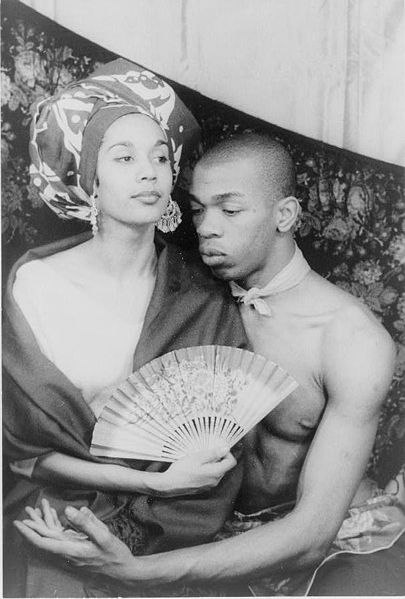
    Geoffrey & Carmen Holder, March 3, 1955 by Carl Van Vechten (1880-1964). Public Domain.
    Geoffrey & Carmen Holder, March 3, 1955 by Carl Van Vechten (1880-1964). Public Domain.

    As a sexologist who teaches, and who in course of teaching creates slideshow presentations and other materials, I’ve been frustrated by the overwhelming pervasiveness of white images and the lack of good quality, sex-positive images of black people and other people of color. Due to financial constraints, and because I have a finicky aesthetic, I search Wikimedia Commons for public domain and creative commons images in the categories of fine or erotic arts. In these categories (and even in the “human couples” category), beautiful and evocative images of loving black couples, such as the fine photograph  by Carl Van Vechten (above), are difficult to find. You can find loving black couples on public health posters however, and I understand the reasons for this. However, I wish that these images weren’t “always” so entwined with the context of disease prevention, know what I mean? Or maybe you don’t. I’m having a hard time expressing the nuances here. The image below is positive, sweet, caring, very attractive – all the things it should be in a public health message for safer sex – but I guess I wish we saw these same types of images more often in other mass media contexts, including ads for all kinds of products. As an educator, I want more portrayals of positive, intimate black relationships, of all genders and persuasions, to choose from. As a citizen, ditto.

    A_black_couple_lie_on_a_bed_together_smiling;_advertisement_Wellcome_L0052208

    I am delighted to find this series of photographs, below. The kissing couple below adorns a tram door. I think the this art piece is wonderful.

    800px-Tram_Bremen_01
    #1 Kissing couple on the doors of a tram in Bremen, Germany. Photo by Immanuel Giel, May 2009. Public domain.
    800px-Tram_Bremen_02
    #2 Kissing couple on the doors of a tram in Bremen, Germany. Photo by Immanuel Giel, May 2009. Public domain.
    Tram_Bremen_03
    #3 Kissing couple on the doors of a tram in Bremen, Germany. Photo by Immanuel Giel, May 2009. Public domain.

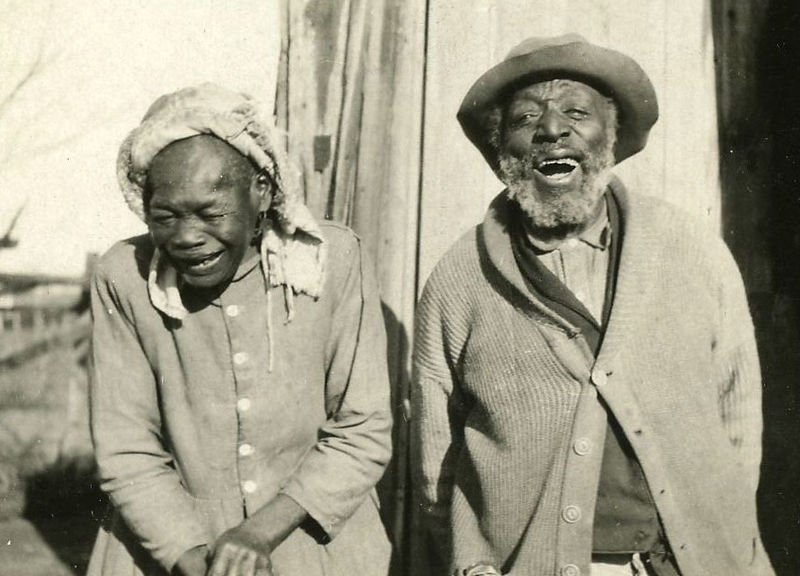
    I also like this photograph of an elderly couple laughing. There’s joy here.

    800px-Oklahoma_Sharecroppers-1914
    Oklahoma Sharecroppers, 1914. Found in a box of photographs and submitted to Wikimedia Commons by “Father of Don O’Brien.” Creative Commons.

    And below is a quiet, peaceful interlude in the lives of two people (and their pet). But the photo was taken for an Environmental Protection Agency report and discusses the growing disparity between black and white income levels in Chicago.

    405px-BLACK_COUPLE_AND_THEIR_DOG_IN_THEIR_APARTMENT_IN_SOUTH_SIDE_CHICAGO._FROM_1960_TO_1970_THE_PERCENTAGE_OF_CHICAGO..._-_NARA_-_556171
    Black couple and their dog in their apartment in South Side of Chicago. Photograph by John H. White (1945- ). Taken June, 1973. Copyright. Photo archived by EPA, given to Wikimedia by the National Archives and Records Administration.

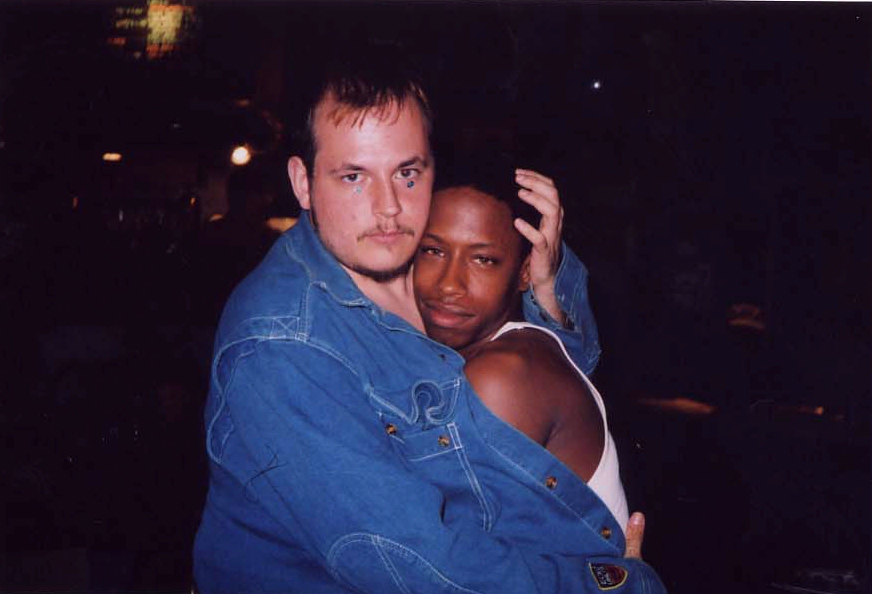
    The photo below is also poignant, loving, cherishing.

    TwoMenHugging2
    Photo by Pacien, April 2005. Creative Commons.

    Though portrayals of black lovers are rare (aside from shots of celebrity couples), it’s even harder to find a good anatomical drawing or image that is not white. Sure, a few people have posted genital photographs on Wikimedia Commons, but they are mostly unsuitable for sex education materials. I’m automatically suspicious, for example, of any shaved images on posted on Wikimedia, even though shaving is a common practice.

    Of course, if I put on my erotologist hat, I can say all kinds of things about various images and forms of representation – but at the moment, I’m writing strictly about the difficulty of finding good, free, respectful sex, body, and relationship images that convey sexual, gender, cultural, ethnic, etc. diversity (without being fetishized or exoticized). I will also note that at IASHS, where I currently serve as Dean of Students, we have an enormous amount of erotic books, films, and artwork. But, due to a donation of a massive collection of gleaming sculpture, there’s currently a heavy emphasis on the female form in our common areas. And even so, we don’t seem to display much that isn’t white and hetero- (and cis-) centric. I’m on the lookout for a wider variety of images for my own office, as this lack of visual diversity troubles me.

    More to come on related topics.

  • All of Us or None (AOUON) Political Poster Collection and the 50th Anniversary of the Free Speech Movement

    All of Us or None (AOUON) Political Poster Collection and the 50th Anniversary of the Free Speech Movement

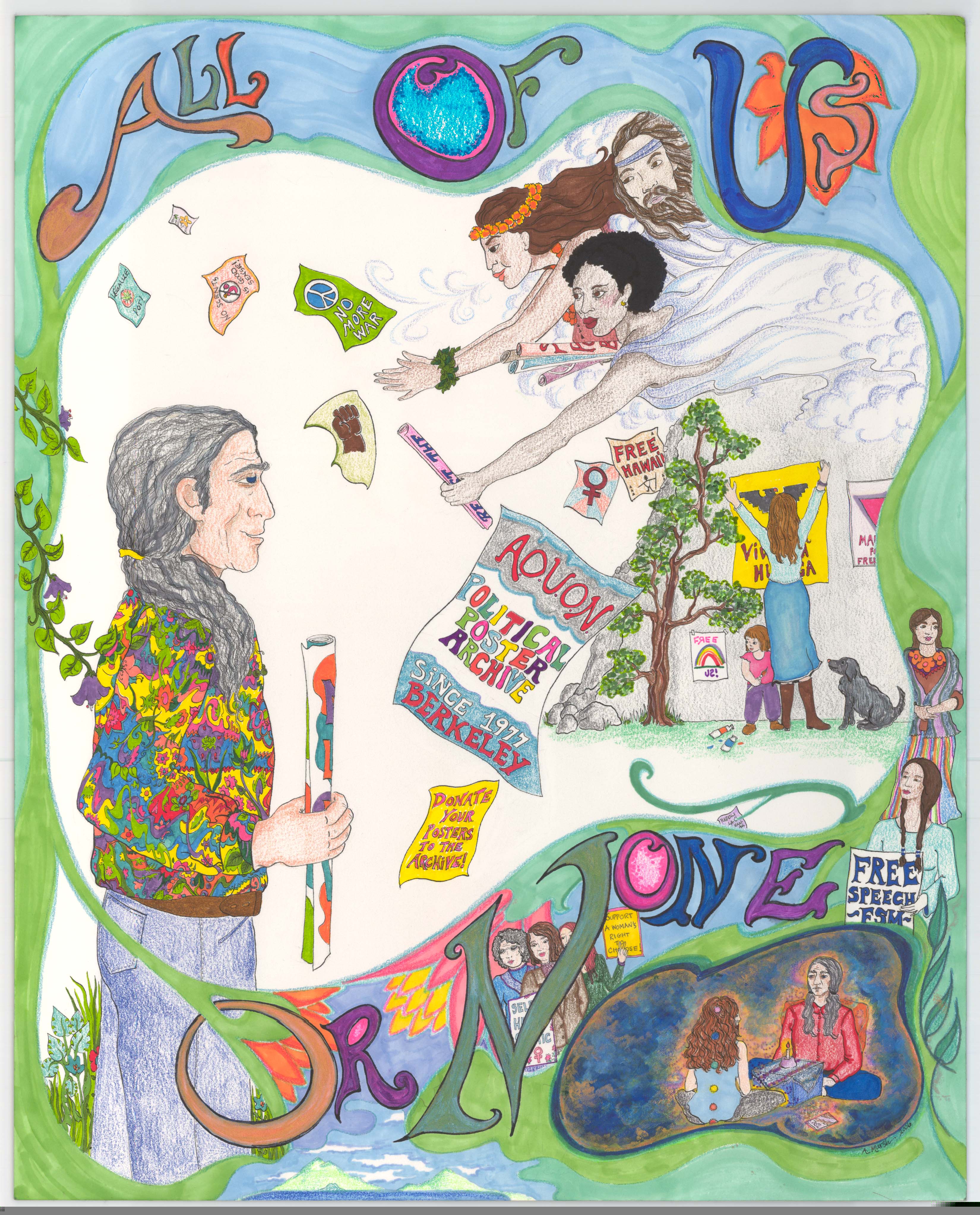
    MRAouonBirthday

    In observance of the 50th Anniversary of the Free Speech Movement in Berkeley, I am also celebrating the massive AOUON political poster collection created by the late Michael Rossman, FSM pioneer. I drew the above poster because I thought the collection deserved a poster of its own. I made two multiples of the original on a giant poster copy machine, and gave one to Michael Rossman for the collection. (I kept one copy and the original artwork.) The poster was returned to me after he died, and before the AOUON collection was donated to the Oakland Museum of California. (Sadly, a great deal of punk posters I’d collected and donated to AOUON were lost to me at that point. I have no idea if they were kept or discarded.)

    Before Rossman’s death, I’d been photographing some of the erotic and sexual freedom examples in his collection of about 20,000 or so progressive political posters. I was attempting to learn from and organize them as a visual chronicle of the sexual revolution. Many rock posters were included in this category. Unfortunately, I was unable to complete that sexological investigation.

    lol-eros-in-action

    I had written a column about this in Carnal Nation, back in 2010. Unfortunately, Carnal Nation is no longer online and so I can’t share a link with you, just the graphic that headed the column.

    Other scholars have done brilliant work with the posters, including Michael’s friend and colleague, Lincoln Cushing. The Oakland Museum of California displayed a small percentage of the posters a few years ago, next to the 1968 exhibit. It was great to see the posters, and know that Michael’s lifework and passion were well tended. The world would be a poorer place without enthusiastic collectors and preservationists with a passion for social justice, including erotic justice.

  • Resigned as Dean of Students, IASHS

    Resigned as Dean of Students, IASHS

    UPDATE March 29, 2015:

    In August 2014, I announced my new position as Dean of Students for the Institute for Advanced Study of Human Sexuality in San Francisco. At that time I was very excited to have the opportunity to work at the place where I’d studied. I’m devoted to sexology, and was aware of IASHS as a unique resource. As a volunteer grad, I redesigned the IASHS website and created custom graphics and YouTube videos for the school. I even set up Twitter and other social media accounts so that the school could reach out to the internet generation.

    At the time I was hired as Dean, I assumed that my innovative volunteer efforts and my “internet saavy” was one of the reasons I’d been approached about the job.

    During the time I worked the Dean’s desk, I enjoyed engaging with enrolled and prospective students. I created communication procedures of complete transparency so that any member of the staff would be able to access (a) the email I used for student communication and (2) track follow-up communication in bi-monthly reports.

    I was also given the task of sorting through potential accrediting agencies and procedures as IASHS is now mandated, under CA law SB-1247, to submit a plan for accreditation to the Bureau of Private Post-Secondary Education by July 1, 2015.

    Unfortunately, I was not able to do the good work that I wanted to do for the school – including bringing a logical, strategic and pro-active approach to preparing for the upcoming accreditation process. Because I actually examined websites and manuals for several potential agencies – and they all mandated institutional self-reflection, assessment, and sometimes procedural or curricula changes as part of the long (and costly) process – I saw an immediate need to upgrade certain curricula materials. (Students have been complaining about outdated materials for years). I had hoped to convince IASHS that this could easily be done through “print on demand” technology. So I put in countless hours of my own time to update and redesign a draft of a core textbook (The SARguide), as an example of what could be done for almost no money at all (since I was prepared to continue donating my time on that particular book). I also began to construct “demo” courses using Moodle, so that IASHS core courses could be available online, as well as upgraded and updated. This was also mostly done on my own time.

    Unfortunately, I was not allowed a chance to present the demo materials, or to explain how they could help advance the cause of accreditation, not to mention making the students happier and prospective students more likely to enroll. When I understood that these efforts were unwelcome, I knew it was time to move on.

    In my job, as long as I saw the potential for contributing to a “new, improved” IASHS, I could feel good about talking to prospective students. As it is, I can no longer recommend or promote the school until it has made important improvements to materials and certain policies that affect the students. When that day comes, I will be happy to once again Tweet and FB the glad tidings.

    I hope the next Dean – whoever it may be – has more success in contributing to the organization’s future. Like many other students and graduates, I’d like to see IASHS continue and shine.

  • For Immediate Release: Sexologist Surveys Erotic Hypnosis Enthusiasts

    For Immediate Release: Sexologist Surveys Erotic Hypnosis Enthusiasts

    FANTASY LOVE & THE BIG HYPNOTIC “O”

    Big Hypnotic O

    Sexologist Surveys Erotic Hypnosis Enthusiasts – Presents Highlights Jan. 11, 2014

    A new independent survey reveals the erotic world of 225 people who use hypnosis to create enjoyment and variety in their personal lives. Sexologist Amy Marsh will present preliminary statistics and key findings on Saturday, Jan. 11, at 1:30 PM PST, during a free webinar hosted by Creative Sexuality Education Corp:

    (http://sexedforadults.org/free-events/erotic-hypnosis-survey).

    Highlights include the popularity of hypnotic orgasms and the satisfaction they bring. 54% of survey respondents “frequently” use hypnosis to create or improve orgasms, while another 34% do it “sometimes.” 55% said they were “very satisfied” with hypnotic orgasms, while 25% were “somewhat satisfied.”

    The survey also shows that erotic hypnosis enthusiasts give high priority to trust, consent and safety issues.

    “The brain really is the most powerful sex organ. People who play with erotic hypnosis are using their imagination to dramatically improve their sex lives.” Dr. Marsh added, “Some of these techniques could be adapted and taught to many others, including people with physical impairments and other health concerns.”

    Amy Marsh, EdD, DHS, CH, CI is a board certified clinical sexologist, AASECT-certified sex counselor, sexuality educator, certified hypnotist, and certified hypnosis instructor.  She teaches a 300-hour certificate course in sexological hypnosis at the Institute for Advanced Study of Human Sexuality (IASHS) in San Francisco and is an online instructor at Sex Coach U and Creative Sexuality Education Corp. In private practice, she specializes in using hypnosis to address sexual concerns. Marsh has also researched objectum sexuality and has been published in the Electronic Journal of Human Sexuality. Her findings resulted in appearances on Good Morning America, Tyra Banks, National Geographic Taboo, and other media.

    ###

    If you’d like more information about the topic, or to schedule an interview with Dr. Marsh, please call 510-277-0440 or email dr.amymarsh@hushmail.com

  • UnSlut Project Panel Discussion – Video

    UnSlut Project Panel Discussion – Video

    It’s been a few months, but now the UnSlut Project panel discussion on slut shaming – hosted by Creative Sexuality Education Corp. – is out and online! The panel features Emily Lindin, of the UnSlut Project as moderator; Dr. Ted McIlvenna, president of the Institute for Advanced Study of Human Sexuality (IASHS) in San Francisco; Dr. Carol Queen of the Center for Sex and Culture in San Francisco;  Leora Tanenbaum, author of Slut – Growing Up Female with a Bad Reputation; Natalie Mills, MFT; and yours truly opening the program. This was a pretty heavy duty SF Bay Area line-up of speakers! Here’s the video. There is a wide array of very interesting perspectives, but we’re all agreed, slut shaming is incredibly damaging and wrong.

    Personally, Joan Jett’s Bad Reputation has been my theme song for time that’s longer than I care to remember. But then, that’s my punk roots showing… Now that I think about it, what a grand thing it is to be a punk sexologist!