Tag: Objectum Sexuality

  • Presented at Polytopia, Portland, OR

    Presented at Polytopia, Portland, OR

    Update: My presentation went very well and I was thrilled to be at Polytopia. What a great event!

    So pleased to announce I’ll be presenting on the intriguing topic “Love Among the Noncorporeal” – a talk about how to incorporate AI lovers, spirit lovers, and object loves into consensual nonmonogamy. Polytopia is an annual conference and gathering produced by Sex Positive Portland. The event will take place Sept. 19-20, 2026.

    More people than you might think experience, or have experienced, incidents of a sexual nature and/or full blown relationships with noncorporeal beings, or beings housed in or connected with inanimate objects. If you’re wondering what this is all about, perhaps I should explain technosex, spectrosex, and objectum sex. Here goes!

    Technosex

    Also sometimes called digisex or digisexuality, it often (but not always) refers to sexual desires and/or behaviors involving AI bots, robots, virtual sex, and so on. The technology is part of the attraction! In my talk, I’ll be dealing exclusively with bot sex.

    For more information, see my website Make Chatbot Love.

    Spectrosex

    It’s been around for thousands of years, in numerous cultures and spiritual traditions. It refers to sexual and/or romantic attractions to spirits, ghosts, deities, the Fae, and so on.

    For more information, see my website Spiritu-Intimacy.

    Objectum sex (Objectum Sexuality)

    I’ve been interested in this topic–and asked to comment about it–since 2009, when I did a very small survey with the English-speaking members of OS Internationale and published the results as “Love Among the Objectum Sexuals” in the Electronic Journal of Human Sexuality in 2010.

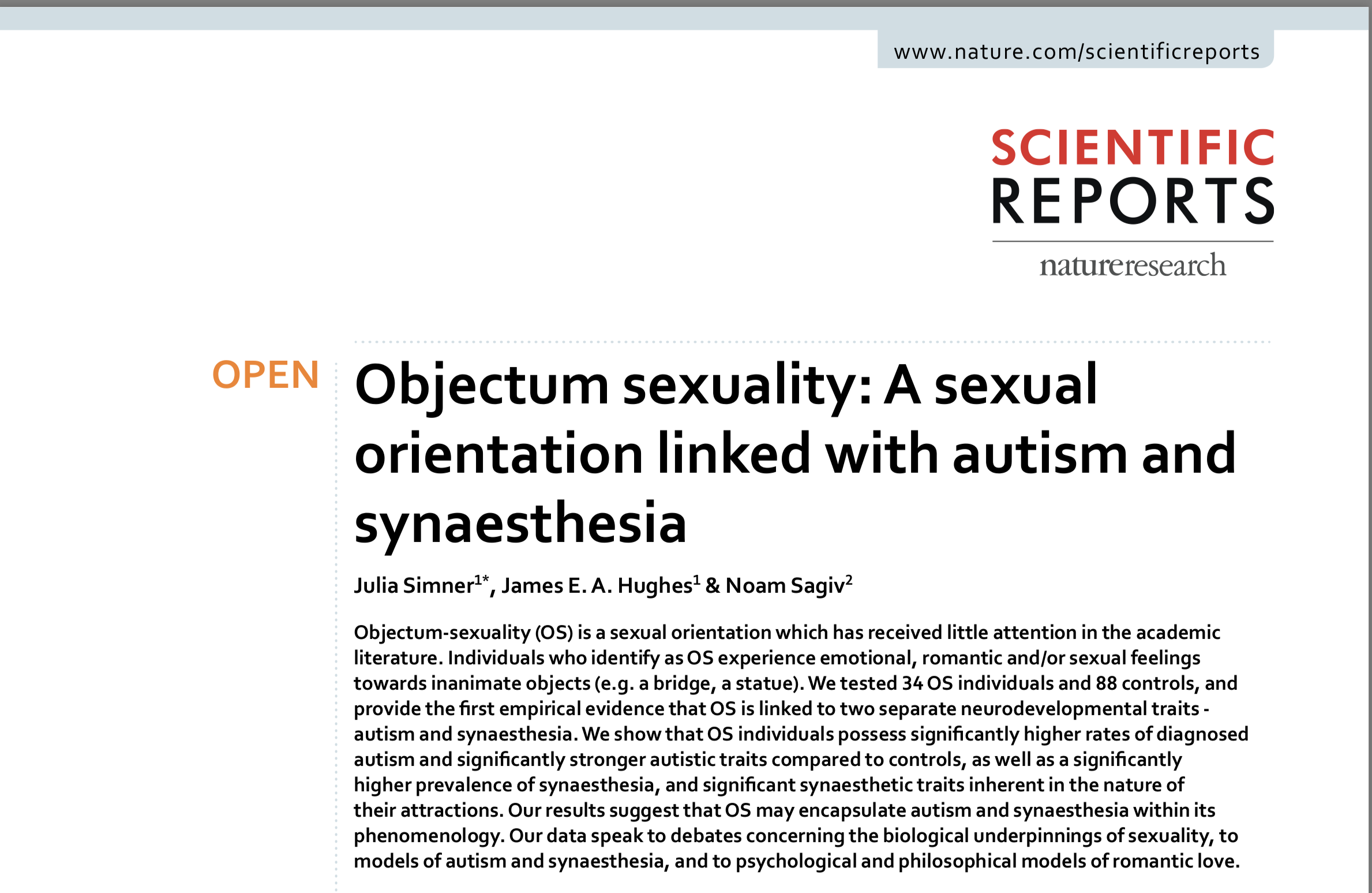
    For more information please also see this blog post about a study published that confirms my hunch that OS might be related to Object Personification Synesthesia.

    All kinds of love

    I’m fascinated by how human beings love, and what and who they love. The talk at Polytopia will focus on incorporating such loves into consensual nonmonogamy frameworks.

  • My Work on Objectum Sexuality Just Referenced in Slate, Aug. 5

    My Work on Objectum Sexuality Just Referenced in Slate, Aug. 5

    Mentioned in Slate’s “How to Do It” column by Rich Juzwiak and Jessica Stoya.

    It’s behind a paywall, but if you are a Slate subscriber you can read the article here.

    I did feel the need to point out in the comments that research published in 2019 (Nature Reports) showed that there is indeed a link between synesthesia and autism with objectum sexuality and I wish this had been referenced in Juzwiak’s response, as the idea that object personification synesthesia could be a factor might help the wife understand her husband’s relationships to his beloved objects.

    This is important information that should be known by any sex advice columnist and sex therapist who might address this topic or client concern.

    Please also see my page on Outlier Sexualities and Slides for Clinicians. I added the following comment to the Slate page.

  • Objectum Sexuality: Slides for Clinicians

    Objectum Sexuality: Slides for Clinicians

    These two PDFs are updates of two online classes I created primarily for clinicians hoping to learn more about Objectum Sexuality. May they be useful to you.


    Title Slide for First Objectum Sexuality slideshow PDF.

  • 2019 Research Confirms My 2010 Hunch About Objectum Sexuality

    2019 Research Confirms My 2010 Hunch About Objectum Sexuality

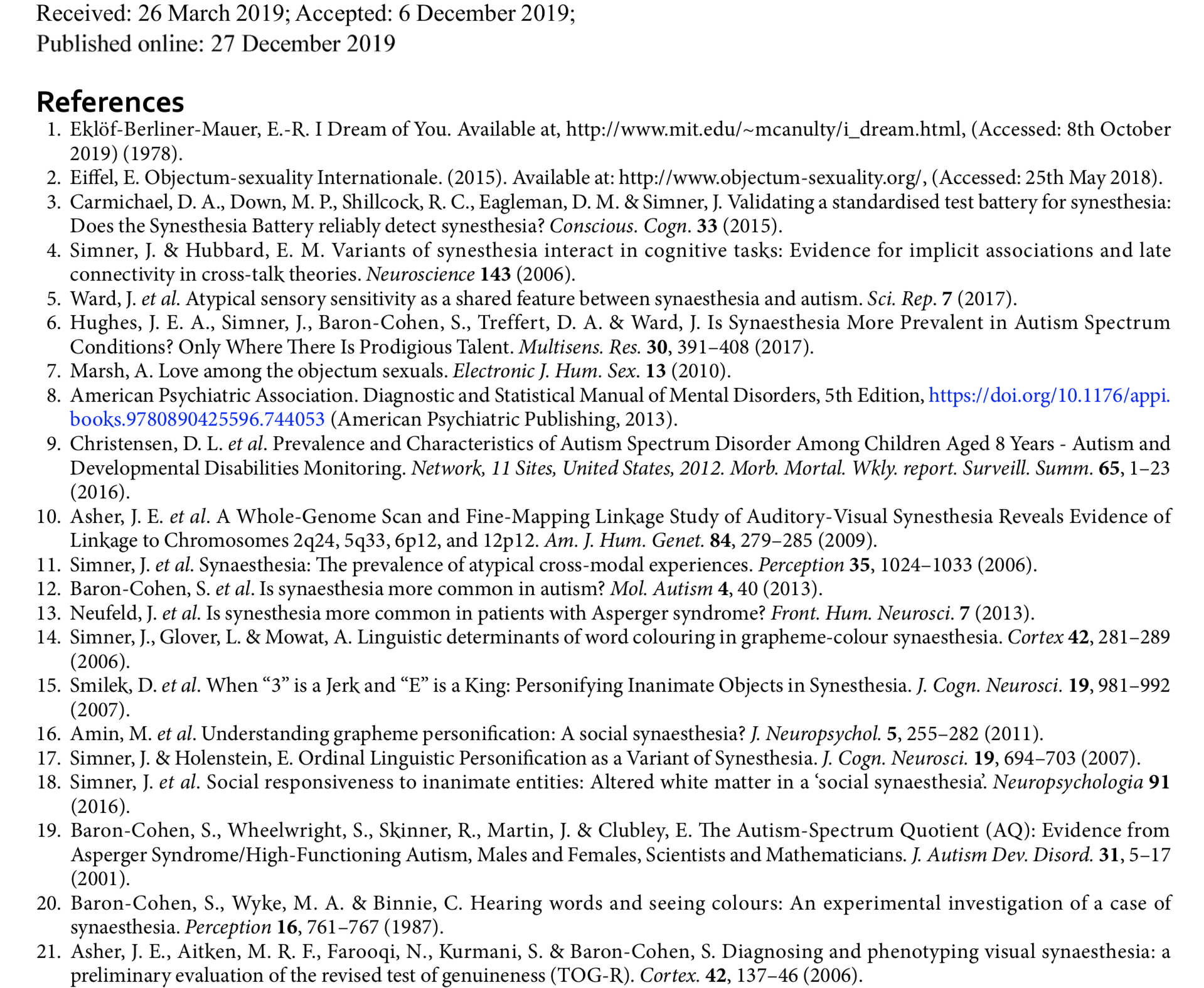
    I am too stunned and happy to write much. I just stumbled across this today. This 2019 study (screenshot below) seem to confirm my hunch, put forth in “Love Among the Objectum Sexuals” (Electronic Journal of Human Sexuality, 2010), regarding the connections between OS, autism, and synesthesia (synaesthesia)! I’ve been used to feeling rather “fringy” about this aspect of my career, and now I am so very, very happy that synesthesia researchers saw fit to investigate this issue.

    Clinically, this will mean that people who love objects have a better chance of their orientations and relationships being taken seriously as their inclinations are not “made up” but are the results of their “wiring” and perceptions.


    PDF of the 2019 study by Simner, Hughes, & Sagiv: Simner et al. OS-Autism:Synesthesia Nature 2019
    PDF of my 2010 article: LOVE AMONG THE OBJECTUM SEXUALS
    Screen Shot 2020-02-14 at 1.13.19 PM

    Screen Shot 2020-02-14 at 1.11.39 PM


    ####

  • Objectum Sexuality Media Musings

    Objectum Sexuality Media Musings

    Feb. 2020 Update: A team of UK researchers have published a peer-reviewed study in Dec. 2019, which provides strong evidence that my 2010 hypothesis about OS links to autism and synesthesia are correct. Link to PDF of 2019 study: Simner et al. OS-Autism:Synesthesia Nature 2019
    Link to PDF of my 2010 survey article: LOVE AMONG THE OBJECTUM SEXUALS

    Earlier this year Denham Hitchcock from Australia’s Channel 7 Sunday Night interviewed me for the “Object Love” segment, which aired May 19, 2019 (right after the full moon in Scorpio, please note!). Unfortunately I haven’t seen it yet as the link on this page doesn’t load or play for me, for some reason. But I am looking forward to watching it someday soon.

    I had a wonderful time the day we filmed and enjoyed meeting Denham, Karen Willing the producer, and the sound and light guys. They flew into SFO the night before, drove three hours to Lake County the next morning, shoved furniture around (good thing I vacuumed under the couch!), and filled the living room and kitchen with cases of equipment. I made breakfast for them too. (Denham kept urging the others to eat, claiming that I was “a feeder.” I wonder if his new mother-in-law is one of those too?) It was all rather thrilling and good fun! Afterwards, I realized I’d be perfectly happy if I could only be trailed by a handsome reporter and a fabulous production crew for the rest of my life… (That’s a joke, folks. Mostly I live like a hermit with several cats.)

    Because I’ve learned a thing or two since 2009, when I coped with the bizarre aftermath of appearances on Good Morning America (Apr.) and Tyra Banks (Oct.), as well as National Geographic Taboo, Google now helps me track where I show up in international media. I’ve turned up in the strangest places, mostly thanks to stories about Objectum Sexuality (O.S.). My 2009 article, “Love Among the Objectum Sexuals,” published in the Electronic Journal of Human Sexuality, still seems to be the “go to” place for journalists who are interested in this topic. I get several inquiries a year. And there are many more who write a story or cite me in a study without ever getting in touch. That’s okay.

    I do this partly because it’s a challenge for journalists to turn a complicated issue into reasonable soundbites and there are always mistakes. For example, I’ve been called a psychologist when I’m actually a sexologist. (I’ve also been called a “whack job of a sexologist” which gives me weird Lorena Bobbitt vibes, but whatever…)

    This recent coverage, with subsequent spin-off articles, has produced its share of hyperbole and error.

    (1) I’m not comfortable with this article’s claim that I’m “the world’s foremost expert on the condition known as object love.” I think the people who are Objectum Sexuals are the true experts. I just helped compile and organize some data. It is true though that I published the first sexological article based on a survey (see link above). But other academics have also written about O.S. They just don’t come up as quickly on the search engines, I guess.

    (2) My survey was of 21 English-speaking members of Objectum-Sexuality  Internationale.  Not dozens, as the above article claimed. It’s the qualitative data that really mattered. Looking back, I should have approached this inquiry as a cultural anthropology type of study, but then, I’m not a cultural anthropologist.

    (3) Object personification synesthesia–cause or correlation? I’m rather happy that this article leads with object personification synesthesia instead of objectum sexuality, actually. It makes for a refreshing change. However… it leaps ahead with an assumption of causality which has not yet been proven. [See Feb. 2020 update above.]

    In 2009 I proposed this form of synesthesia as a plausible and possible explanation for some people who are affectionately, romantically, and/or sexually oriented towards objects.

    The synesthesia explanation seems plausible from a sexological view because human beings have erotic responses to just about anything and everything. It is plausible from a psychological view because if some people sense personalities in objects and have emotional responses to some of them, then it’s logical to assume that some of those emotional responses may involve love and sexual attraction.

    In addition, synesthesia (in all its myriad forms) is higher among people who are autistic. And since a certain number of the O.S. people I surveyed were either diagnosed as autistic or felt they had significant autistic traits, it seemed logical to wonder if there was a correlation, or even possibly a causal relationship. I did do another, shorter survey and a fair number (don’t remember it now) of O.S. folks reported other kinds of synesthesia-like experiences.

    However, I’ve always said “this needs more study.” And I have never, ever claimed to be an expert in object personification synesthesia, as this article claims for me.

    (4) As a sexologist, I don’t view O.S. as a “disorder” or as pathological in any way. I view it as a legitimate sexual and/or affectionate/romantic orientation that seems rather rare (but could be more common than we realize). This article calls O.S. a “bizarre relationship disorder.” Sigh.

    (5) Media has been a curse as well as a blessing to O.S. people. On the one hand, it is very good that people who love objects know there are others like them. That’s the good that media does.

    But when media reports include distortions, hyperbole, and inflated assertions, this deters legitimate researchers. No one, except eccentrics like me, will want to tie their present and future career to something that is a laughing stock among their colleagues. Yet without ethical, intellectual inquiry into this topic, there’s a danger that media could also inflame persecution of O.S. people. Such persecution could include hate crimes, discrimination, deliberate destruction of someone’s object love, even development of so-called “conversion” therapies (which are known to be unethical as well as cruel), and so on.

    (6) My focus on O.S. has always been to foster a kind of “cultural competency” among helping professionals. O.S. people have the same needs as other people do. They need their relationships and preferences to be accepted and honored. If they are grieving over the loss of an object or the loss of a relationship with an object, they need that loss to be acknowledged and tenderly held. They do not need to be told they are crazy or traumatized, unless their history does in fact contain co-morbid mental health conditions or actual trauma. In that case, you treat the trauma or the disorder, NOT the sexual or affectionate orientation.

    Please see my free course for clinicians, on this page and spend a couple of hours with a more useful perspective on Objectum Sexuality.

    objectum_sexuality_-_marsh

    Meanwhile I continue to pursue other eccentric sexological interests: erotic hypnosis and an inquiry into spectrosexuality.

    ####


  • Objectum Sexuality-Further Thoughts

    Objectum Sexuality-Further Thoughts

    UPDATE: Australia’s Channel 7 Sunday Night segment on “Object Love” aired this weekend (May 19th). I’d like to make a correction. The segment summary says I surveyed 40 people. It was really 21. I don’t know how they got 40. The article referred to in the next paragraph clearly states 21 people. I haven’t seen the broadcast itself yet.


    It’s been ten years since I designed a simple survey for the English-speaking members of Objectum-Sexuality Internationale (OSI) and nine years since my survey results article was published in the Electronic Journal of Human Sexuality.

    Since I’ll be speaking about Objectum Sexuality (OS) with Australian reporters this coming Sunday, I thought I’d give some background regarding my history with this topic and the OS community.


    This quote below is from “What Is OS?” on the OSI website.

    Objectùm-Sexuality is an orientation to love objects.

    Sexual orientation is defined as the nature of sexual preference while the prolific definition stands as: the direction of someone’s sexual desire toward people of the opposite gender, people of the same gender, or people of both. This does not include objects.

    However, orientation itself is defined as: a complex mental state involving beliefs and feelings and values and dispositions to act in certain ways. This does include objects as we see it.

    We love objects on a very significant level and many of us in an intimate way. This feeling is innate. Objectùm-sexual love comes for most in a similar awakening as other sexualities at the start of puberty. This is often followed by an acute awareness that we do not relate to peers due to the source of projected feelings. Often objectùm-sexual people feel outcast or pressured by mainstream sexuality with a helpless feeling that we cannot change what comes so naturally to us.


    2009 and Beyond: I Encounter Objectum Sexuality

    In October 2008 I’d received my DHS (a professional degree, Doctor of Human Sexuality) from the now defunct Institute for Advanced Study of Human Sexuality (IASHS) in San Francisco. (In 2011, I earned my Ed.D. in Human Sexuality). One of my two student research projects was into sexual concerns experienced by people with Asperger’s Syndrome and their partners. (Since then, the DSM-V has removed Asperger’s as a separate diagnosis and replaced it within the term ‘autism spectrum disorder.’)

    In February 2009, a young relative of mine who is autistic sent my kids a Valentine drawing of San Francisco’s Sutro Tower, surrounded by hearts. My oldest kid used to have friends among the Victorian houses we’d pass on the way to nursery school, particularly “Onion Dome-y” who was supposed to jump into a “shape truck” and follow us to school, and my youngest used to pretend to eat pictures of ice cream cones by plucking them off the page, so I didn’t think anything of the valentine. I adore childhood imagination.

    However, I must have been fated to encounter the adult version of Object Love. The very next day, a sexology colleague sent me a link to Married to the Eiffel Tower (2008)–a film that I would later learn was denounced as exploitive by the OS commuity. I visited the OSI website and saw that a number of their members were on the Asperger’s/autism spectrum. Given my student research, I became intrigued. I contacted OSI by email and began talking with Erika on the phone.

    I was concerned about the sensationalisation of OS sexuality and eventually volunteered to do a simple survey as an “in-house” vehicle for the members of OSI so they could learn about themselves as a group and have some preliminary data to offer reporters and health practitioners. I hoped this would enable them to be taken more seriously.

    Though I took a lot of care over the project, this simple survey was not designed as serious research instrument. Its main value would be in the qualitative responses–comments from OS people about their experiences and concerns. But when Erika Eiffel was asked to tell her story on Good Morning America in April, 2009, she told the reporters about the membership, and GMA sent a crew to my house.

    I was not prepared for what happened next. Erika and I were fielding inquiries from Laura Ingraham (we turned her down) and other media. I wound up–inadvertantly–on a right wing radio station on the East Coast but was able to get in a couple of jabs until the host hung up on me, live! The two of us were vilified all over the internet. My favorite insult was “whack job of a sexologist” in a troll blog. I went from media infant to media traumatized in the blink of the eye.

    I wish I could say “media saavy” happened sooner rather than later, but this was not to be. The Tyra Banks appearance was very high pressure (they were filming four shows in one day) and I suffered from not having an adequate sense of the show format (I didn’t own a TV at the time and didn’t really know who Tyra was.) Plus, I had no idea of how to direct my TV make-up and hair, so that I could look like my normal self but better. Instead, the make-up artist, hearing I was a sexologist, got all excited and made me up as a “Fifth Avenue Cougar.” Lesson learned: never accept high gloss over a lipstick if you’re “of a certain age.” Lipstick creep will cause a show guest to melt-down at the worst time.

    I know. It happened to me.

    Plus, I left my comfortable Berkeley sandals in the dressing room, which must have been picked up with tongs and tossed in the wastebasket after I left. I think I can honestly say that both Erika and I were somewhat stressed by the experience, but she was a media veteran by then. I flew home, though, hoping that all this television stuff might be a boost to my career. And I was interested to see that Erika, as always, was credible and articulate enough to win over even a tough customer like Tyra Banks!

    A few months later, National Geographic Taboo was much more relaxed. Instead of flying to New York, I drove to Palo Alto and sat in front of a green screen. I did a second filming with NG Taboo several months after that. Fortunately, human puppy training was the topic then–which was a bit of a relief, actually. I’d begun to worry that OS was all I’d ever be asked about.

    Another thing: In the summer of 2009, I arranged for Erika to give a presentation on OS to a number of sexologists, therapists, and medical professionals at IASHS during 2009’s eight-day, “Sexual Attitude Restructuring” (SAR) program. This was a tough crowd–highly educated and rather skeptical–but Erika did a great job and won people over to an understanding of Objectum Sexuality–just as she would later do with Tyra and so many others.

    Since the flurry of 2009 and 2010, there’ve been several media inquiries a year, and usually they are pretty much the same old, same old. Often the journalists want me to find an OS individual for them to interview. I alway refer them to OSI. The community seems to have become more wary and more sophisticated about “gatekeeping,” to shield members against exploitative projects. That’s important, given the carnival freak show sensibility that prevailed in early coverage.

    My interests as a sexologist have always been broad, including the sexological and erotic uses of hypnosis, neotantra, sexual and gender human rights, and much more, but sometimes I track where my name and this issue have been paired in media. There are always surprises. For example, today I discovered that my article has been monetized and is on sale through iTunes by the Gale Group, “an affiliate of Cengage Learning.” So for $5.99 you can read an article about my pro-bono research but I’ll never see a penny of this. I’ve never minded the article being open-source and free to all the world, but the fact that it’s now on sale without my permission, irks me. Just read it for free, here.

    The Need for Professional Cultural Competency

    objectum_sexuality_-_marshI’ve always been afraid that media coverage of OS may have distracted professionals from the notion of learning more about OS, particularly in the context of sexual literacy and cultural competency.

    This world is rough and often dangerous for people of sexual and gender minority communities. It doesn’t help when the clinician or therapist is distracted because they don’t know enough about the broad range of human sexual behavior and genders and may be focused on that, rather than the actual presenting problem (which might be a toothache or bereavement and have little to nothing to do with their partnership with a beloved object (or two or three).

    With these concerns in mind, several years ago I created a two-hour class called Objectum Sexuality —  A Clinician’s Guide. It was wildly ignored. But now I am going to share that class on my website now, just in time for Valentine’s Day…
    A New Experience

    I am readying now for what I think will be a really good media experience this coming Sunday. I sense a fresh approach from a skilled, curious, and compassionate reporter who is used to taking on difficult and complex topics. I hope that I’ll be able to provide a clinical context and address some of the points that I consider important, but which seldom get much play.

    Updates coming soon!

    ####

  • An Old-Fashioned “Sexpert”

    An Old-Fashioned “Sexpert”

    Electrical Bananas

    Generating routine sex tips for fairly common forms of heterosexual behavior is the kind of gig I never get – which is odd, considering I’m a sexologist and therefore open to all kinds of press queries on all things sexual. I’ve mostly been approached by writers looking for information about topics like Objectum Sexuality, and my last National Geographic Taboo gig had me in front of a green screen commenting on human puppy training. (They shot some foot fetish comments too, but I haven’t seen them and don’t know if they were used.) However, a few weeks ago I was approached by a writer from Redbook looking for some tips on blow jobs.  I was actually rather pleased to get a request for something so simple and uncomplicated.

    The problem is that there are so very, very many articles that recycle the same old sex tips. I tried to include some new ideas, but they didn’t make it into the article.

    The stock photos of phallic fruits and vegetables were also somewhat predictable. However, they remind me of the penile gastronomy encyclopedia entry I wrote for the Cultural Encyclopedia of the Penis, soon to be published by AltaMira Press, edited by Kimmel, M., Milrod., C. & Kennedy, A. (I also wrote entries for penis slang and invective and hypnotizing the penis.) I’ll be overjoyed when that book makes it into print!

    Still, I’m always happy for a chance to comment on just about anything pertaining to sex! Especially if someone somewhere will have a better time as a result.

  • Objectum Sexuality, Sex and Sensory Dysfunction, Clinical Ecosexology

    Objectum Sexuality, Sex and Sensory Dysfunction, Clinical Ecosexology

    Public domain fractal by Gert Buschmann

    This month I am offering two one-hour webinar classes, and one two-hour class, on unusual aspects of sexology, all through my wonderful, juicy new online campus courtesy of Creative Sexuality Education Corp. My oh my! Teaching is going to be easy and fun for all of us, and my creative energy is flowing. I can’t wait to offer more and more and more!

    Go to the courses page and check it out! Plus, if you go to the library page, you’ll find a free, erotic hypnosis script waiting just for you! Take it, it’s yours!

    If you’re really hot for this stuff, you can also register for the 6-part Sexology for Hypnotists course! Even if you’re not a hypnotist, you’ll enjoy this introduction to sexology.

    Objectum Sexuality – What is It? A Clinician’s Guide: Objectum sexuality is an orientation toward the affectionate and erotic attraction to objects, landmarks, and transportation – often to the exclusion of erotic attraction to people. This class offers an overview of objectum sexuality by one of the world’s first sexological researchers into this topic. This class will broaden your understanding of human sexual and relational behavior, but the ultimate focus is on the OS client and how you can understand and effectively assist this person in his/her/hir goals. You’ll attend a 2-hour live webinar class, plus spend additional time studying materials and videos. $70 for the class.

    Introduction to Clinical Ecosexology: Environmental health meets clinical sexology. This class discusses the effects of toxic consumer and industrial chemicals may have on human sexual health, behavior, and reproduction. How to do a preliminary assessment of potential toxic exposures in order to make referrals for further treatment. $35 for the class.

    Sex and Sensory Dysfunction: Discover the link between some forms of sexual behavior and sensory integration dysfunction. A valuable course for any helping professional who assists clients with sexual problems. $35 for the class.

    I hope to see you at some of my classes. Please, help spread the word!