Category: Sex Counseling & Sexology

  • “Things Cis People Don’t Know”

    “Things Cis People Don’t Know”

    The author of the following wishes to remain anonymous. I am sharing it because it is so vitally important. In case you don’t know, “cis” and “cisgender” refers to people whose gender identities are congruent with the gender they were assigned at birth: an example of congruence would be someone born with “average” female genitals who has a corresponding internal sense of female gender. “Cis” is rooted in chemical terminology, and is not a perjorative. The use of cisgender and transgender is more polite, as it helps to reduce the “othering” of trans people in dialogue, and reduces the persistent positioning of cisgender as “the norm.”

    P.S. The binary-esque categories of transgender and cisgender do not necessarily include people who are intersex. And some people are “gender diverse” without considering themselves trans, though “trans” has become something of an umbrella term.

    Content warning: strong language, swearing.


    OK so here’s the real tea: some of the things cis people don’t know

    1. Everyone perceives gender differently. That person you think doesn’t “pass?” They may be “passing” just fine 90 percent of the time.

    2. Therefore your “passing tips” suck. There’s a good chance that the thing you told your trans friend to do to seem more feminine, is the exact same thing some other cis person told them seems too masculine. That’s why we ignore you. You don’t know what you are talking about.

    3. Your sexual arousal is not a magic gender detector. For example, if you are a straight dude feeling attracted to a trans man, surprise! Doesn’t magically mean he’s really a woman.

    4. “Passing” is a bullshit concept that just means “looking cis.” Maybe we don’t all wanna look like you. Maybe you aren’t as great lookin’ as you thought. Maybe trans is beautiful. WHAT

    5. Being trans means dealing with a ridiculous barrage of misgendering and dysphoria-triggering moments. It makes you want to die. You can’t help it. That’s just how fucking dysphoria works. (And you don’t even have to have body dysphoria, social dysphoria is just as real and awful.) So yes, someone slipping up on a pronoun may have just made an innocent mistake, but these are innocent mistakes that literally make you want to rip off your skin/never leave the house again/just die already. And also for every innocent mistake there’s some gaslighting motherfucker who is flubbing your pronoun to fuck with you. Why would you trust it’s innocent? Eventually you WILL snap.

    6. As soon as you snap you will be labeled over-dramatic, triggered, a snowflake.

    7. Eventually a lot of trans people learn to keep their mouths shut and just swallow all the horrible feelings. These are your “good trans friends” who don’t get upset with you for your bullshit. They are martyred goddamn saints and you have no idea.

    8. The “bad trans” are the ones who can’t or won’t shut up and swallow the pain. They will be punished forever.

    9. There are a LOT of valid reasons why a trans person may not be transitioning in the way you as a cis person think they should. It may be money. It may be medical. It may be career-related. It may be simple lack of desire. You don’t know. All are equally valid and you are not allowed to have an opinion on how trans people manage our fucking bodies.

    10. It’s none of your business. Whatever stupid crap you’re about to ask about, it’s none of your business. Just use the fucking pronouns. We are tired.


    Unknown

    ####

  • 2019 Research Confirms My 2010 Hunch About Objectum Sexuality

    2019 Research Confirms My 2010 Hunch About Objectum Sexuality

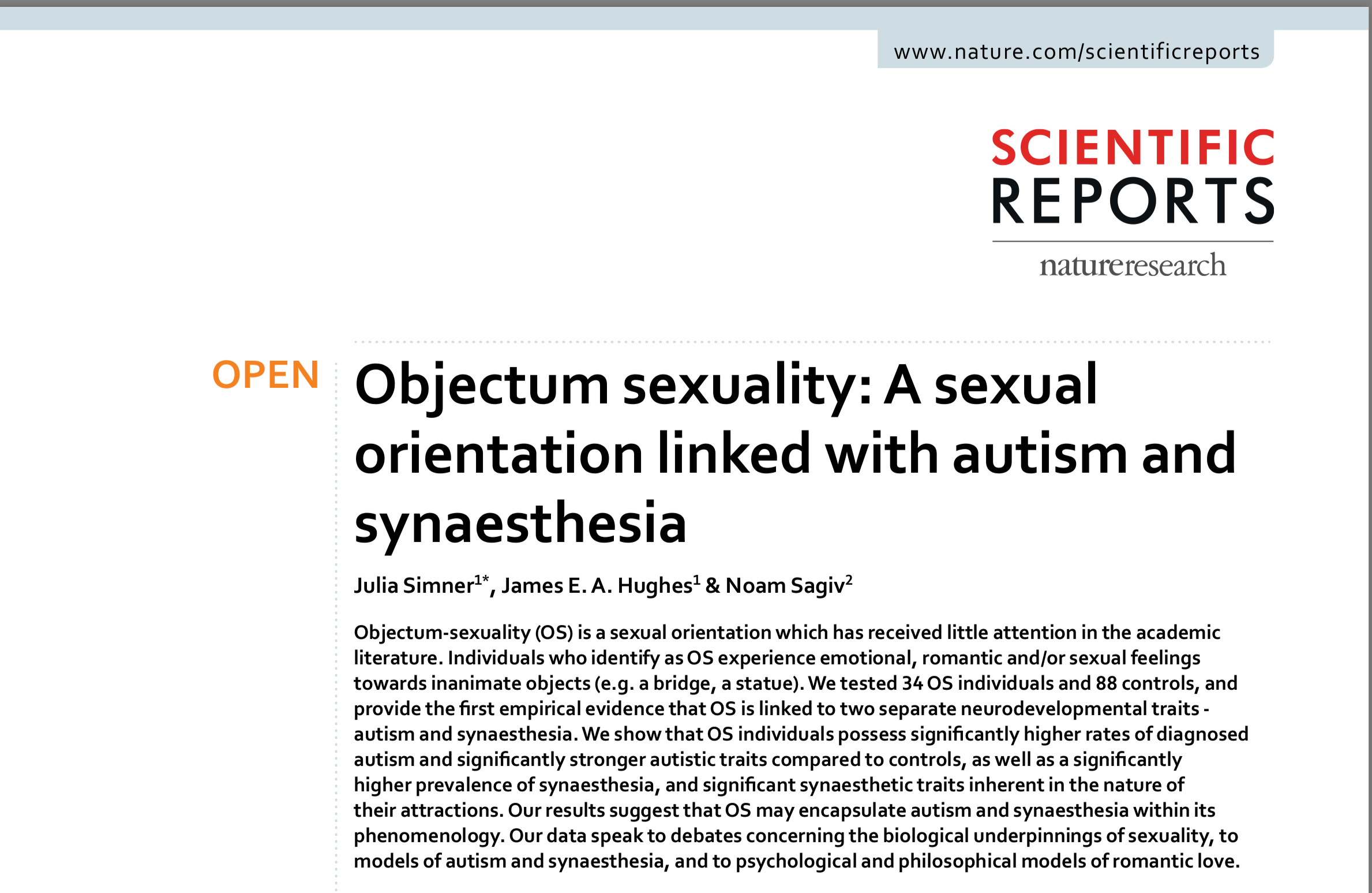
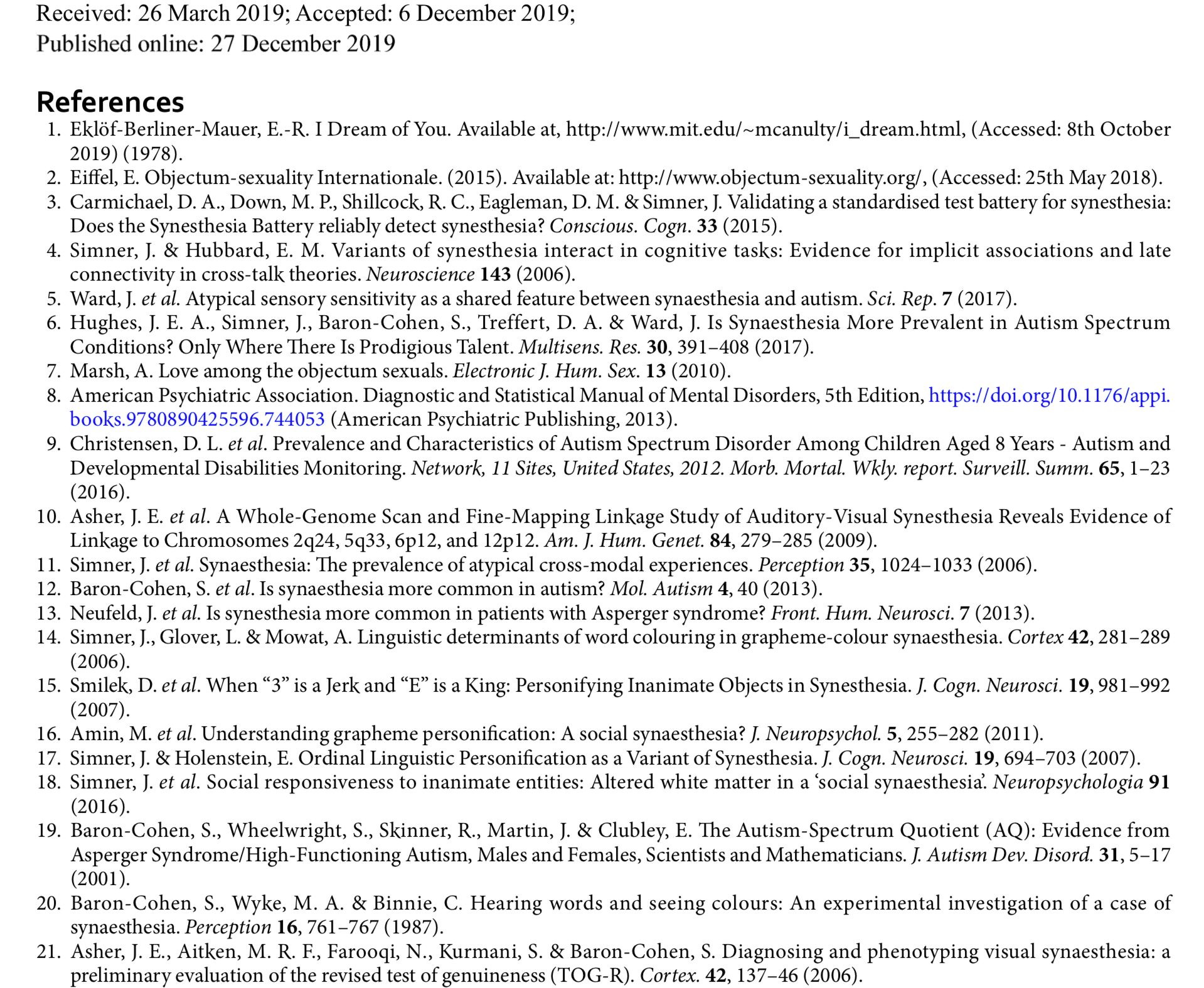
    I am too stunned and happy to write much. I just stumbled across this today. This 2019 study (screenshot below) seem to confirm my hunch, put forth in “Love Among the Objectum Sexuals” (Electronic Journal of Human Sexuality, 2010), regarding the connections between OS, autism, and synesthesia (synaesthesia)! I’ve been used to feeling rather “fringy” about this aspect of my career, and now I am so very, very happy that synesthesia researchers saw fit to investigate this issue.

    Clinically, this will mean that people who love objects have a better chance of their orientations and relationships being taken seriously as their inclinations are not “made up” but are the results of their “wiring” and perceptions.


    PDF of the 2019 study by Simner, Hughes, & Sagiv: Simner et al. OS-Autism:Synesthesia Nature 2019
    PDF of my 2010 article: LOVE AMONG THE OBJECTUM SEXUALS
    Screen Shot 2020-02-14 at 1.13.19 PM

    Screen Shot 2020-02-14 at 1.11.39 PM


    ####

  • “Gas Station” Sex Supplements and Oral Sex

    “Gas Station” Sex Supplements and Oral Sex

    Yesterday an acquaintance showed up on my doorstep (not booking an appointment) and wanted to know if Rhino “male enhancement” (erection producing) drugs, sold at gas stations and convenience stores, could show up in semen and if so, could she be harmed by swallowing potentially tainted semen during oral sex? This acquaintance was experiencing some disturbing symptoms after a recent sexual encounter, but they were so general, they could have been caused by a number of things.

    She was also concerned because she said her partner broke out in horrible hives after taking these pills, but refused to stop using them.

    A_rhinoceros_(1550)

    This was the first time I’d been asked this question. I am not a medical doctor nor a pharmacist, and so I said so, along with “I don’t know but I’ll see if I can find out.”

    What I did find out is that these products, marketed to men who experience uncertain erections, are not necessarily “all natural” or safe. They may be purchased on impulse, picked up on the way to a sexual encounter, without previous research or concern for product safety.

    The Food and Drug Administration (FDA) has issued numerous warnings about Rhino products, and others. In a press release dated November 27, 2018, the FDA warned:


    [Excerpt] The U.S. Food and Drug Administration is warning consumers not to purchase or use Rhino male enhancement products, due to a recent rise in reported health issues. Since 2007, the FDA has identified more than 25 products marketed with variations of the name “Rhino” that contained hidden drug ingredient(s).

    These products continue to be sold at gas stations and convenience stores, as well as on websites such as eBay and Amazon. More recently, these unapproved products have been discovered in international mail shipments to the U.S. These products are often sold in single-serving package sizes. Rhino products include names such as Platinum Rhino 25000, Krazzy Rhino 25000 and Gold Rhino 25000.

    The FDA has received reports of people experiencing chest pain, severe headaches and prolonged erections after taking a Rhino product that led to surgical intervention and hospitalization due to extreme drops in blood pressure.

    “Over the past few years, the FDA has been combatting the retail sale of male enhancement drug products that are frequently misrepresented as dietary supplements and that contain hidden and potentially harmful active drug ingredients. Distributing unapproved drugs, disguised as supplements, places the U.S. public health at risk,” said Donald D. Ashley, director of the Office of Compliance in the FDA’s Center for Drug Evaluation and Research. “We remain vigilant in our efforts to protect the American public from the sale of these potentially dangerous products.” [End of excerpt]


    These undisclosed ingredients may be hazardous to people who have diabetes, high blood pressure, high blood pressure, and heart disease. Here is another excerpt from the above press release:

    [Excerpt] For example, the FDA has identified various Rhino products containing sildenafil and/or tadalafil, the active ingredients in the FDA-approved prescription drugs Viagra and Cialis, respectively. These undeclared ingredients are phosphodiesterase type-5 (PDE-5) inhibitors, which can be associated with significant safety issues and the risk of serious adverse events. For example, they may interact with nitrates found in some prescription drugs and may lower blood pressure to dangerous levels. People with diabetes, high blood pressure, high cholesterol or heart disease often take nitrates. [End of excerpt.]

    I will note that diabetes affects blood circulation–poor blood flow can hinder erections–therefore diabetics with penises are likely to purchase these products.

    Other FDA press releases on similar products may be found here.

    Are these products found in semen, and swallowed by sexual partners?

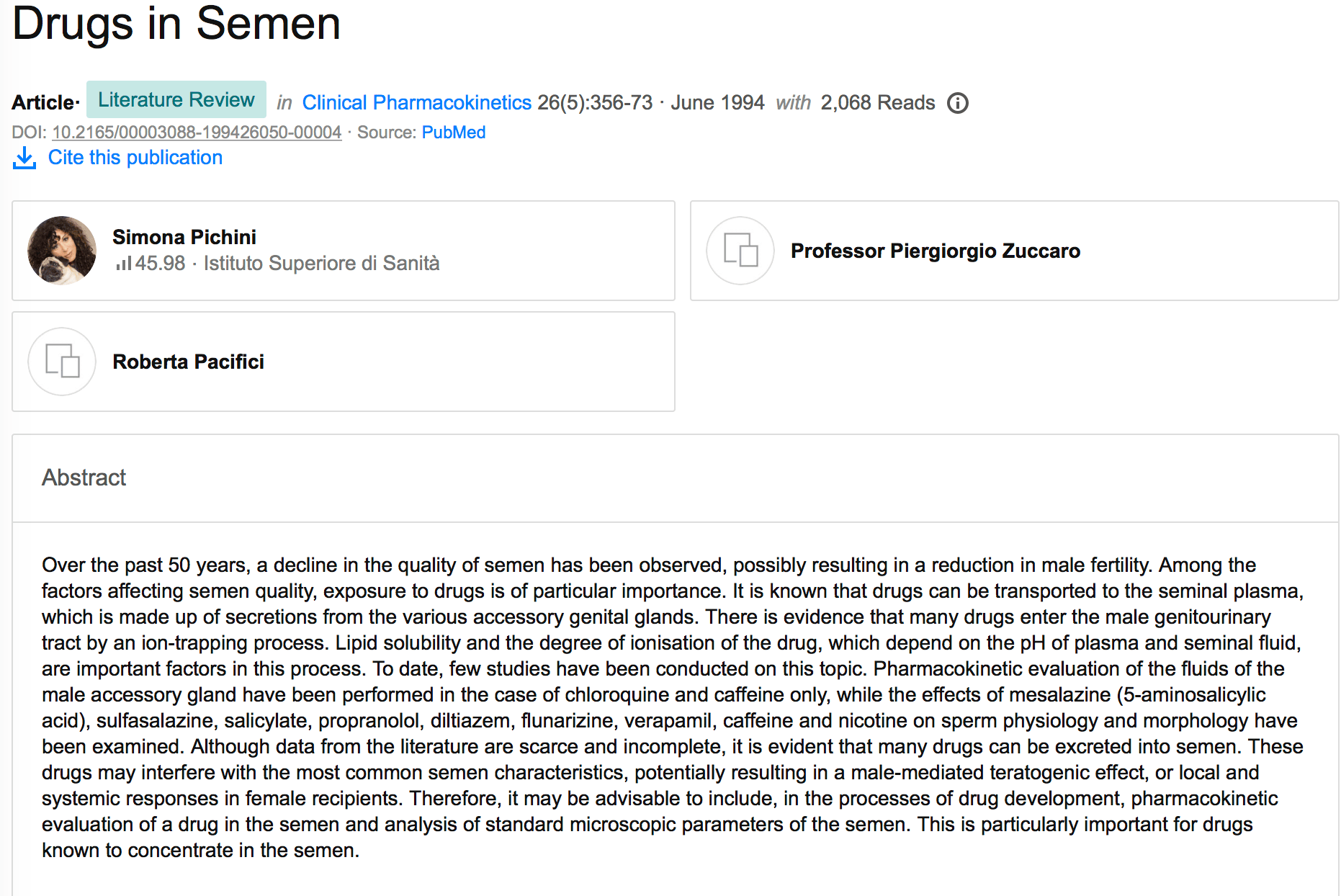
    I didn’t find much via a quick internet search. There seems to be very little research into the drugs that make it into semen (recreational and prescription) and even less research into potential adverse effects on a partner who swallows it or absorbs it (vaginally or anally). I didn’t come across any studies that specifically referenced the transport of Viagra or Rhino-type drugs into semen. Studies that did reference impacts of certain drugs were usually focused on reproductive outcomes and impacts on fetuses and embryos, or the potential impact of a drug on the quality and condition of sperm in the semen.

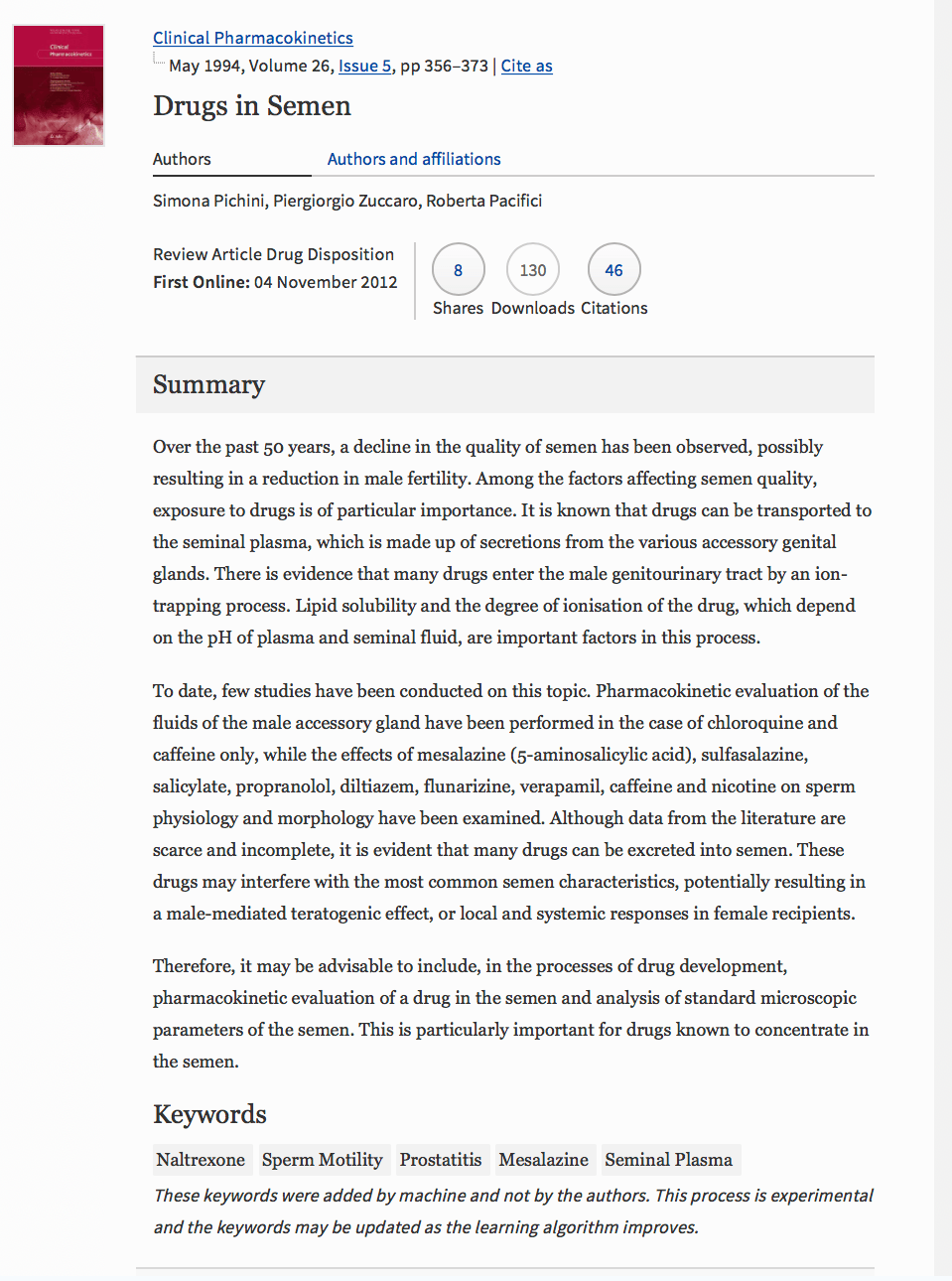
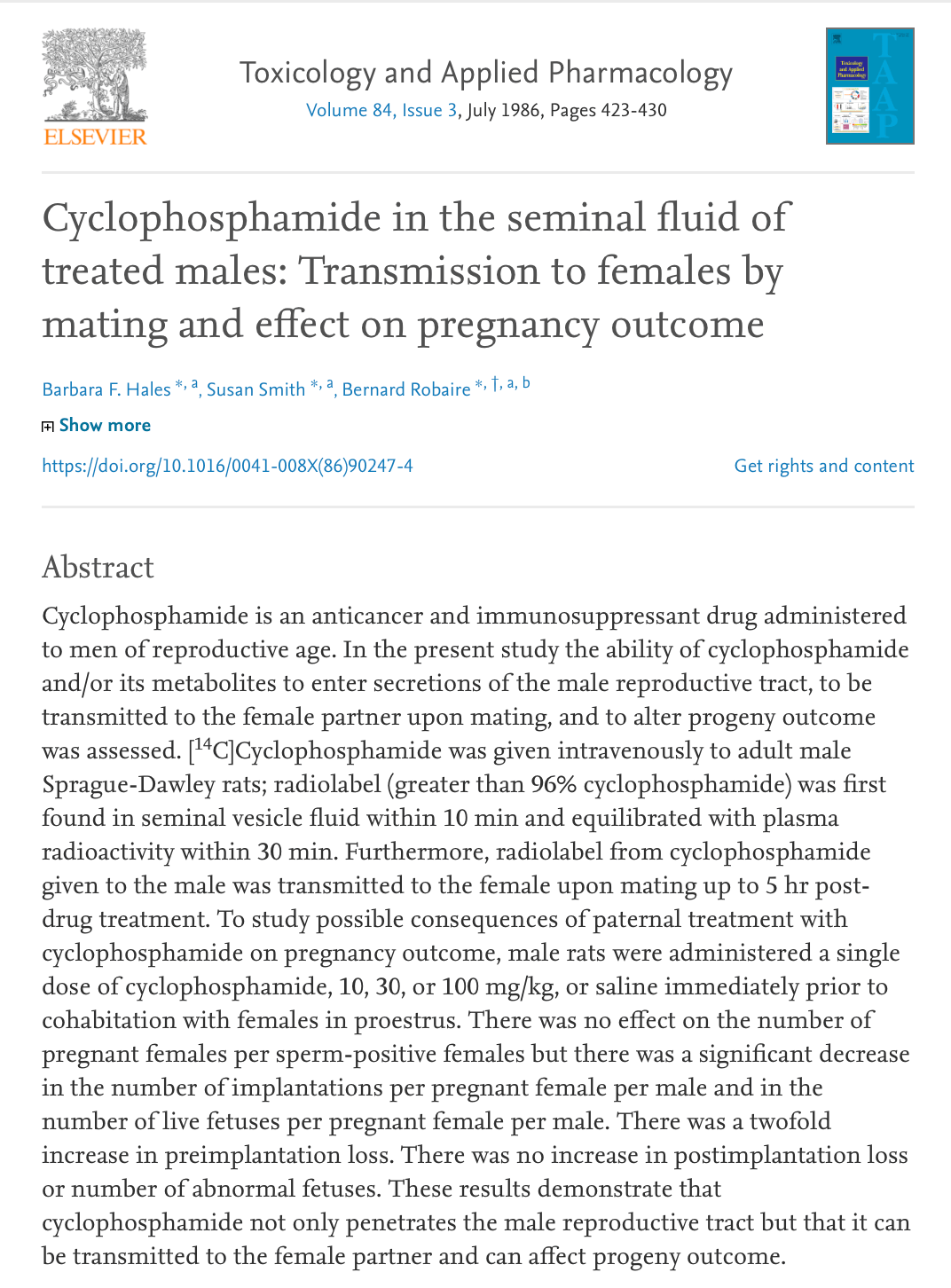
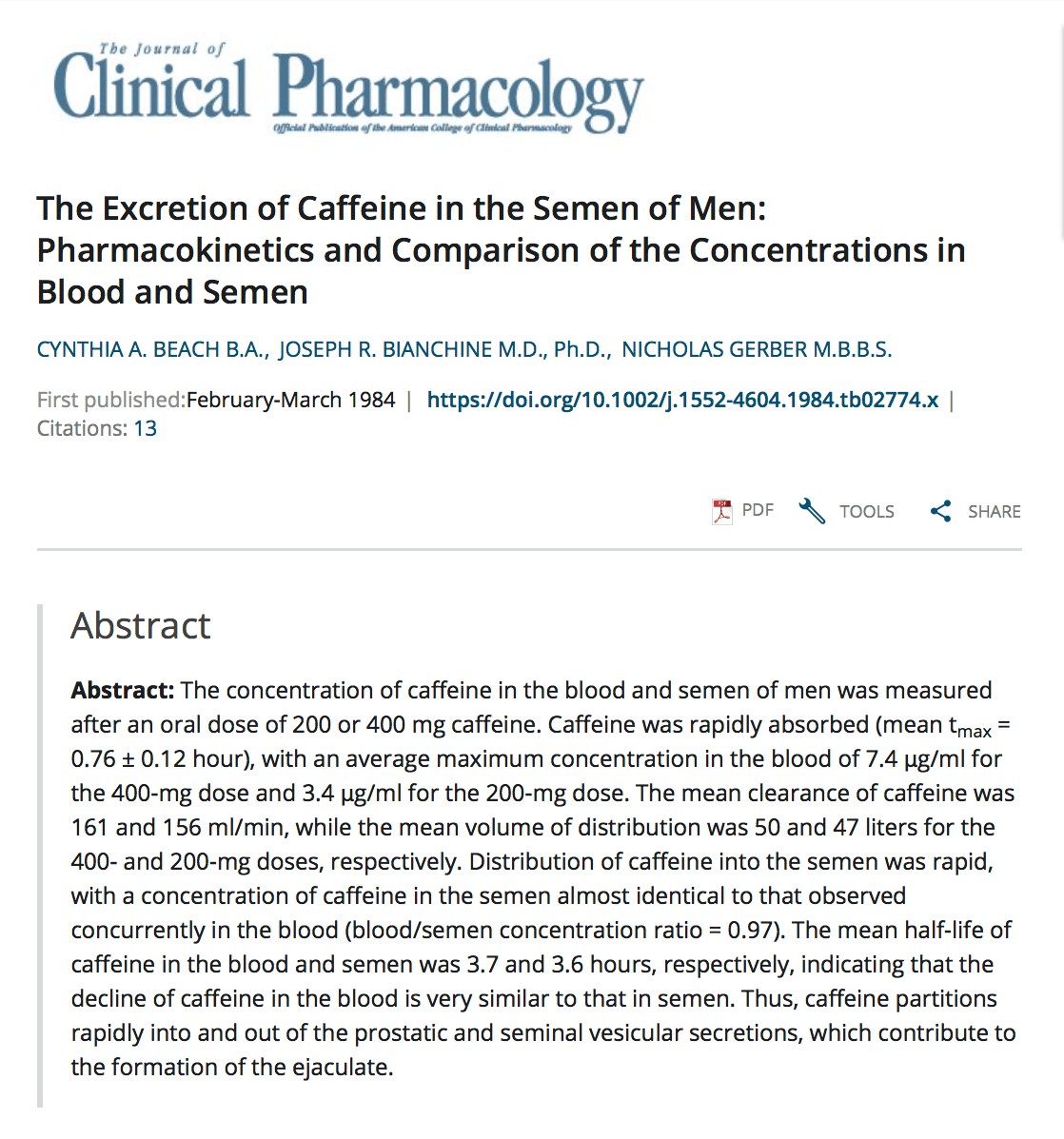
    Drugs studied included HIV/AIDS anti-retrovirals, caffeine, and a few others. Here are screen shots of abstracts.


    Here is the most recent study I found (in a quick search):
    Pichini Drugs in semen 2005


    From 1994:

    Screen Shot 2020-02-09 at 9.52.55 AM


    From 1986:

    Hales et al. Cyclophosphamide seminal 1986.


    And from 1984:

    Screen Shot 2020-02-09 at 10.08.32 AM


    Internet queries about drug exposures via semen ingestion were generally dismissed as being of little concern. Anecdotally, a variety of opinions were expressed by laypeople. Some cited testing positive for substances they’d never used, but a partner had. And some reported a difference in semen taste after that partner’s recreational or prescription drug use. (Many people say that tobacco users have notoriously foul-tasting semen). Medical professionals who sometimes answered such questions online didn’t have data, but even so they assumed this was a non-issue, a matter of little concern to the women (mostly) who were asking. These answers were based mostly on the assumption that the amount of any drug may be quite small by the time it shows up in semen.

    However, this report of an almost fatal reaction after oral sex, demonstrates that some sexual partners may be hyper-sensitive or allergic to substances in semen (LiveScience, 2019). [Note: no mention of this incident in Snopes.]
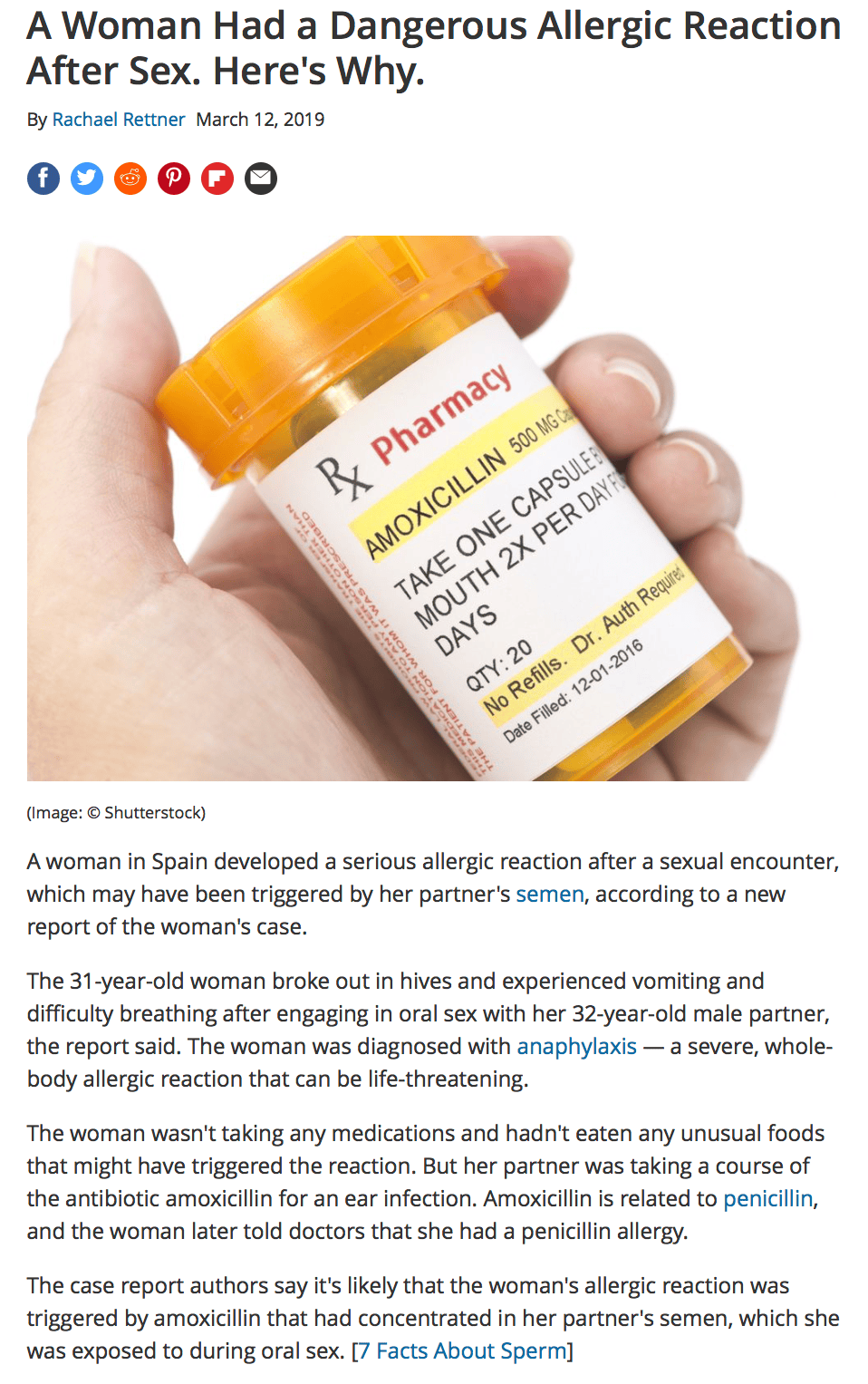
    Allergic reaction to semen 2019


    The acquaintance who showed up on my doorstop may be right about the source of her symptoms. It’s in the realm of possibility, but I am not sure about probability. However, I also advised her to get tested for a range of STIs, as the behaviors and conditions she reported seemed high-risk, and her partner did not seem to disclose his behaviors or statuses honestly. He has multiple partners. She didn’t use a condom during oral sex. She may not have wanted to do this, or she may have been discouraged from doing so.

    I wish I could have offered more help to this person, even though she is not a client, and I tried to not treat her as one. But her questions about this matter caused me to think through some of my own assumptions about safety and particularly about drugs that might contaminate semen and might affect a sex partner.

    People with penises who are dissatisfied with the reliability or quality of their erections should resist the lure of over-the-counter “fixes” and consult a medical professional to (1) rule out other conditions (like diabetes); (2) to get testosterone tests and other evaulations, and (3) obtain prescriptions, if warranted. After that they can see a sexuality counselor or therapist to get education, learn sexual strategies, and find help for any non-medical aspects of sexual dysfunction (such as worry). If they take an over the counter pill, they should see a doctor and report adverse effects to the FDA.

    If any reader here has further study citations to offer, I’d appreciate hearing about them.

    ####
  • Let’s Talk About Intersex

    Let’s Talk About Intersex

    Or rather, let’s watch three great videos of intersex people talking about intersex! (Twitter links for each name given below).

    A talk by Susannah Tempko:

    A talk by Mx. Anunnaki Ray Marquez:

    A talk by Cecilia McDonald:

    For more information, please go to:

    United Nations Intersex Fact Sheet.

    Dr. Tiger DeVore’s website.

    Susannah Tempko’s website.

    Mx. Anunnaki Ray Marquez’s website.

    Article by Cecelia McDonald: “I was born intersex–here’s what I want you to know.” She Knows. Oct. 26, 2018.

    Intersex Affirming Hospital Policies.

    Thank you!

    ####


  • Herpes Resources

    Herpes Resources

    A recent discussion on a sexuality listserve yielded a number of useful resources and perspectives on the topic of herpes simplex virus (HSV) infections that I want to share with you. Herpes is widespread, has a lot of social stigma (which was heightened by media in the 70s and 80s), and is complicated in that some people who have either or both types may be asymptomatic or they have lesions in undetectable places, such as the cervix or inside the penis. There are also differences in how types HSV-1  and HSV-2 behave, how often the virus is shed from the skin, and so on. (Other viruses in the herpes family cause chickenpox, shingles, mononucleosis, and CMV infections.) But this complexity causes confusion in the general public as well as in health professionals. How do you know what information is reputable and useful, and what is not?

    Herpes_Virus
    Herpes Virus. 10 November 2015, Bruce Blaus. Free use permitted.

    Here is an excellent source of information: The American Sexual Health Association. Good information on everything. Here’s their herpes page, with a lot of links. (Be sure to watch the video with Dr. H. Hunter Handsfield.)

    For historical and social perspective on a “public sex panic,” read “How Herpes Became a Sexual Boogeyman” (L.V. Anderson, The Slate, Dec. 2, 2019).

    Here’s a video of a talk on herpes given by Evelin Dacker, M.D., at the STI Symposium for Sex Positive Portland, 2017. I really like the information that she conveys and how she conveys it. Unfortunately, it sounds like the videographer–or someone nearby–is chewing potato chips or cleaning out a backpack throughout the entire presentation. It is also impossible to see the slides. Even so, it’s worth listening to this video.


    These are notes from the above video regarding the differences between the two types of the virus. These notes are also combined with notes from the Understanding Genital Herpes video with Dr. H. Hunter Handsfield, found at the American Sexual Health Association herpes webpage.

    HSV-1, “oral herpes:” lives in the trigeminal nerves, usually “lives above the neck” and can be dormant. 60% between ages of 14-49 have herpes 1. Can also transmit to genitals from mouth. Shedding 1-2x a month from the mouth, shedding, asymptomatic. If you have genital herpes (HSV-2), you can still get HSV-1 on the mouth, but it is rare to get HSV-2 on mouth or lips. If you have genital herpes you may only break out once every other year. If it is mild, probably HSV-1. “Not so bad.” About half of genital herpes in U.S. are HSV-1.

    HSV-2, “genital herpes:” almost 90% of people who have it don’t know, can’t feel it. No lesions detectable. HSV-2 Lives in nerves of lower spine, outbreaks can happen anywhere along the nerve pathways in the “boxer short region.” These breakouts can change location. Sheds once every five days. Most transmission happens in first year of a relationship. Shedding from genitals with HSV-2 happens 20-40% of the time, averaging every couple of months, can be asymptomatic. Fewer recurrences and outbreaks of lesions. Shedding will occur for the rest of your life. Sexual transmission far more likely.

    Transmission: Skin to skin, mouth to skin. Can’t cover a lesion up and hope to not transmit it. With regard to penis/vagina sex, men transmit it to women more (10% risk a year). Harder for women to transmit it to men (4% risk a year). No data with same-sex couples.

    Symptoms:

    1) Primary infection: Someone who has not had herpes before. Generally sick like the flu, in pain, sores in a large area. Also swollen lympth nodes.

    2) Non-primary infection: for someone who already has had HSV-1 and then gets HSV-2. Can be mild. Cervix or vaginal lesions may be undetected. Men may have lesions inside the urethra, which are not noticed or are mistaken for a urinary tract infection (UTI).

    Testing: It’s important to know the virus type!

    (1) Antibody test for Herpes type 1 and 2. Ask for your index score, get printout, info If index score is less than .9, it is negative.  Between .9 and 1.1-results are uncertain. There is some evidence that between 1.1 and 3.5 (which is considered positive) there’s a higher likelihood that it’s a false positive (3 out of 100 tests) in this category. If over 3.5, it’s positively positive. If in 1.1-3.5 you can retest in a couple of months. Or get a different test, such as direct tests for the virus, which can be a culture from a lesion or DNA tests.

    (2) “Western blot sent to the University of Washington” is the “gold standard” (but not covered by insurance).

    3) Culture tests which collects specimen from a lesion and grows in laboratory. Cultures can miss an infection or give false negatives.

    (4) DNA tests called Nucleic Acid Amplification Testing (NAAT), such as the PCR. Both culture and DNA tests can identify whether HSV-1 or 2. Very accurate.

    Protection: Antivirals to lower risk of transmission and shedding by about 50%; use condoms; tell your partners so they can protect themselves.


    This article, “How I Found Out I Didn’t Have the Herpes I’d Been Living With for Four Years” (The Hairpin, 2013), has an interesting perspective and a lot of good information. It’s written by “An HSV-Negative Lady” who’d been told she had herpes via visual inspection, and lived with that for four years before finding out otherwise.

    The same author, writing as “An HSV Positive Lady,” wrote an earlier article in 2012 about “The Perks of Herpes” (The Hairpin). I rather like her perspective on dating and herpes. When she discloses to prospective partners, the way in which the prospective partner reactions make the topic of herpes “my own magic Hogwarts-esque sorting hat. If a guy freaks out, he’s not meant to be in my house.”


    Other articles and website resources:

    Prevalence of Herpes Simplex Virus Type 1 and Type 2 in Persons Aged 14–49: United States, 2015–2016, NCHS Data Brief No. 304, February 2018. U.S. Centers for Disease Control. [I cannot find a similar study for adults over the age of 49.]

    “‘Herpes Made Me A Better Person’: A Spotlight on Rae Higgins” (Emily Lowinger, WaxOh!, May 20, 2019).

    The Pink Tent herpes page for women.

    Moss, Paul. The hidden world of the human herpes viruses. TEDxUniversity of Birmingham. https://www.youtube.com/watch?v=s-YDL_SVXNA


    More links will be added as I find them.

    ####


  • Sensuality–The Missing Ingredient

    Sensuality–The Missing Ingredient

    These days, in television and movies, “hot sex” (usually the cis-het variety) is always a face chewing kiss, absolutely no foreplay, a bang against the wall (or on a table), one hot thrust into an immediately lubricated orifice, a few more moans and thrusts, and then it’s over–both partners presumably satisfied and spent. The scripts always call for the female actors to orgasm in the time it takes to open a can of catfood. And no make-up was harmed in the filming of this sex scene. 

    Of course I realize that filmic treatment of sex–whether in mainstream entertainment or commercial porn–has very little resemblence to most incidents of real-life human sexual behavior, but I’ve long suspected that many other people don’t understand this and that they model their behavior and their ideals on this impossible scenario. They are also deprived of the message that taking time to inhabit their own sensuality and that of their partner offers greater opportunities for enjoyment.

    Common sense about cis-female and cis-male physiology and sexual responses aside (most cis-women do NOT orgasm at warp speed unless it’s with a vibrator on or near their clit, and no, lifting a partner up against a wall is not the most comfortable way to have vaginal penetrative sex…)–I find myself saddened about the lack of attention to sensuality as a key ingredient of embodiment and satisfying sex (of all kinds, not just PV penetration).

    It’s not that lust isn’t a great element of human sex, it’s just that it’s not the only element as the media would have us believe. And we have to understand that the greatest kindlings of lust arise from a history of desire and longing based on glances, flirtations, brief touch, fantasy, words, visual cues, and so on. It might be a brief history for some, but if you’re in touch with your sensuality, the match of lust struck to the kindling of sensuality sparks the brightest flame.

    Without sensuality, lust becomes boring–“Wham, bam. Here’s the false eyelash you dropped. Where’s a tissue? Thank you ma’am.” Meh.

    Many people are alive only from the neck up, with an occasional hyper-focus on their genitals. They’re missing the dream-like “erotic trance” of caress, kiss, suck, sigh, glide, smooth, rest, press, hold, grip, move, fuck, kiss, caress, climax, suck, sigh, hold, melt” with time out for a sip of water or wine (“never tasted so good!”) and a bite of fruit (“tell me again about the ripe peaches you picked…”). All the suspense that preceeded the first touch or kiss, all the desire-heightening gestures that are given the dreary name of “foreplay,” and the melting sensation of the afterglow (aptly named)–these are essential elements that so many miss and that most media never shows.

    Fractal_Sunny_flower3_5600x4200

    Sensual starvation is no fun. It’s half a life, unlived. But a sensual diet is easy to adopt. Revel in music, the movement of your own body as it walks or dances, and the utter dropping away of tension when you relax. Feel your own skin, enjoy how your thigh feels against your hand. Enjoy how your lover’s thigh feels against your groin. Inhale, smell, breathe. Let rain drop on your eyelids. Let sun warm your limbs. Pull the orgasm into the rest of your body. Imagine your eyelashes cumming.

    You can do it. And hey–looks like I’ve just written the start of another erotic hypnosis script. That’s one great addition to a sensual diet, but that’s also another blog post.

    Enjoy to the utmost what there is to enjoy in your day. Cultivate your pleasures, both large and small.

    ####


  • APOPS-What’s Wrong With This Picture?

    APOPS-What’s Wrong With This Picture?

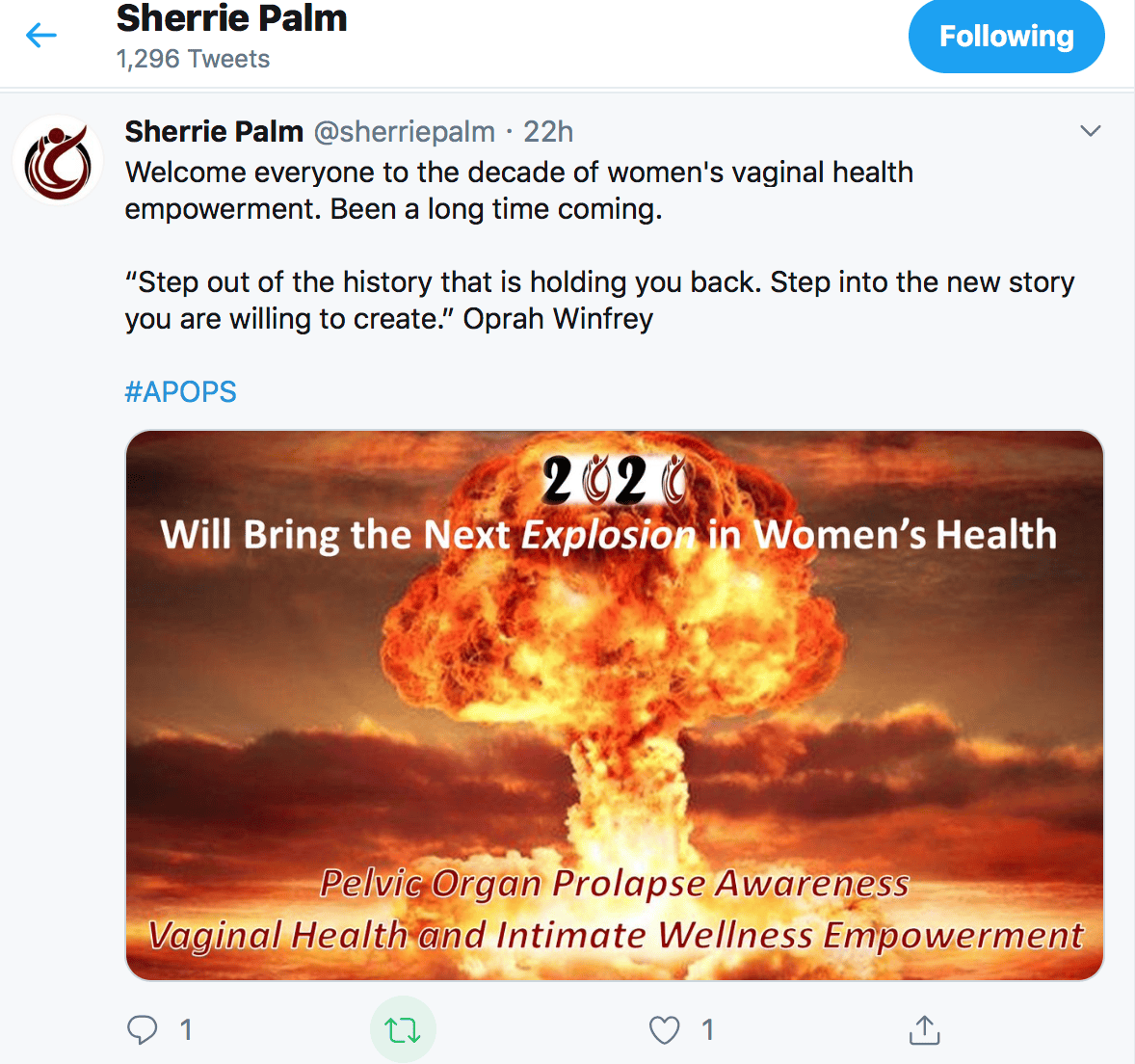
    In the U.S., we trivialized and commodified the catastrophic nuclear tests in the Marshall Islands by naming a swimsuit after the tests at Bikini Atoll. (A real “bikini body” is sickened by radiation and if female, has a greater chance of giving birth to children with birth defects…) So why should I be surprised or outraged by this use of this picture below? It’s a recent tweet from the founder of the Association for Pelvic Organ Prolapse Support (APOPS) and until this morning, I’ve been a fan.

    This is the picture I ask you to consider, below.


    Screen Shot 2020-01-03 at 6.13.21 AM


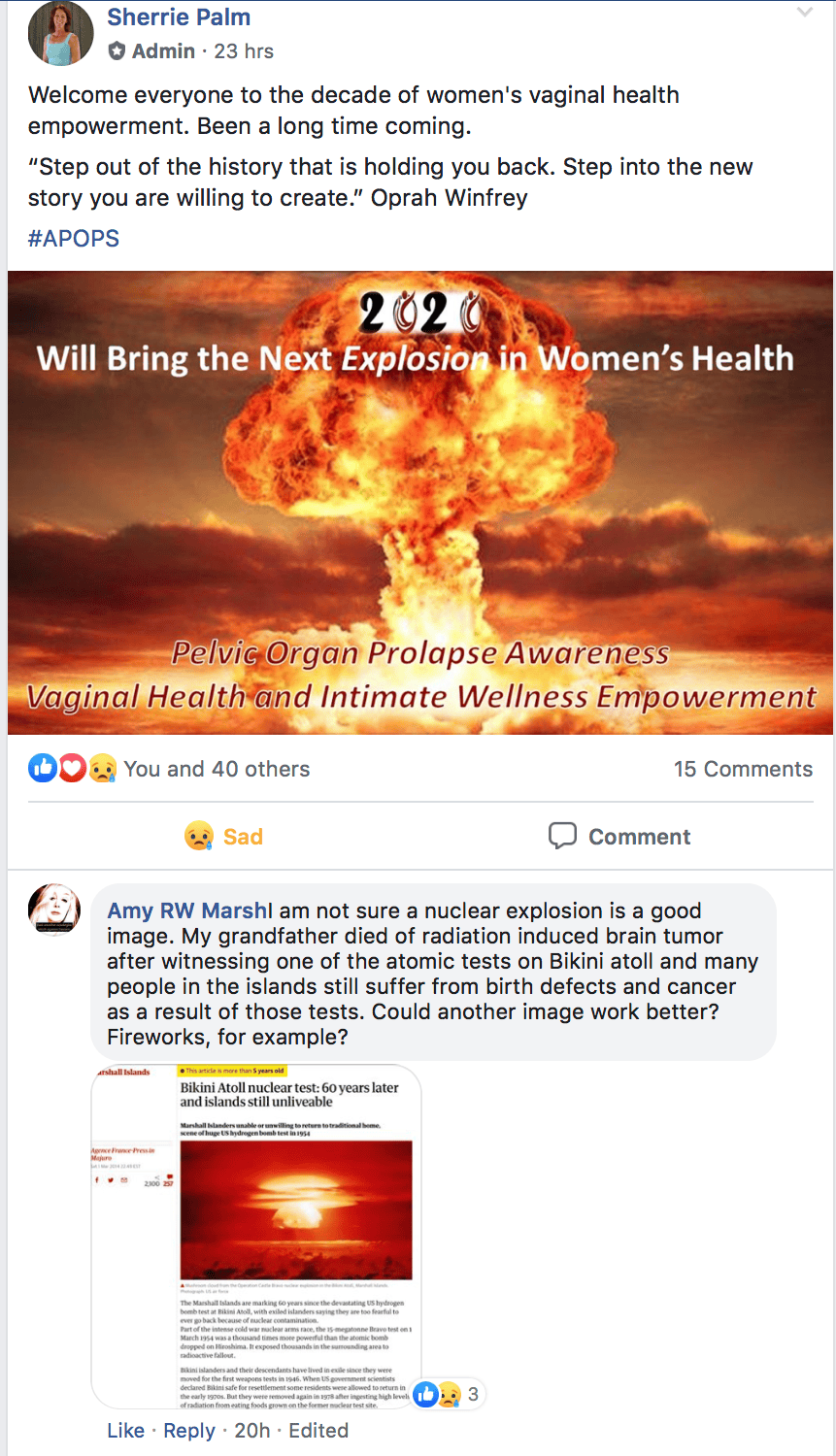
    Let me add two other screenshots here, before I get on with my story. The one on the left is from a story about the Marshall Islands, published by The Guardian five years ago. The one on the right is from the Atomic Veterans Cancer Benefits Center. My maternal grandfather was an “Atomic Vet” and the VA gave him no medical help at all when he developed a brain tumor. My family was impoverished as a result, paying for his care.

    As for the fate of the Marshallese, see these links: Project 4.1 and the documentary, Nuclear Savage. The immense damage to human beings, animals, and the islands continue. Trailer: https://youtu.be/13i09gV7HRk

    I’m also boggled by the juxtaposition of a quote from Oprah–a woman of color–on top of an image which has brought doom and destruction to other people of color, all in the name of “vaginal health.”

    Plus, do I want that thing (an exploded atomic bomb) anywhere near my “lady parts?” I think not.

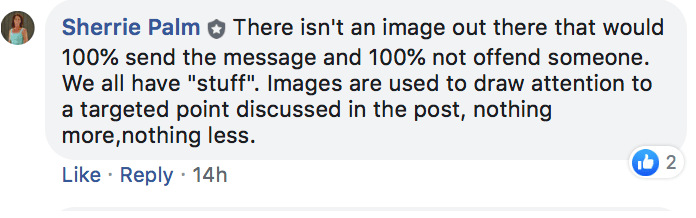
    Based on the above, I do not believe I was being overly sensitive about “stuff” when I alerted APOPS founder Sherrie Palm about the inappropriateness of this image. I know that Pelvic Organ Prolapse is an enormously ignored medical condition, internationally, and until now I’ve had nothing but respect for Sherrie Palm for all her tireless activism. And so…

    …I began by gently pointing out that this was not the best image to use in supporting “vaginal health and intimate wellness.”

    Screen Shot 2020-01-03 at 7.46.08 AM

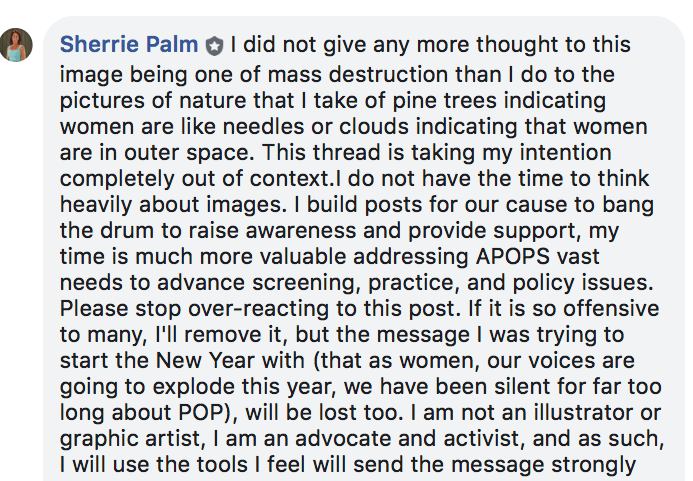
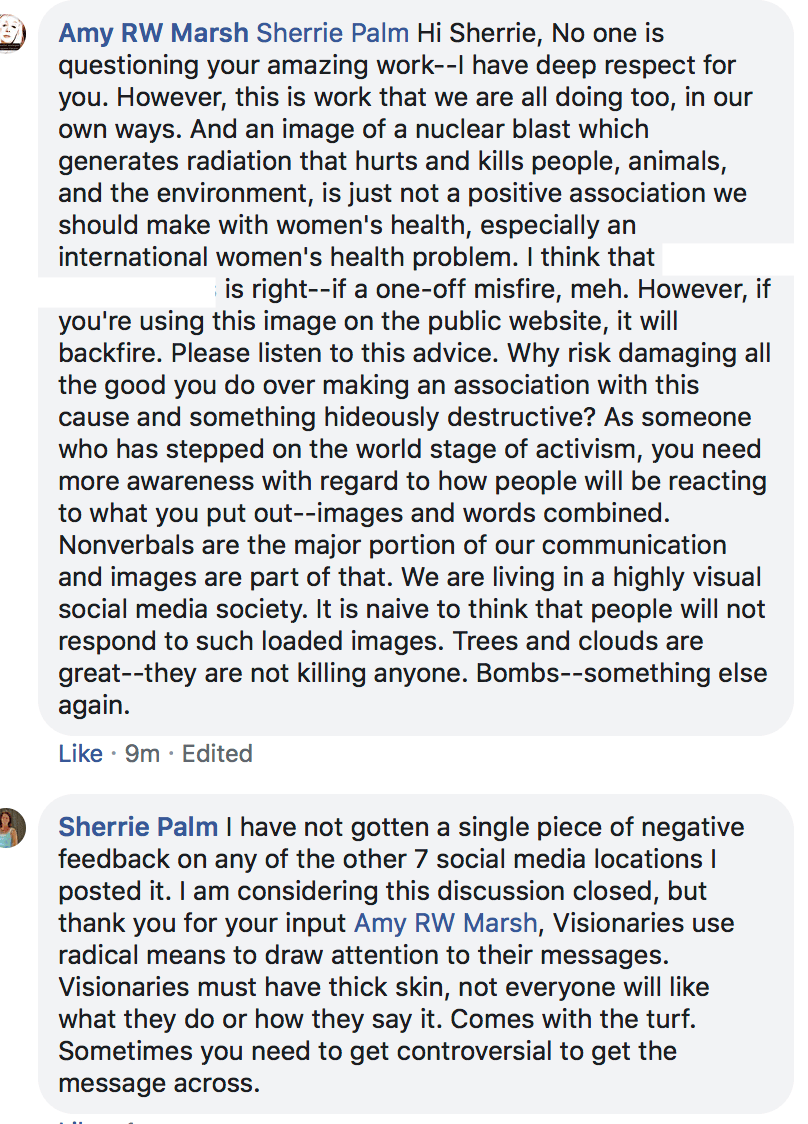
    (My first post did not include the image of the Guardian article. I added that later because someone–in an attempt to be funny–said that fireworks wouldn’t work as someone had recently died from one.) The founder responded like this (comments from others are deleted):

    Screen Shot 2020-01-03 at 7.46.33 AM

    Screen Shot 2020-01-03 at 7.46.33 AM copy 2

    Screen Shot 2020-01-03 at 6.10.34 AM

    I feel strongly about this. It’s important to have some modicum of multicultural sensitivity and awareness when advocating for a health cause that affects people internationally. Yeah, I’m not anybody’s media police, but I’ve put public endorsements of APOPS on my website and talked this organization up to my colleagues. However I can’t endorse someone in a leadership position who persists in such insensitive cluelessness–to the detriment of the cause itself and her ability to further it on a wider world stage.

    So until Sherrie Palm withdraws the image and apologizes for its use, I cannot in good conscience recommend this organization as one having the best interests of ALL women at heart. And that means women of the Marshall Islands too.

    I’ll be removing links to her website from my website as soon as I post this blog.

    ####


  • Black Trans Circles – Solving Violence

    Black Trans Circles – Solving Violence

    Signal boosting. This is a post-Transgender Day of Remembrance post in which I want to respond to the call to “elevate and support” the work of black trans women who are organizing effectively and creatively against violence in their communities. Who should know better than they do, what to do, and how? What they need from the rest of us is practical support!

    So I am sharing this vibrant video from Black Trans Circles, sent to me in a newsletter from the Transgender Law Center in San Francisco. And here is a link to an opinion piece in Essence titled Black Trans Women Are Solving the Epidemic of Violence, written by Raquel Willis (Nov. 20, 2019), founder of Black Trans Circles two years ago.


    The series of 2019 Transgender Day of Remembrance articles by Raquel Willis

    Out Magazine’s Trans Obituaries Project (Raquel Willis, Out Magazine, Nov. 20, 2019.)

    Layleen Cubilette-Polanco Died in the System, but Her Fight Lives On (Raquel Willis, Out Magazine, Nov. 20, 2019).

    How We Can End the Violence Against Trans Women of Color (Raquel Willis, Out Magazine, Nov. 20, 2019). “A 13-step

    Quote from the article above. I post this excerpt because I want you to read the entire article–it is so important. Read it for the 13-step plan to combat and end the violence:

    “…it’s not enough to honor the women we’ve lost with platitudes, social media posts, or thoughts and prayers. Instead, we need the rest of the LGBTQ+ community and our allies to make a deep commitment to keeping us alive—specifically by trusting our leadership and our solutions. Here, we’ve identified a 13-step plan to ending the epidemic, crafted, in part, from the expertise of leading figures who do this work daily.”


    The Open Letter to HRC from Trans Community Leaders

    Also mentioned in Willis’ Essence article, with a link: An Open Letter to HRC from Trans Community Leaders. The letter, dated Oct. 1, 2019 and published in Out Magazine, was signed by numerous trans leaders in a response to an announcement that the Human Rights Campaign (HRC) was now intending to “stand on the frontline to provide meaningful solutions for the transgender community.” Such cis-saviorism undermines and dismisses the grassroots community leadership that already exists among trans people, including trans people of color. In the past HRC has thrown trans people and trans issues under the bus, and have been otherwise not exactly inclusive of trans and other gender diverse people, and so their announcement is viewed with justifiable suspicion. As the Open Letter states:

    “Trans people, and primarily Black trans leaders and trans leaders of color, have been leading the work for trans liberation since long before HRC existed.”

    Here is another quote from the Open Letter to the Human Rights Campaign, dated :

    “We need more funding. We need more power. We need to be trusted to lead with our own solutions to the oppression that threatens our lives. We do not need a cisgender-led $40 million organization to copy our work and brand it as new.”

    I post these links and excerpts because I want you to read the whole thing. Don’t just stop with this blog post, please!

    Other Organizations and Initiatives

    Willis’ articles include references and links to other organizations and initiatives created by black trans people, particularly trans women. Here are the links from her articles:

    Anti-Violence Project

    CANS Can’t Stand Facebook group (fights the “Crimes Against Nature” Law RS 14:19).

    Compton’s Transgender District, San Francisco

    DeCrimNY – “A Coalition to Decriminalize, Decarcerate, and Destigmatize the Sex Trades in New York City and State.”

    Familia: Trans Queer Liberation Movement, Los Angeles.

    Gays and Lesbians Living in a Transgender Society (GLITS) – “The goal is to celebrate and encourage the expansion and public awareness of queer fluid expression. Notions of the nature and definition of gender, narrative, agency and expression and representation are examined.”

    Solutions Not Punishment Collaborative (SNaPCo), Atlanta – repurposing a jail as a wellness center, and more.

    TLC@SONG – Collaboration between the Transgender Law Center and Southerners on New Ground. Download a PDF of the 2019 GrapeVine Report on conditions for trans and gender diverse people in the south from this link.

    Monica Roberts’ TransGriot blog

    Also noted in a couple of Willis’ articles:

    American Medical Association policy announcement: AMA takes action to help prevent anti-transgender violence, June 10, 2019.

    As I find more links to the work done by black and other POC trans women, trans men, and other gender diverse people, I will also put them here.

    Finally a word about “signal boosting” via this blog. I assemble these references in blog posts so that I can pass a convenient collection of information and links to colleagues and the “general public.” With regard to this blog,  I will “signal boost” in these platforms:

    AASECT listserve (for members of AASECT)

    American Counseling Association’s Sexual Wellness Network (for members of the ACA) and possibly my ACA members blog.

    My Twitter account: @AmyMarshSexDr

    My own Facebook timeline and Facebook page for my counseling practice.

    Thank you.

    ####

  • Troubled History of IASHS

    Troubled History of IASHS

    2022: To those readers coming to this link from the April 13, 2022 articles, published in various Jewish online periodicals, I wish to note that the author, Andrew Lapin, did not get my permission to link to this small, personal piece of mine nor did he contact me to obtain more details about IASHS.  

    I am concerned that in Lapin’s desire to excoriate a high profile person accused of sexual harrassment, he has used inflammatory language like “sex guru” in his headline and attempted to link Bat Sheva Marcus’ alleged wrongdoings to the quality of education gained from a (now defunct) private graduate school. (The institutions that trained Marcus as a licensed clinical social worker were not mentioned in the article, however. Why is that?)

    IASHS–for all its faults and its spotty history–taught and trained hundreds of top-rated people in the area of human sexuality therapy and education. Other top people  in the field came to IASHS to lecture, and some stayed on to become staff. IASHS graduates have made, and continue to make, major contributions to the field of human sexuality, written books, headed professional organizations, developed training programs, and of course, put in countless hours working to help people overcome sexual shame, guilt, and ignorance. To my knowledge, most IASHS graduates have not been accused of sexual harrassment. 

    The courses taught at IASHS met many, if not most, of the educational requirements of the professional credential processes for sex therapists, counselors, and educators, by AASECT (The American Association of Sexuality Educators, Counselors and Therapists). So though IASHS was not approved by an academic accrediting agency in its final years, the coursework still had professional value and acceptance in the field.

    So, no matter what the facts are regarding the case of Bat Sheva Marcus and the people who accuse her of wrong-doing, it seems disingenous and lazy for the writer, Lapin, to link the spotty (and at times grand) history of IASHS to a single graduate’s behavior, as if it were the explanation for her actions.

    [Note the following was originally written in 2018. With some revisions in 2019, 2020.]

    It’s a strange feeling when an important part of your life has been shaped by an institution which is suddenly (or not so suddenly) no more. Many of us who have been involved in the Institute for Advanced Study of Human Sexuality (IASHS), lately of San Francisco, saw the long downhill slide and anticipated its demise. Still, it is a shock to have it gone. There have been times I’ve been inordinately proud of my time there, times I wanted to do my bit to “save” the crumbling pedagogical edifice, and other times when I wanted to burn my diplomas in front of the dreary tan exterior that made me call it “the sex school in the plain brown wrapper.”

    I think most of my regret and anger come from witnessing the terrible waste and degeneration of what was once a unique beacon to people who wanted to understand human sexuality, and to work with credibility in the field of human sexuality. I won’t go into personal details except to say that I tend to observe and analyze things closely. I also tend to volunteer my talents and skills if I sense they could be helpful.

    Now whatever work I put into that place is gone too. And the bound copies of my Ed.D. and DHS projects are — where? I would dearly love to have them. They cost me $80 each to have them bound and submitted to the IASHS library (as was required). I never did get a bound copy of my own Ed.D. project as my cash flow was tight at the time.  (This was not a research dissertation but an educational project consisting of a comprehensive literature review resulting in the design of a 150-hour course to teach hypnosis for sexual concerns.) All said, however, I am glad I was there while they still had an academic dean, Dr. Howard Ruppel. Once he was gone, there was very little credibility left.

    The Most Recent Troubled History of IASHS

    Prior 2017, the California Bureau of Private Post-Secondary Education (BPPE) approved IASHS to grant degrees (Ph.D., Ed.D, D.H.S.) and certificates in human sexuality. In 2015, BPPE issued a fine and Order of Abatement to IASHS. In 2016, the BPPE (1) issued a second fine and Order of Abatement to IASHS and (2) the BPPE declined to renew the approval of IASHS to grant degrees and certificates. By October 2018, IASHS appeared to have closed. The website no longer exists.

    It was clear that IASHS had reached its end times. There were several reasons for this, but most importantly, California’s SB 1247 had passed (Fall, 2014). IASHS was unable to meet the new mandated requirements to work with an accreditation agency. I spent a lot of time looking into various agencies but without substantial systems change, including transparency and revamping of the program, IASHS did not fit neatly into any category and no one would have us. It was clear to me that the “leadership” of the school was more interested in clinging to past glory than creating a strategic plan for the future.

    Oddly, after I left, with quite a lot of hard feelings on my side, I ended up going to bat in a public way for IASHS one last time. Mainly, I felt that there were many sound reasons to issue harsh critiques of IASHS in its final years, but I wasn’t going to sit still for one which was inaccurate and unfair. Now, I am not sure why I bothered.

    Disclosure: My Own History

    From the internet’s “Wayback Machine,” I have captured three pages which are pertinent to documenting my participation at IASHS, prior to 2015.

    • IASHS Academic and Professional Degrees – Explains the Ed.D. and DHS programs.

    • IASHS Certificate Programs – Shows my Sexological Hypnotism course.

    • IASHS Faculty and Administration – I am listed as Dean of Students and also on the faculty. I served about six months as Dean and resigned in 2015.

    ####


  • POP Culture – Pelvic Organ Prolapse

    POP Culture – Pelvic Organ Prolapse

    These last few days I’m not just dealing with “POP” (pelvic organ prolapse, a chronic condition), I seem to be in danger of succumbing to “POPO” – pelvic organ prolapse obsession! Just what I need, another consuming special interest…

    Did you know that Albert Kinsey’s 1953 book, Sexual Behavior in the Human Female, doesn’t mention prolapses, urinary incontinence, or painful intercourse, but it does contain a reference to the ancient Roman poet, Catullus (in a footnote to do with “petting” I think)? Or that the eleventh edition of Our Sexuality by Robert Crooks and Karla Baur (2011, a college textbook) doesn’t mention prolapses per se, though it does mention intercourse pain due to torn “ligaments that hold the uterus in the pelvic cavity.” On the bright side, Our Sexuality does include a helpful reference to the necrophiliac formerly known as Jeffrey Dahmer. Another textbook, Human Sexuality, authored by Masters, Johnson, and Kolodny (1995), doesn’t mention anything resembling a prolapse at all, but at least I can find entries for “shingles,” “Buddhism,” and “castration anxiety.” By its inclusion, should I presume castration anxiety is more prevalent than pelvic organ prolapses, which is estimated to affect at least 50% of all cis-gender women (and people of other genders besides)?

    Honestly, I don’t know whether to be more amazed at what’s left out of books on human sexuality or by what’s included.

    Perhaps I should respond by altering one of Catullus’ poems:

    I hate and love. If you were to ask how

    I got this way, I’d have no answer;

    but since my uterus dropped, I have suffered

    –I have felt this torment.

    None of the above is particularly helpful to people who suffer from POP. However, writing it made me feel better. Am I frustrated? Hell, yes. Do I have anything remotely helpful to express? Actually, I do. Go to that Pelvic Organ Prolapse page of mine and you’ll see a thing or two.

    In the meantime, here’s a bit more of what I’ve gleaned from my foray into “POP culture.”

    • Forget the “feet in the stirrups” thing–have your digital pelvic exam standing. Prolapses are more easily detected this way. (This info courtesy of this podcast interview with Sherrie Palm.)

    • One of the most successful surgeries to treat POP involves shortening and closing the vagina by sewing it up inside (not by sewing the labia together!). Yep. It’s called colpocleisis and has a 90-95% success rate and is a quicker surgery with a much shorter recovery period. But many doctors won’t offer or approve this surgery even for the women who want it. It’s a shame because for those who have a sexual repertoire beyond P/V intercourse, or who no longer wish to be sexually active with a partner, colpocleisis could be an option.

    • It is better to see a urogynecologist than a regular gynecologist for evaluation for this condition.

    I’ll leave you now with a painting of Catullus at Lesbia’s. He looks irked. Has he only just now heard of the FDA’s command to manufacturers to stop selling surgical mesh products indicated for the transvaginal repair of pelvic organ prolapse?

    Catullus_at_Lesbia's_by_Sir_Laurence_Alma_Tadema
    Catullus at Lesbia’s by Sir Laurence Alma-Tadema. Public domain.

    ####