It’s been a few years since I first dreamt about founding a sexological hypnosis training center – one which could provide truly exceptional training in the uses of hypnosis for sexual problems and enjoyment. I want to promote sexual health and well-being through well-trained practitioners!
I am happy to say that I’ve successfuly jumped one bureaucratic hurdle in making this dream a reality! I received official word (as of April 8, 2015) that the CA Bureau of Private Postsecondary Education has granted my application for exemption for the Intimate Hypnosis Training Center. What this means is that the type of professional training that I intend to offer does NOT fit into a category requiring oversight by this particular agency. This is because (1) no class costs over $2,500; (2) IHTC does not and will not accept state or federal money for student tuition; and (3) IHTC does not and will not create degree-granting programs. Nope – it’s all strictly professional training, and while it’s a shame I won’t be able to offer financial assistance to students, it’s best to keep this operation simple and small. My focus is on delivering top quality, online and onsite hypnosis and sexology education. I’d like to avoid getting mired in unnecessary bureaucratic challenges.
So, as of April 10, 2015, consider the Intimate Hypnosis Training Center as officially “launched,” even though I have a few more business-type hoops to get through. Another piece of good news – I have updated my course syllabi and submitted them to the American College of Sexologists International, so that people who take my training can also qualify for membership in that organization, with all its benefits, the directory, etc.
Classes will start on June 1, 2015. Come study with me!
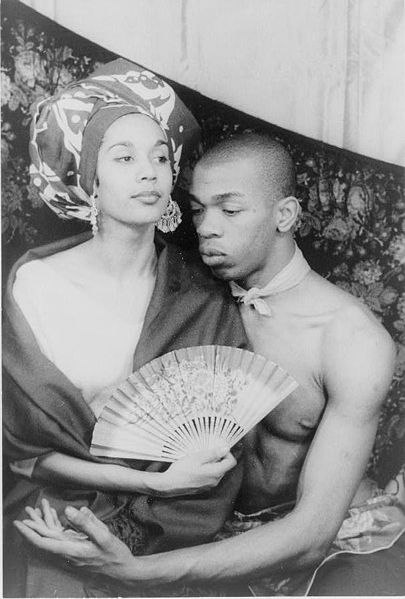
Geoffrey & Carmen Holder, March 3, 1955 by Carl Van Vechten (1880-1964). Public Domain.
As a sexologist who teaches, and who in course of teaching creates slideshow presentations and other materials, I’ve been frustrated by the overwhelming pervasiveness of white images and the lack of good quality, sex-positive images of black people and other people of color. Due to financial constraints, and because I have a finicky aesthetic, I search Wikimedia Commons for public domain and creative commons images in the categories of fine or erotic arts. In these categories (and even in the “human couples” category), beautiful and evocative images of loving black couples, such as the fine photograph by Carl Van Vechten (above), are difficult to find. You can find loving black couples on public health posters however, and I understand the reasons for this. However, I wish that these images weren’t “always” so entwined with the context of disease prevention, know what I mean? Or maybe you don’t. I’m having a hard time expressing the nuances here. The image below is positive, sweet, caring, very attractive – all the things it should be in a public health message for safer sex – but I guess I wish we saw these same types of images more often in other mass media contexts, including ads for all kinds of products. As an educator, I want more portrayals of positive, intimate black relationships, of all genders and persuasions, to choose from. As a citizen, ditto.
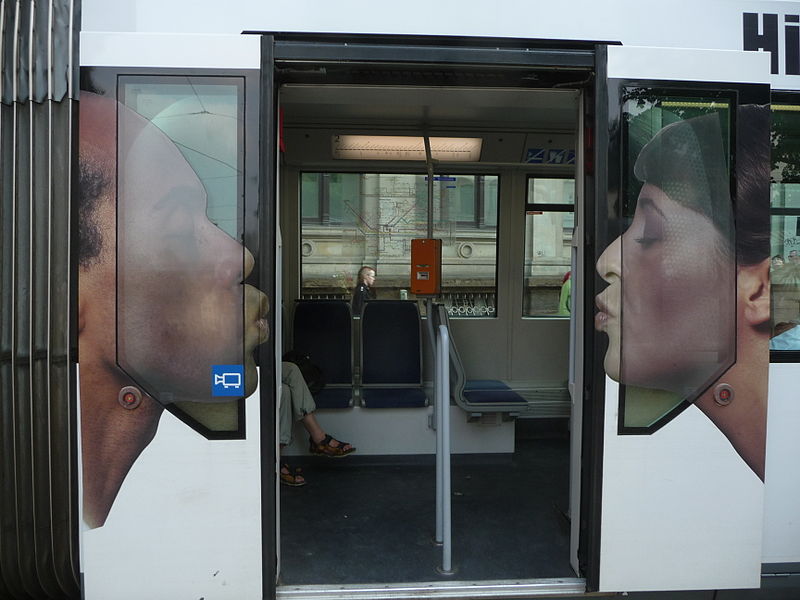
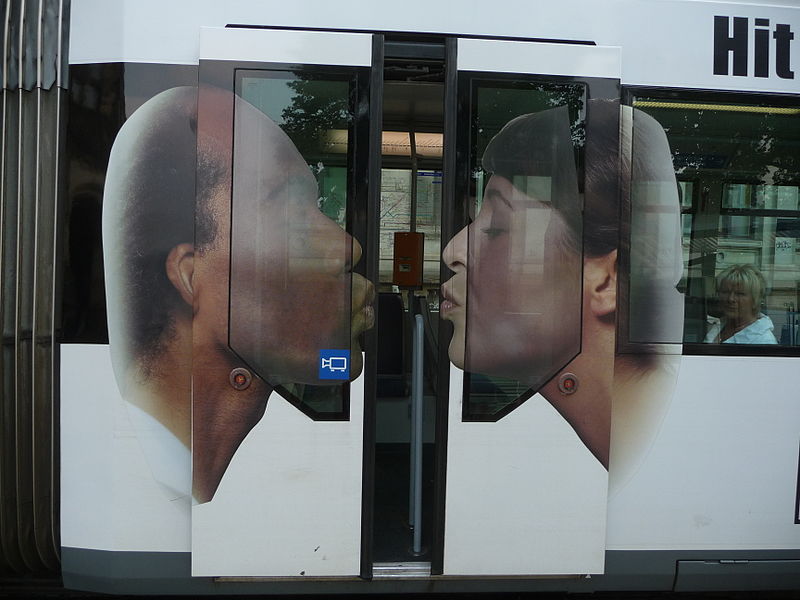
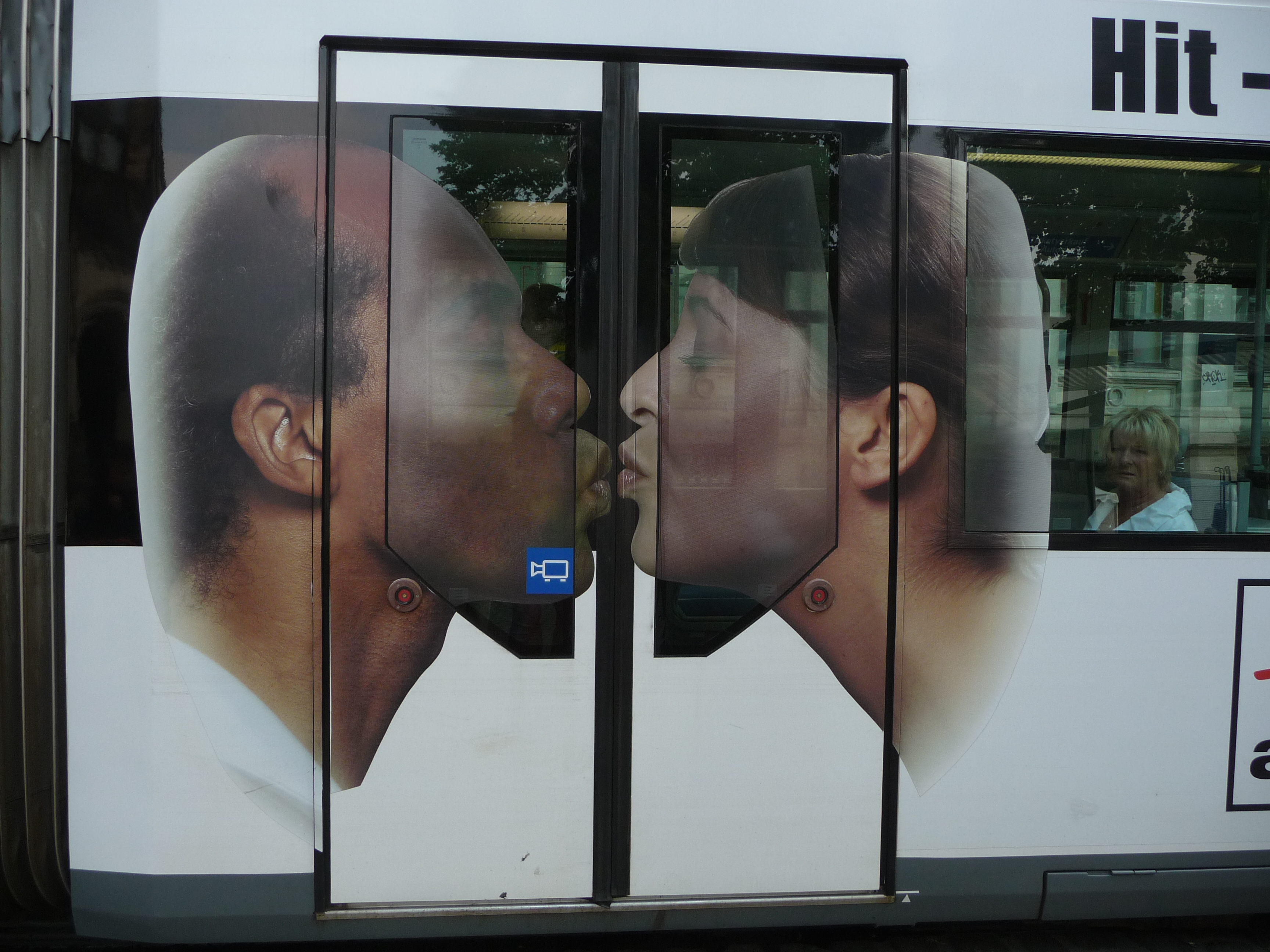
I am delighted to find this series of photographs, below. The kissing couple below adorns a tram door. I think the this art piece is wonderful.
#1 Kissing couple on the doors of a tram in Bremen, Germany. Photo by Immanuel Giel, May 2009. Public domain.#2 Kissing couple on the doors of a tram in Bremen, Germany. Photo by Immanuel Giel, May 2009. Public domain.#3 Kissing couple on the doors of a tram in Bremen, Germany. Photo by Immanuel Giel, May 2009. Public domain.
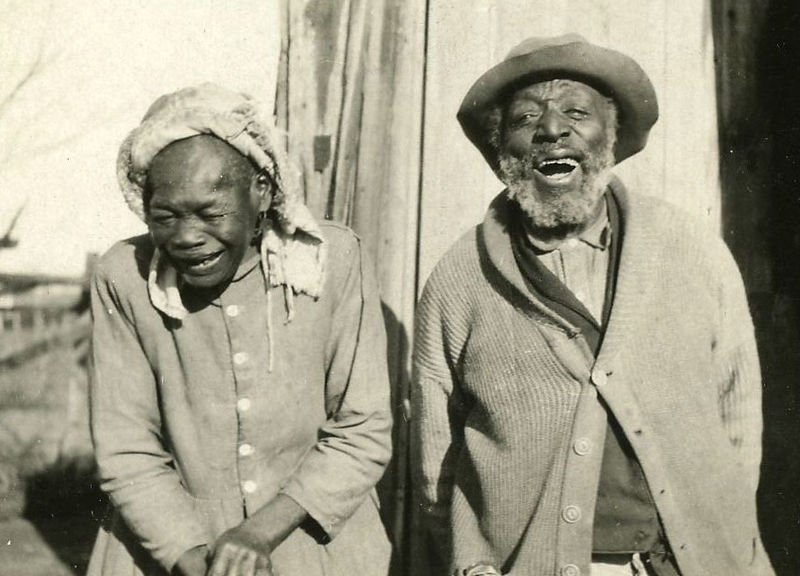
I also like this photograph of an elderly couple laughing. There’s joy here.
Oklahoma Sharecroppers, 1914. Found in a box of photographs and submitted to Wikimedia Commons by “Father of Don O’Brien.” Creative Commons.
And below is a quiet, peaceful interlude in the lives of two people (and their pet). But the photo was taken for an Environmental Protection Agency report and discusses the growing disparity between black and white income levels in Chicago.
Black couple and their dog in their apartment in South Side of Chicago. Photograph by John H. White (1945- ). Taken June, 1973. Copyright. Photo archived by EPA, given to Wikimedia by the National Archives and Records Administration.
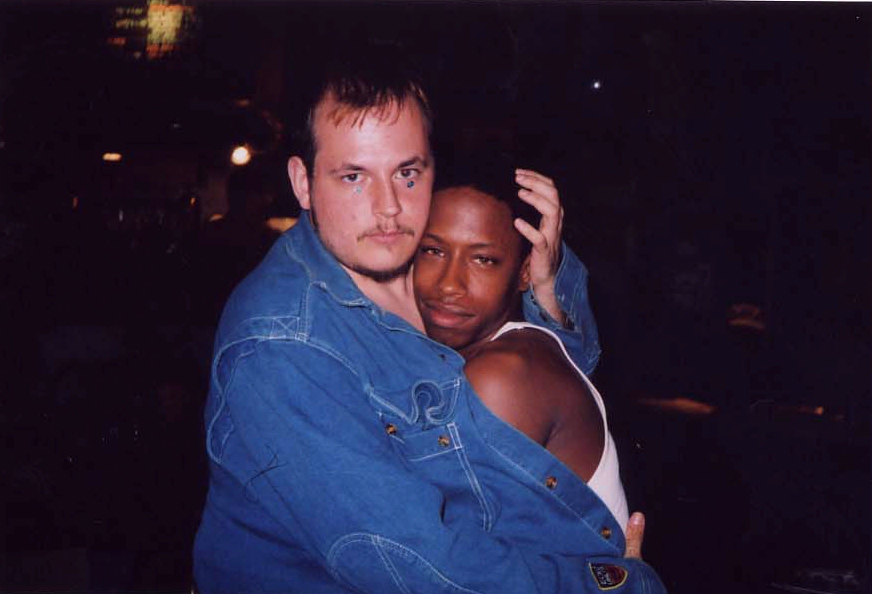
The photo below is also poignant, loving, cherishing.
Photo by Pacien, April 2005. Creative Commons.
Though portrayals of black lovers are rare (aside from shots of celebrity couples), it’s even harder to find a good anatomical drawing or image that is not white. Sure, a few people have posted genital photographs on Wikimedia Commons, but they are mostly unsuitable for sex education materials. I’m automatically suspicious, for example, of any shaved images on posted on Wikimedia, even though shaving is a common practice.
Of course, if I put on my erotologist hat, I can say all kinds of things about various images and forms of representation – but at the moment, I’m writing strictly about the difficulty of finding good, free, respectful sex, body, and relationship images that convey sexual, gender, cultural, ethnic, etc. diversity (without being fetishized or exoticized). I will also note that at IASHS, where I currently serve as Dean of Students, we have an enormous amount of erotic books, films, and artwork. But, due to a donation of a massive collection of gleaming sculpture, there’s currently a heavy emphasis on the female form in our common areas. And even so, we don’t seem to display much that isn’t white and hetero- (and cis-) centric. I’m on the lookout for a wider variety of images for my own office, as this lack of visual diversity troubles me.
Today I simply want to present the link to this excellent article/essay by the Women of Color Sexual Health Network which challenges human sexuality professionals to (1) recognize their complicity with myriad manifestations of structural, systemic, (and yes, even personal) racism and to (2) actually do something about this.
I’d like the above article to speak first, before I offer a response. Also, here is the link to the WOCSHN Statement of Solidarity.
Tomorrow (or maybe the day after), I will write about how I want to take action and address the challenges in the article.
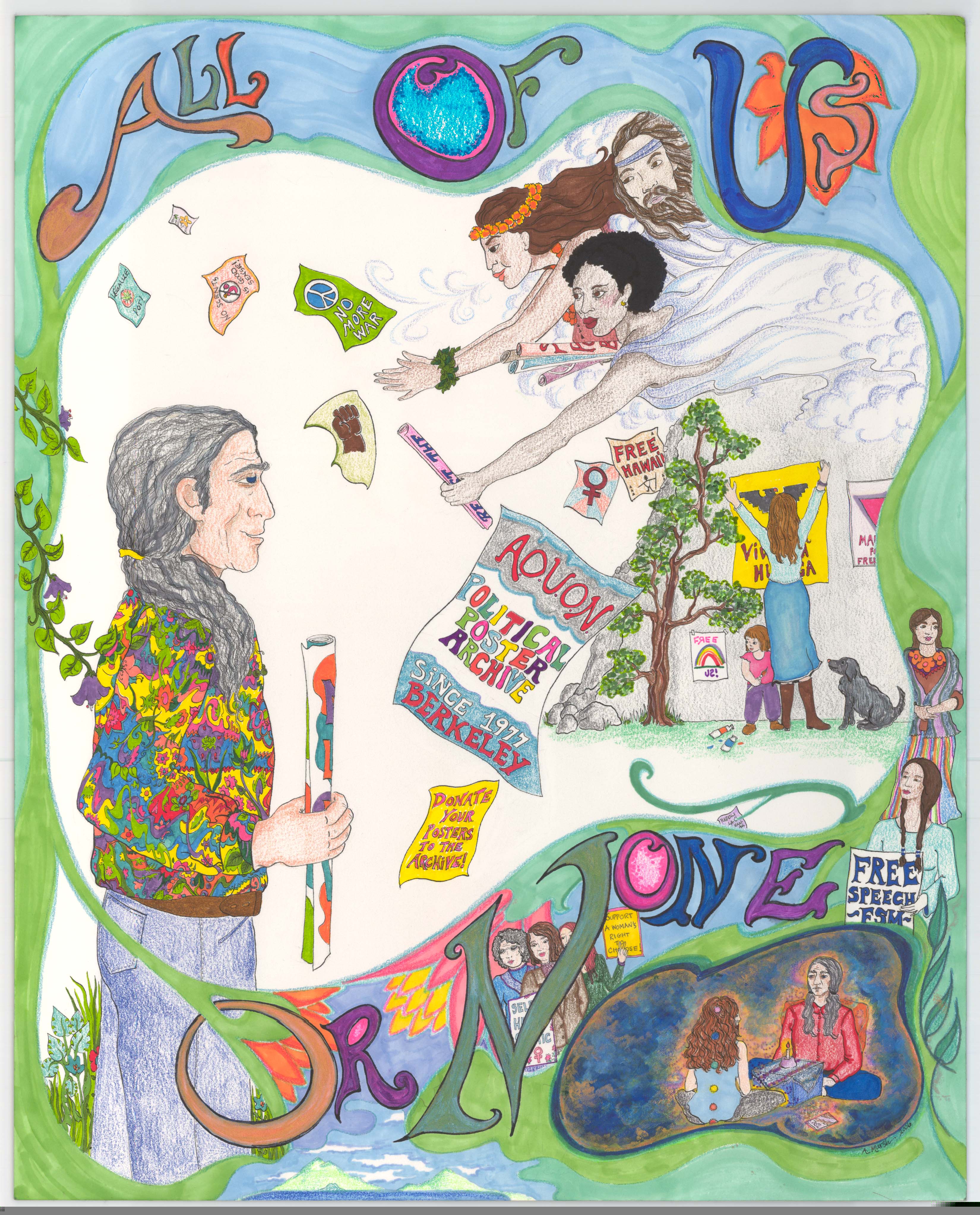
In observance of the 50th Anniversary of the Free Speech Movement in Berkeley, I am also celebrating the massive AOUON political poster collection created by the late Michael Rossman, FSM pioneer. I drew the above poster because I thought the collection deserved a poster of its own. I made two multiples of the original on a giant poster copy machine, and gave one to Michael Rossman for the collection. (I kept one copy and the original artwork.) The poster was returned to me after he died, and before the AOUON collection was donated to the Oakland Museum of California. (Sadly, a great deal of punk posters I’d collected and donated to AOUON were lost to me at that point. I have no idea if they were kept or discarded.)
Before Rossman’s death, I’d been photographing some of the erotic and sexual freedom examples in his collection of about 20,000 or so progressive political posters. I was attempting to learn from and organize them as a visual chronicle of the sexual revolution. Many rock posters were included in this category. Unfortunately, I was unable to complete that sexological investigation.
I had written a column about this in Carnal Nation, back in 2010. Unfortunately, Carnal Nation is no longer online and so I can’t share a link with you, just the graphic that headed the column.
Other scholars have done brilliant work with the posters, including Michael’s friend and colleague, Lincoln Cushing. The Oakland Museum of California displayed a small percentage of the posters a few years ago, next to the 1968 exhibit. It was great to see the posters, and know that Michael’s lifework and passion were well tended. The world would be a poorer place without enthusiastic collectors and preservationists with a passion for social justice, including erotic justice.
Jeremy Glass seems to be a pleasant fellow and he’s a journalist besides. A few months ago he contacted me about having an erotic hypnosis session so he could write about it for a well-known website for fashionable twenty-somethings. The well-known website didn’t publish it, but he just rewrote the article for another site and now you can find it here.
Now, I didn’t actually do what I’d call an erotic hypnosis session with him. I don’t know him that well (in fact, I didn’t know him at all), so I provided what I’d call a sexual confidence building session, the kind I’d actually do for clients. And I’m amused by his account of his experience in his article. He says he was “brain fried” but I think what actually happened was a gentle buzz. But “brain fried” certainly makes a nice headline, and it also reminds me of eggs, which is unfortunate, as I’ve been on a liquid diet the last few days and I’m so very hungry…
But I digress.
However, I would like to make a teensy correction to his article. Actually, sometimes people CAN “jizz on command” in hypnosis (as Glass says) but I don’t think it’s something you can usually get to happen right away with a stranger. Ditto with non-jizzing orgasms. I sure wasn’t going to try it with someone I didn’t know, over Skype, for a lark – not even with a journalist. Just not my thing, if you know what I mean.
Now eggs, I could get into those! Even with someone I didn’t know.
But I digress. (With butter. Yum…)
Other than that, I’m happy to have the publicity.
So then I guess I should mention that in October I’ll be doing two more Erotic Hypnosis workshops in Berkeley. Please join me. They are reasonably priced. And fun.
And in November I’ll be on the “Think Kink” program of the Society of Janus, talking about my survey of erotic hypnotists. The SOJ event will be held November 12 at the Center for Sex and Culture, 1349 Mission St, SF (btw 9 &10th St).
In August 2014, I announced my new position as Dean of Students for the Institute for Advanced Study of Human Sexuality in San Francisco. At that time I was very excited to have the opportunity to work at the place where I’d studied. I’m devoted to sexology, and was aware of IASHS as a unique resource. As a volunteer grad, I redesigned the IASHS website and created custom graphics and YouTube videos for the school. I even set up Twitter and other social media accounts so that the school could reach out to the internet generation.
At the time I was hired as Dean, I assumed that my innovative volunteer efforts and my “internet saavy” was one of the reasons I’d been approached about the job.
During the time I worked the Dean’s desk, I enjoyed engaging with enrolled and prospective students. I created communication procedures of complete transparency so that any member of the staff would be able to access (a) the email I used for student communication and (2) track follow-up communication in bi-monthly reports.
I was also given the task of sorting through potential accrediting agencies and procedures as IASHS is now mandated, under CA law SB-1247, to submit a plan for accreditation to the Bureau of Private Post-Secondary Education by July 1, 2015.
Unfortunately, I was not able to do the good work that I wanted to do for the school – including bringing a logical, strategic and pro-active approach to preparing for the upcoming accreditation process. Because I actually examined websites and manuals for several potential agencies – and they all mandated institutional self-reflection, assessment, and sometimes procedural or curricula changes as part of the long (and costly) process – I saw an immediate need to upgrade certain curricula materials. (Students have been complaining about outdated materials for years). I had hoped to convince IASHS that this could easily be done through “print on demand” technology. So I put in countless hours of my own time to update and redesign a draft of a core textbook (The SARguide), as an example of what could be done for almost no money at all (since I was prepared to continue donating my time on that particular book). I also began to construct “demo” courses using Moodle, so that IASHS core courses could be available online, as well as upgraded and updated. This was also mostly done on my own time.
Unfortunately, I was not allowed a chance to present the demo materials, or to explain how they could help advance the cause of accreditation, not to mention making the students happier and prospective students more likely to enroll. When I understood that these efforts were unwelcome, I knew it was time to move on.
In my job, as long as I saw the potential for contributing to a “new, improved” IASHS, I could feel good about talking to prospective students. As it is, I can no longer recommend or promote the school until it has made important improvements to materials and certain policies that affect the students. When that day comes, I will be happy to once again Tweet and FB the glad tidings.
I hope the next Dean – whoever it may be – has more success in contributing to the organization’s future. Like many other students and graduates, I’d like to see IASHS continue and shine.
The film screened yesterday in SF, and will be shown in Berkeley tonight. I was lucky to go yesterday with one of my hanai sisters, Therese Wonnacott aka Aunty Anita, who is herself a mahuwahine community and cultural activist. Among other things, she runs and promotes the California Panache pageant (a topic which deserves its own separate blog!). (And have to give a shout-out to Danielle Castro, my adopted niece!)
It was thrilling and emotionally moving to sit in the Castro Theater and hear the voice of San Francisco hula luminary, Kumu Patrick Makuakane, as he welcomed Kumu Hina with a chant, and to hear her voice ring out as she answered in kind. (After the film, some members of the audience stood up and offered I Ku Mau Mau, a chant often used to express solidarity.)
The film itself was glorious. Personally, I was in heaven as it combined two of my top passions – Hawaiian culture (and activism) and support for gender variant people. And, as the mother of two, including a recent college graduate who just happens to be a trans guy, the portrayal of Ho’onani, one of Kumu Hina’s young students, was very meaningful. The fact that this kid was able to take her “place in the middle” with the full support of her teacher (and perhaps the somewhat more cautious permission of her family) was outstanding. Honestly, this is so rare in the world! Ho’onani is not the only “in the middle” kid Kumu Hina has taught, but her story and presence was especially compelling.
Of course, opportunities for examination of all kinds of intersectionality abound in this film. And though this blog is not meant to be a film review as much as it is a tale of my experiencing of the film, I can’t avoid mentioning some of them. For one thing, though my heart was wide open, I was watching with non-Hawaiian eyes. And I had many lenses over these eyes: sexologist lens, parent of a trans person lens, former hula student lens, Hawaiian independence ally lens, partner of an elder Hawaiian independence activist and cultural practitioner lens, hapless citizen of the country occupying Hawai’i lens, younger partner of somewhat older person lens, feminist lens, settler-colonist of Turtle Island lens, and so on. Different parts of the film resonated with me on different levels and in different ways, while at other times I was aware of how profoundly different my life is from the experiences of the people in the film.
When Ho’onani opened up her voice and spirit and chanted, I was remembering how my oldest kid, as an eleven-year-old hula student, also used to chant with an intense spirit and voice. Watching the footage of rural Kaua’i, I hearken back to a certain off-grid plot of land in Waimea on Hawai’i island, where wild pigs, sheep, and dogs sometimes have roamed together. I also commiserated with the difficulties of long-distance relationships.
And when I came home late last night from the reception which followed the screening, I found a large pile of dishes in the sink – left for me to clean. So I recalled scenes from the film where Kumu Hina, an accomplished professional woman, copes at the end of the day with dinner and cleaning while her husband watches television. Her remarks about Polynesian men hit home too – and I responded to them as someone who has sometimes clashed with my (long-distance) Polynesian partner over issues which seem crystal clear to me as a white, feminist, urban Californian, but are far deeper and much more complex when taking so many other issues – and a whole other human being with a different genealogy and culture – into account.
Cultural clashes, intersections, and complexities are inevitable and not all binary, in spite of how I have written them here. In the Kumu Hina film there are many opportunities to explore elements which are either explicit or implicit (or both!) and which rub up against each other in various ways, causing sensations of pleasure, confusion, inspiration, or pain: in front of the camera/behind the camera; love/struggle; male/female; rural/urban; American/Hawaiian; gender conforming/gender variant; colonizer/colonized; compliant/resistant; commodified/authentic; educated/less educated; younger/older; professional/working class; this island/that island; student/teacher; parent/child; conservative/progressive; and so on.
And yet the main message of this film – kept real by Hinaleimoana Wong-Kalu’s honesty, integrity, and groundedness – was not just the explicit message of aloha (the deeper kind, not the touristy interpretation), but also an implicit one of teachability. The film seemed to trust that most of us who watched it (as well as those who were involved in the making and living of it) could and would experience many layers of learning through the film – learning which would lead us with more hopeful certainty to the possibility of understanding and experiencing aloha.
I am happy that Bay Area folks in LGBTQI etc, ally, Hawaiian, Pacific Islander, and Hawaiian music communities (often overlapping) combined to give Kumu Hina a welcome and a reception that was warm, loving, appreciative, and hospitable. She has many friends and sisters here, and they came out in force for her, cooked for her, played and sang for her, fetched more teriyaki sauce, and admired her copper colored sandals…
The rest of us who only knew of her, rather than knowing her personally, joined the standing ovations she and the film deserved. And I’m hoping some of us at least will also give to the film’s Kickstarter campaign (they’re trying to raise $10,000 and are about $7,000 short) and to Hinaleimoana Wong-Kalu’s OHA election campaign fund. OHA stands for “Office of Hawaiian Affairs” and she is running for election as a trustee.
I am also hoping that Halau Lokahi, the Hawaiian charter school where Kumu Hina teaches, will survive its current troubles. You can sign a petition supporting the school here and donate at the above link. These schools are super important for Kanaka Maoli (Native Hawaiian) kids, and deserve our support.
If you haven’t done so already, you can download the PDF by clicking the National Teacher Preparation Standards link above.
Because cultural appropriation and intersectionality are so important, I am delighted to see that the new standards include respect for “diversity and equity” as described below. I am not surprised by this. Helping professionals and their organizations know that these are key elements in any successful and useful interaction with clients, patients, consumers, and students. The excerpt below is taken from the PDF:
<<Standard 2: Diversity and Equity
Teacher candidates show respect for individual, family and cultural characteristics and experiences that may influence student learning about sexuality.
There is tremendous diversity represented in US classrooms. Often, “diversity” refers to race, culture and ethnicity. Within sexuality education, however, there are other forms of diversity to consider as well, such as family structure (e.g., single parents, step parents, teen parents); religious affiliation; social, emotional and physical developmental level; sexual orientation; gender identity and expression; sexual history; and relationship abuse. These visible and invisible diversities are present in every classroom and affect how students learn. Effective teachers are respectful of multiple dimensions of diversity and tailor instruction appropriately.
Indicators
Successful teacher candidates will:
2.1 Demonstrate the ability to create a safe and inclusive classroom environment for all students.
2.2 Describe how students’ diverse backgrounds and experiences may affect students’ personal beliefs, values and knowledge about sexuality.
2.3 Demonstrate the ability to select or adapt sexuality education materials that both reflect the range of characteristics of the students and community and respect the visible and invisible diversities that exist in every classroom.>>
When sexual health and education products are created in either conscious or unconscious violation of respect for diversity, the learning (and therapeutic) environment is affected. It is no longer safe or inclusive for the person or group who is disrespected. Learning will be less likely to occur. In a clinical environment, there can be no therapeutic value either. In fact, in both of the above situations, disrespect is likely to produce a negative experience rather than a neutral one.
Any truly ethical “helping professional” will make great effort to attain a measure of “multicultural competency” in order to effectively assist people who are of different backgrounds, religions, ethnicities, countries, cultures, etc. than the person who is doing the “helping.” This is important because offending a person – intentionally or otherwise – means the “helping” is less likely to happen. There will be no trust, and without trust, no rapport, and without rapport nothing can be achieved on behalf of the client, student, patient, consumer.
Helping professionals include licensed clinical social workers, medical personnel (doctors, nurses, clinic staff, etc.), mental health professionals, licensed professional counselors, sex therapists, sexologists, sexuality educators, sexual health educators, physical therapists, case managers, and so on. Many of these folks will spend time and money on training to improve multicultural competency, either through academic or continuing education venues, such as conferences, workshops, etc. Professional and scientific literature also proves and endorses the importance of multicultural competency and awareness in ethical clinical practice.
To get a rough sense of the range of multicultural ethical considerations and practice expectations which affect the competency of helping professionals, check out these links. In some cases these documents represent decades of work.
The Ethics of Cultural Competence by Michael Paasche-Orlow, MD, MPH, MA (PDF of the entire article). Here’s a quote from the abstract: Though rarely stated explicitly, the essential principles of cultural competence are (1) acknowledgement of the importance of culture in people’s lives, (2) respect for cultural differences, and (3) minimization of any negative consequences of cultural differences. Culturally compe- tent clinicians promote these principles by learning about culture, embracing pluralism, and proactive accommoda- tion. Generally, culturally competent care will advance patient autonomy and justice.
AMCD Multicultural Counseling Competencies – PDF of guidelines. Here’s a quote: Culturally skilled counselors understand and have knowledge about sociopolitical influences that impinge upon the life of racial and ethnic minorities. Immigration issues, poverty, racism, stereotyping, and powerlessness may impact self esteem and self concept in the counseling process.
A Review of APA & ACA Cultural Guidelines Implementing Multicultural Health Care Standards, which mentions the need to “develop culturally appropriate materials and programs.”
Note: This blog was revised on May 7th after the May 6th announcement that the controversial “hula” STD alert app will receive a name change in the near future. I thank Qpid.me CEO Ramin Bastani for his decision to do the right thing and for his willingness to learn from the Native Hawaiians who contacted him.
My book is coming out at last! This has truly been one of the best weeks of my life! A few days ago, I received an invitation to serve on the Advisory Board of the American College of Sexologists (see previous blog) and I’m so thrilled about that! And today I got my first peek at the cover of my first book, Sex Squicks, published by Sizzler Editions in the Sexperience (nonfiction) section. I’m so delighted with the cover! It surpasses my expectations! Sex Squicks is volume one of a collection of my Carnal Nation columns. I adored writing a weekly column for Carnal Nation and was so sorry when they abruptly stopped publishing. The second and third volumes should be out later this year.
Sex Squicks will be available as an eBook and later in paperback. It should be up on Amazon, too!
I’m just so glad and delighted about this, today of all days! It was worth the wait! Many thanks to the amazing Jean Marie Stein, my publisher, and Frankie, the talented graphic designer, and all the rest of the amazing Sizzler Editions staff!