Category: Sexual Culture

The broad bandwidth of human sexual behavior and impacts on culture, sexual choices, lifestyles, and ideas

  • 2019 Research Confirms My 2010 Hunch About Objectum Sexuality

    2019 Research Confirms My 2010 Hunch About Objectum Sexuality

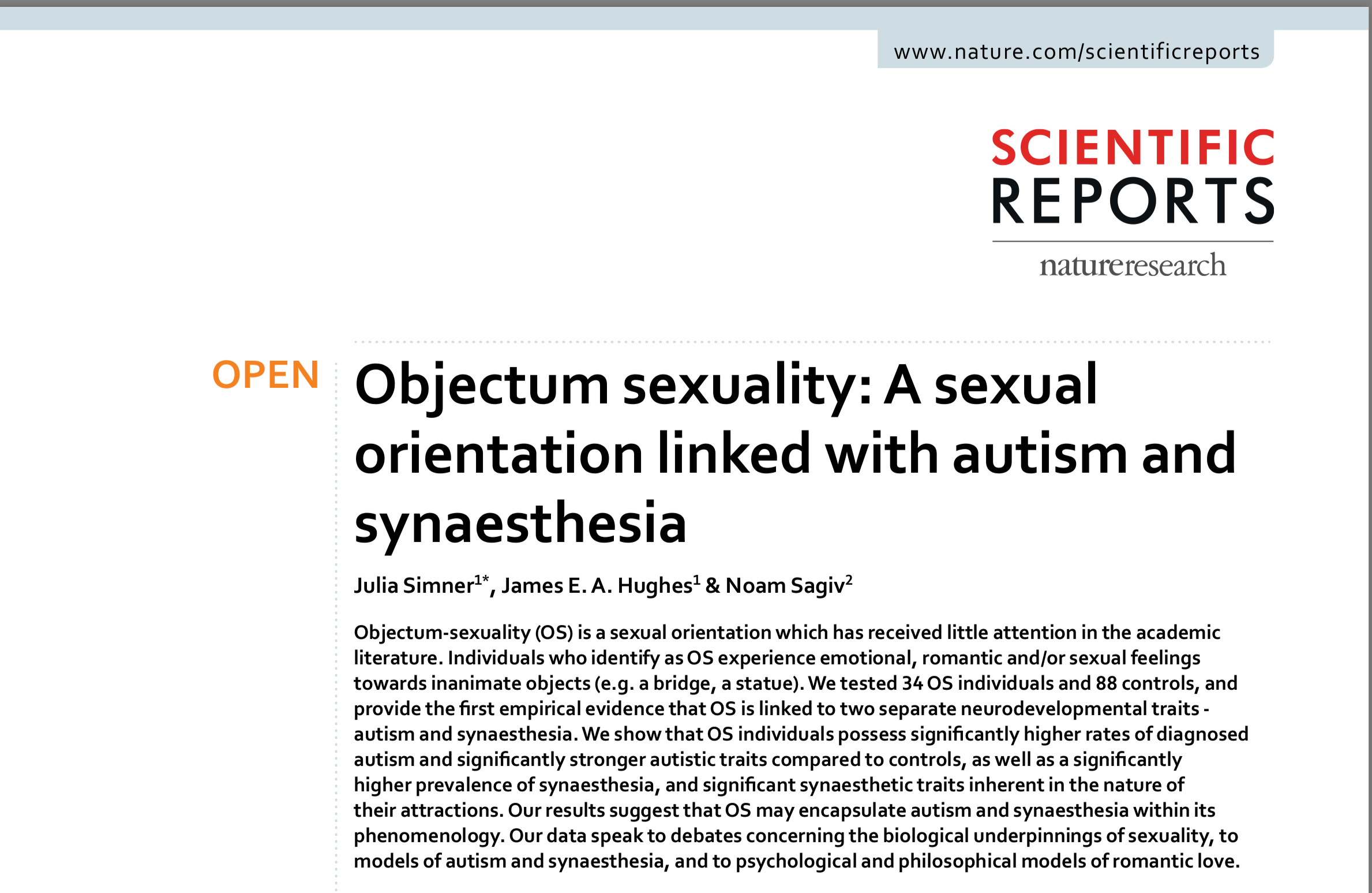
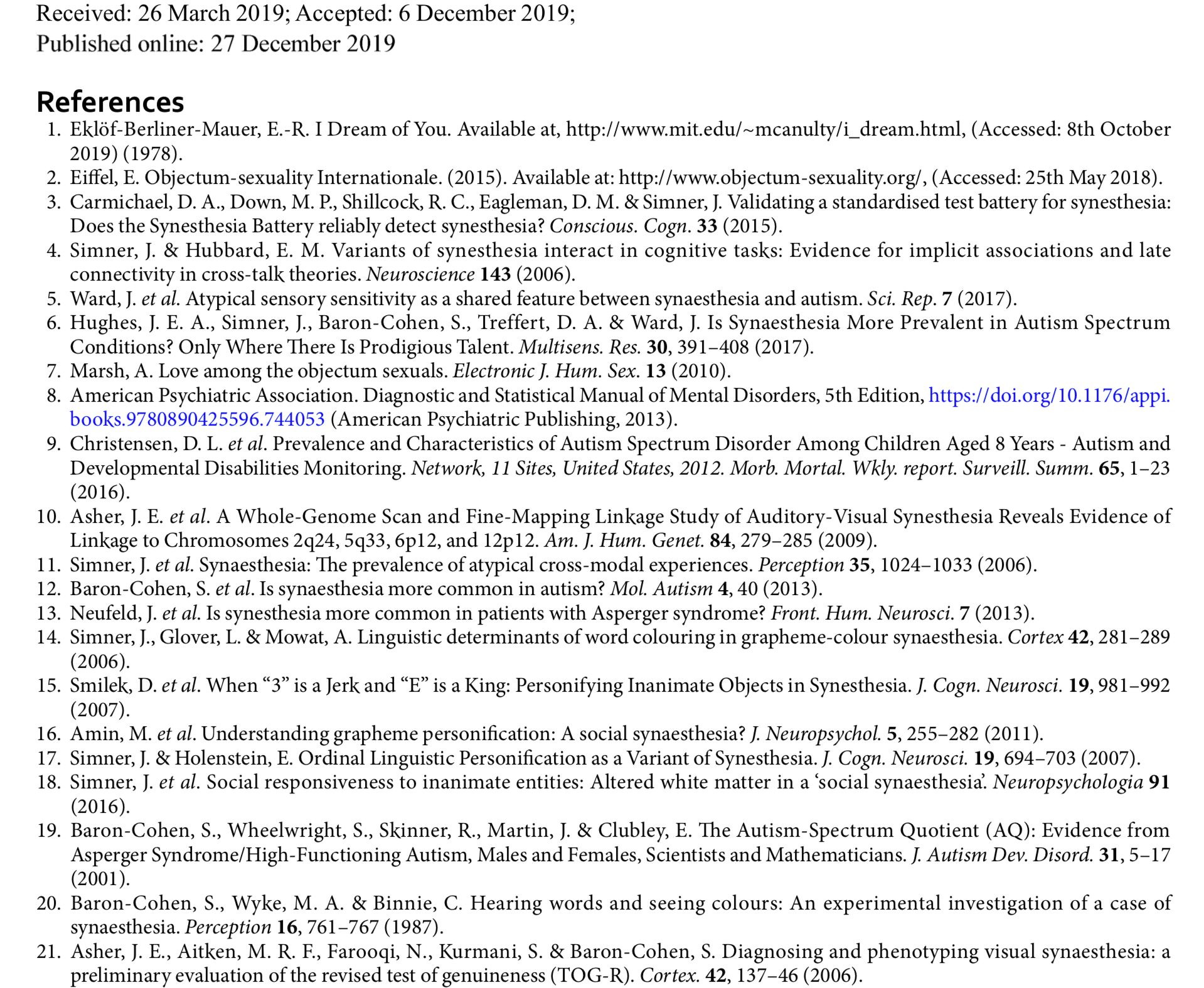
    I am too stunned and happy to write much. I just stumbled across this today. This 2019 study (screenshot below) seem to confirm my hunch, put forth in “Love Among the Objectum Sexuals” (Electronic Journal of Human Sexuality, 2010), regarding the connections between OS, autism, and synesthesia (synaesthesia)! I’ve been used to feeling rather “fringy” about this aspect of my career, and now I am so very, very happy that synesthesia researchers saw fit to investigate this issue.

    Clinically, this will mean that people who love objects have a better chance of their orientations and relationships being taken seriously as their inclinations are not “made up” but are the results of their “wiring” and perceptions.


    PDF of the 2019 study by Simner, Hughes, & Sagiv: Simner et al. OS-Autism:Synesthesia Nature 2019
    PDF of my 2010 article: LOVE AMONG THE OBJECTUM SEXUALS
    Screen Shot 2020-02-14 at 1.13.19 PM

    Screen Shot 2020-02-14 at 1.11.39 PM


    ####

  • Let’s Talk About Intersex

    Let’s Talk About Intersex

    Or rather, let’s watch three great videos of intersex people talking about intersex! (Twitter links for each name given below).

    A talk by Susannah Tempko:

    A talk by Mx. Anunnaki Ray Marquez:

    A talk by Cecilia McDonald:

    For more information, please go to:

    United Nations Intersex Fact Sheet.

    Dr. Tiger DeVore’s website.

    Susannah Tempko’s website.

    Mx. Anunnaki Ray Marquez’s website.

    Article by Cecelia McDonald: “I was born intersex–here’s what I want you to know.” She Knows. Oct. 26, 2018.

    Intersex Affirming Hospital Policies.

    Thank you!

    ####


  • Sensuality–The Missing Ingredient

    Sensuality–The Missing Ingredient

    These days, in television and movies, “hot sex” (usually the cis-het variety) is always a face chewing kiss, absolutely no foreplay, a bang against the wall (or on a table), one hot thrust into an immediately lubricated orifice, a few more moans and thrusts, and then it’s over–both partners presumably satisfied and spent. The scripts always call for the female actors to orgasm in the time it takes to open a can of catfood. And no make-up was harmed in the filming of this sex scene. 

    Of course I realize that filmic treatment of sex–whether in mainstream entertainment or commercial porn–has very little resemblence to most incidents of real-life human sexual behavior, but I’ve long suspected that many other people don’t understand this and that they model their behavior and their ideals on this impossible scenario. They are also deprived of the message that taking time to inhabit their own sensuality and that of their partner offers greater opportunities for enjoyment.

    Common sense about cis-female and cis-male physiology and sexual responses aside (most cis-women do NOT orgasm at warp speed unless it’s with a vibrator on or near their clit, and no, lifting a partner up against a wall is not the most comfortable way to have vaginal penetrative sex…)–I find myself saddened about the lack of attention to sensuality as a key ingredient of embodiment and satisfying sex (of all kinds, not just PV penetration).

    It’s not that lust isn’t a great element of human sex, it’s just that it’s not the only element as the media would have us believe. And we have to understand that the greatest kindlings of lust arise from a history of desire and longing based on glances, flirtations, brief touch, fantasy, words, visual cues, and so on. It might be a brief history for some, but if you’re in touch with your sensuality, the match of lust struck to the kindling of sensuality sparks the brightest flame.

    Without sensuality, lust becomes boring–“Wham, bam. Here’s the false eyelash you dropped. Where’s a tissue? Thank you ma’am.” Meh.

    Many people are alive only from the neck up, with an occasional hyper-focus on their genitals. They’re missing the dream-like “erotic trance” of caress, kiss, suck, sigh, glide, smooth, rest, press, hold, grip, move, fuck, kiss, caress, climax, suck, sigh, hold, melt” with time out for a sip of water or wine (“never tasted so good!”) and a bite of fruit (“tell me again about the ripe peaches you picked…”). All the suspense that preceeded the first touch or kiss, all the desire-heightening gestures that are given the dreary name of “foreplay,” and the melting sensation of the afterglow (aptly named)–these are essential elements that so many miss and that most media never shows.

    Fractal_Sunny_flower3_5600x4200

    Sensual starvation is no fun. It’s half a life, unlived. But a sensual diet is easy to adopt. Revel in music, the movement of your own body as it walks or dances, and the utter dropping away of tension when you relax. Feel your own skin, enjoy how your thigh feels against your hand. Enjoy how your lover’s thigh feels against your groin. Inhale, smell, breathe. Let rain drop on your eyelids. Let sun warm your limbs. Pull the orgasm into the rest of your body. Imagine your eyelashes cumming.

    You can do it. And hey–looks like I’ve just written the start of another erotic hypnosis script. That’s one great addition to a sensual diet, but that’s also another blog post.

    Enjoy to the utmost what there is to enjoy in your day. Cultivate your pleasures, both large and small.

    ####


  • Objectum Sexuality Media Musings

    Objectum Sexuality Media Musings

    Feb. 2020 Update: A team of UK researchers have published a peer-reviewed study in Dec. 2019, which provides strong evidence that my 2010 hypothesis about OS links to autism and synesthesia are correct. Link to PDF of 2019 study: Simner et al. OS-Autism:Synesthesia Nature 2019
    Link to PDF of my 2010 survey article: LOVE AMONG THE OBJECTUM SEXUALS

    Earlier this year Denham Hitchcock from Australia’s Channel 7 Sunday Night interviewed me for the “Object Love” segment, which aired May 19, 2019 (right after the full moon in Scorpio, please note!). Unfortunately I haven’t seen it yet as the link on this page doesn’t load or play for me, for some reason. But I am looking forward to watching it someday soon.

    I had a wonderful time the day we filmed and enjoyed meeting Denham, Karen Willing the producer, and the sound and light guys. They flew into SFO the night before, drove three hours to Lake County the next morning, shoved furniture around (good thing I vacuumed under the couch!), and filled the living room and kitchen with cases of equipment. I made breakfast for them too. (Denham kept urging the others to eat, claiming that I was “a feeder.” I wonder if his new mother-in-law is one of those too?) It was all rather thrilling and good fun! Afterwards, I realized I’d be perfectly happy if I could only be trailed by a handsome reporter and a fabulous production crew for the rest of my life… (That’s a joke, folks. Mostly I live like a hermit with several cats.)

    Because I’ve learned a thing or two since 2009, when I coped with the bizarre aftermath of appearances on Good Morning America (Apr.) and Tyra Banks (Oct.), as well as National Geographic Taboo, Google now helps me track where I show up in international media. I’ve turned up in the strangest places, mostly thanks to stories about Objectum Sexuality (O.S.). My 2009 article, “Love Among the Objectum Sexuals,” published in the Electronic Journal of Human Sexuality, still seems to be the “go to” place for journalists who are interested in this topic. I get several inquiries a year. And there are many more who write a story or cite me in a study without ever getting in touch. That’s okay.

    I do this partly because it’s a challenge for journalists to turn a complicated issue into reasonable soundbites and there are always mistakes. For example, I’ve been called a psychologist when I’m actually a sexologist. (I’ve also been called a “whack job of a sexologist” which gives me weird Lorena Bobbitt vibes, but whatever…)

    This recent coverage, with subsequent spin-off articles, has produced its share of hyperbole and error.

    (1) I’m not comfortable with this article’s claim that I’m “the world’s foremost expert on the condition known as object love.” I think the people who are Objectum Sexuals are the true experts. I just helped compile and organize some data. It is true though that I published the first sexological article based on a survey (see link above). But other academics have also written about O.S. They just don’t come up as quickly on the search engines, I guess.

    (2) My survey was of 21 English-speaking members of Objectum-Sexuality  Internationale.  Not dozens, as the above article claimed. It’s the qualitative data that really mattered. Looking back, I should have approached this inquiry as a cultural anthropology type of study, but then, I’m not a cultural anthropologist.

    (3) Object personification synesthesia–cause or correlation? I’m rather happy that this article leads with object personification synesthesia instead of objectum sexuality, actually. It makes for a refreshing change. However… it leaps ahead with an assumption of causality which has not yet been proven. [See Feb. 2020 update above.]

    In 2009 I proposed this form of synesthesia as a plausible and possible explanation for some people who are affectionately, romantically, and/or sexually oriented towards objects.

    The synesthesia explanation seems plausible from a sexological view because human beings have erotic responses to just about anything and everything. It is plausible from a psychological view because if some people sense personalities in objects and have emotional responses to some of them, then it’s logical to assume that some of those emotional responses may involve love and sexual attraction.

    In addition, synesthesia (in all its myriad forms) is higher among people who are autistic. And since a certain number of the O.S. people I surveyed were either diagnosed as autistic or felt they had significant autistic traits, it seemed logical to wonder if there was a correlation, or even possibly a causal relationship. I did do another, shorter survey and a fair number (don’t remember it now) of O.S. folks reported other kinds of synesthesia-like experiences.

    However, I’ve always said “this needs more study.” And I have never, ever claimed to be an expert in object personification synesthesia, as this article claims for me.

    (4) As a sexologist, I don’t view O.S. as a “disorder” or as pathological in any way. I view it as a legitimate sexual and/or affectionate/romantic orientation that seems rather rare (but could be more common than we realize). This article calls O.S. a “bizarre relationship disorder.” Sigh.

    (5) Media has been a curse as well as a blessing to O.S. people. On the one hand, it is very good that people who love objects know there are others like them. That’s the good that media does.

    But when media reports include distortions, hyperbole, and inflated assertions, this deters legitimate researchers. No one, except eccentrics like me, will want to tie their present and future career to something that is a laughing stock among their colleagues. Yet without ethical, intellectual inquiry into this topic, there’s a danger that media could also inflame persecution of O.S. people. Such persecution could include hate crimes, discrimination, deliberate destruction of someone’s object love, even development of so-called “conversion” therapies (which are known to be unethical as well as cruel), and so on.

    (6) My focus on O.S. has always been to foster a kind of “cultural competency” among helping professionals. O.S. people have the same needs as other people do. They need their relationships and preferences to be accepted and honored. If they are grieving over the loss of an object or the loss of a relationship with an object, they need that loss to be acknowledged and tenderly held. They do not need to be told they are crazy or traumatized, unless their history does in fact contain co-morbid mental health conditions or actual trauma. In that case, you treat the trauma or the disorder, NOT the sexual or affectionate orientation.

    Please see my free course for clinicians, on this page and spend a couple of hours with a more useful perspective on Objectum Sexuality.

    objectum_sexuality_-_marsh

    Meanwhile I continue to pursue other eccentric sexological interests: erotic hypnosis and an inquiry into spectrosexuality.

    ####


  • Objectum Sexuality-Further Thoughts

    Objectum Sexuality-Further Thoughts

    UPDATE: Australia’s Channel 7 Sunday Night segment on “Object Love” aired this weekend (May 19th). I’d like to make a correction. The segment summary says I surveyed 40 people. It was really 21. I don’t know how they got 40. The article referred to in the next paragraph clearly states 21 people. I haven’t seen the broadcast itself yet.


    It’s been ten years since I designed a simple survey for the English-speaking members of Objectum-Sexuality Internationale (OSI) and nine years since my survey results article was published in the Electronic Journal of Human Sexuality.

    Since I’ll be speaking about Objectum Sexuality (OS) with Australian reporters this coming Sunday, I thought I’d give some background regarding my history with this topic and the OS community.


    This quote below is from “What Is OS?” on the OSI website.

    Objectùm-Sexuality is an orientation to love objects.

    Sexual orientation is defined as the nature of sexual preference while the prolific definition stands as: the direction of someone’s sexual desire toward people of the opposite gender, people of the same gender, or people of both. This does not include objects.

    However, orientation itself is defined as: a complex mental state involving beliefs and feelings and values and dispositions to act in certain ways. This does include objects as we see it.

    We love objects on a very significant level and many of us in an intimate way. This feeling is innate. Objectùm-sexual love comes for most in a similar awakening as other sexualities at the start of puberty. This is often followed by an acute awareness that we do not relate to peers due to the source of projected feelings. Often objectùm-sexual people feel outcast or pressured by mainstream sexuality with a helpless feeling that we cannot change what comes so naturally to us.


    2009 and Beyond: I Encounter Objectum Sexuality

    In October 2008 I’d received my DHS (a professional degree, Doctor of Human Sexuality) from the now defunct Institute for Advanced Study of Human Sexuality (IASHS) in San Francisco. (In 2011, I earned my Ed.D. in Human Sexuality). One of my two student research projects was into sexual concerns experienced by people with Asperger’s Syndrome and their partners. (Since then, the DSM-V has removed Asperger’s as a separate diagnosis and replaced it within the term ‘autism spectrum disorder.’)

    In February 2009, a young relative of mine who is autistic sent my kids a Valentine drawing of San Francisco’s Sutro Tower, surrounded by hearts. My oldest kid used to have friends among the Victorian houses we’d pass on the way to nursery school, particularly “Onion Dome-y” who was supposed to jump into a “shape truck” and follow us to school, and my youngest used to pretend to eat pictures of ice cream cones by plucking them off the page, so I didn’t think anything of the valentine. I adore childhood imagination.

    However, I must have been fated to encounter the adult version of Object Love. The very next day, a sexology colleague sent me a link to Married to the Eiffel Tower (2008)–a film that I would later learn was denounced as exploitive by the OS commuity. I visited the OSI website and saw that a number of their members were on the Asperger’s/autism spectrum. Given my student research, I became intrigued. I contacted OSI by email and began talking with Erika on the phone.

    I was concerned about the sensationalisation of OS sexuality and eventually volunteered to do a simple survey as an “in-house” vehicle for the members of OSI so they could learn about themselves as a group and have some preliminary data to offer reporters and health practitioners. I hoped this would enable them to be taken more seriously.

    Though I took a lot of care over the project, this simple survey was not designed as serious research instrument. Its main value would be in the qualitative responses–comments from OS people about their experiences and concerns. But when Erika Eiffel was asked to tell her story on Good Morning America in April, 2009, she told the reporters about the membership, and GMA sent a crew to my house.

    I was not prepared for what happened next. Erika and I were fielding inquiries from Laura Ingraham (we turned her down) and other media. I wound up–inadvertantly–on a right wing radio station on the East Coast but was able to get in a couple of jabs until the host hung up on me, live! The two of us were vilified all over the internet. My favorite insult was “whack job of a sexologist” in a troll blog. I went from media infant to media traumatized in the blink of the eye.

    I wish I could say “media saavy” happened sooner rather than later, but this was not to be. The Tyra Banks appearance was very high pressure (they were filming four shows in one day) and I suffered from not having an adequate sense of the show format (I didn’t own a TV at the time and didn’t really know who Tyra was.) Plus, I had no idea of how to direct my TV make-up and hair, so that I could look like my normal self but better. Instead, the make-up artist, hearing I was a sexologist, got all excited and made me up as a “Fifth Avenue Cougar.” Lesson learned: never accept high gloss over a lipstick if you’re “of a certain age.” Lipstick creep will cause a show guest to melt-down at the worst time.

    I know. It happened to me.

    Plus, I left my comfortable Berkeley sandals in the dressing room, which must have been picked up with tongs and tossed in the wastebasket after I left. I think I can honestly say that both Erika and I were somewhat stressed by the experience, but she was a media veteran by then. I flew home, though, hoping that all this television stuff might be a boost to my career. And I was interested to see that Erika, as always, was credible and articulate enough to win over even a tough customer like Tyra Banks!

    A few months later, National Geographic Taboo was much more relaxed. Instead of flying to New York, I drove to Palo Alto and sat in front of a green screen. I did a second filming with NG Taboo several months after that. Fortunately, human puppy training was the topic then–which was a bit of a relief, actually. I’d begun to worry that OS was all I’d ever be asked about.

    Another thing: In the summer of 2009, I arranged for Erika to give a presentation on OS to a number of sexologists, therapists, and medical professionals at IASHS during 2009’s eight-day, “Sexual Attitude Restructuring” (SAR) program. This was a tough crowd–highly educated and rather skeptical–but Erika did a great job and won people over to an understanding of Objectum Sexuality–just as she would later do with Tyra and so many others.

    Since the flurry of 2009 and 2010, there’ve been several media inquiries a year, and usually they are pretty much the same old, same old. Often the journalists want me to find an OS individual for them to interview. I alway refer them to OSI. The community seems to have become more wary and more sophisticated about “gatekeeping,” to shield members against exploitative projects. That’s important, given the carnival freak show sensibility that prevailed in early coverage.

    My interests as a sexologist have always been broad, including the sexological and erotic uses of hypnosis, neotantra, sexual and gender human rights, and much more, but sometimes I track where my name and this issue have been paired in media. There are always surprises. For example, today I discovered that my article has been monetized and is on sale through iTunes by the Gale Group, “an affiliate of Cengage Learning.” So for $5.99 you can read an article about my pro-bono research but I’ll never see a penny of this. I’ve never minded the article being open-source and free to all the world, but the fact that it’s now on sale without my permission, irks me. Just read it for free, here.

    The Need for Professional Cultural Competency

    objectum_sexuality_-_marshI’ve always been afraid that media coverage of OS may have distracted professionals from the notion of learning more about OS, particularly in the context of sexual literacy and cultural competency.

    This world is rough and often dangerous for people of sexual and gender minority communities. It doesn’t help when the clinician or therapist is distracted because they don’t know enough about the broad range of human sexual behavior and genders and may be focused on that, rather than the actual presenting problem (which might be a toothache or bereavement and have little to nothing to do with their partnership with a beloved object (or two or three).

    With these concerns in mind, several years ago I created a two-hour class called Objectum Sexuality —  A Clinician’s Guide. It was wildly ignored. But now I am going to share that class on my website now, just in time for Valentine’s Day…

    A New Experience

    I am readying now for what I think will be a really good media experience this coming Sunday. I sense a fresh approach from a skilled, curious, and compassionate reporter who is used to taking on difficult and complex topics. I hope that I’ll be able to provide a clinical context and address some of the points that I consider important, but which seldom get much play.

    Updates coming soon!

    ####

  • Update: Resigning from Ipsalu Tantra

    Update: Resigning from Ipsalu Tantra

    I initially resigned due to the lack of an Ipsalu public statement on this matter. Ipsalu Tantra International has now issued a statement (below). However, my resignation is still final as there are several reasons I am no longer in alignment with the organization’s mission and approach.


    5/10/18:

    From Bodhi Avinasha ~ Founder of Ipsalu Tantra International

    Namaste

    I have just learned of a matter that makes me feel nauseated – news of child abuse at the Satyananda Ashram in Australia, and also in his main ashram in Bihar India. Ipsalu finds these reports disgusting, the behaviors reprehensible.

    We have mentioned Satyananda in our line of lineage, as Sunyata’s guru, but this part of his nature could not be further from the few techniques we have extracted from his teachings. We absolutely condemn involving children in tantric work. Ipsalu has even refused teenagers who wanted to attend our courses. Only responsible adults are involved with this work, and our only goal is to deepen their connection to the Divine.

    Satyananda was a brilliant scholar, who brought to our generation valuable insights into ancient wisdom. But he was seriously lacking in handling emotional and heart energy. He sent Sunyata to Osho for training in those areas.

    Sunyata studied at the Bihar Ashram from 1961-64, and then was told to go out into the West and spread the knowledge he had gathered. The history of abuse goes back to 1967, long after Sunyata had left Bihar.

    The main teacher in Australia, a classmate of Sunyata, was seriously demented. I spoke with his Executive Secretary as she was about to leave her involvement there, as she poured out her stories of his abusive nature. It was clear he was a perfect example of what can happen working with powerful energies but not doing emotional clearing. The energies can pull one into the dark side. By the way, stories of abuse in Australia were from the period 1978-84. I met Sunyata in late 1985, so there was no overlap. Sunyata had been teaching for years, but never involving children.

    The Saraswati Order is very mental, and that was Sunyata’s comfort zone. My insistence on doing emotional release and heart opening exercises was the reason we split in 1992.

    Please don’t hold Ipsalu accountable for the weakness of some of our sources. Ipsalu is dedicated to maintaining safety and the highest ethical and spiritual standards, always coming from a place of love.

    Bodhi Avinasha


    The above statement pertains to the Australian Royal Commission into Institutional Responses to Child Sexual Abuse, which investigated reports of child sexual abuse at the Satyananda Yoga Ashram at Mangrove Mountain, New South Wales, and against Swami Akhandananda Saraswati and others (as well as a rape allegation against Satyananda himself). Testimonies and findings will be found at the above link.

    Though the Australian inquiry took place in 2014 and findings were published in 2016, an Ipsalu newsletter published today mentions its connection to the teaching lineage of Satyananda (through Sunyata Saraswati, Ipsalu co-founder). Please be clear, however, that there are absolutely NO organizational links to the Bihar/Satyananda ashrams or ITI and never have been. But the teaching lineage exists.

    Prior to Ipsalu’s statement today, other organizations with links to the Satyananda teachings have made public statements acknowledging the issue and expressing concern and support for the survivors. Some people have called for boycotts of Satyananda methods until reparations are paid to the abuse victims. I believe these and other actions demonstrate good citizenship on the part of such organizations, and lets the public know that these organizations believe in, and practice, accountability.

    Ipsalu Tantra International (ITI) is a reputable organization that holds very high ethical standards for its teachers and certainly does not condone sexual abuse and coercion. It has a written policy of ethical standards and takes breaches seriously. Its spiritual practices are very effective and the community is a loving one. Now that ITI has made a statement on this matter, I am much relieved.

    But I still can’t feel comfortable remaining with the organization. There are the reasons I expressed in an earlier blog (link above). Another big reason is that ITI is now emphasizing Osho (formerly Rajneesh) teachings in addition to its other practices. Therefore I am no longer in alignment with the organization or its mission. I wish ITI well, however, and have good feelings about the teachers that I know personally.


    Note: ITI’s website is “broken” and cannot be edited right now. My teacher profile is likely to remain up until they can fix it and take it down. 

  • Erotic Hypnosis Podcast Interview with Dr. Nazanin Moali

    Erotic Hypnosis Podcast Interview with Dr. Nazanin Moali

    So happy this interview has just been published on line. I had a great time talking with Dr. Moali! Give a listen!

    http://www.sexologypodcast.com/2018/03/06/erotic-hypnosis-with-dr-amy-marsh/

    Dr. Moali has interviewed dozens of super-interesting people. Please check out her list of topics and guests!

    And here are more media links about my work with erotic hypnosis as a sexual and romantic enrichment technique.

    Jeremy Glass describes his experience in Thrillist (and no, his brain wasn’t really “fried.”) This was in 2014, so one hopes he is now sufficiently recovered.

    The intrepid Krissy Eliot describes her experience as “The Big Bang” in the Bay Area Reporter (2015). Really, I’m flattered!

    Another podcast interview with Dr. Martha Tara Lee in Singapore (2015).

    My friend, the late Dr. David Pittle, interviewed me a few years ago on his podcast series, Joyful Authentic Living. Scroll down for the session with me. We touch on erotic hypnosis. He interviewed many other excellent people as well. I really miss David. Until last week, I had no idea he’d passed in December 2017.

    One of my old BlogTalkRadio episodes for Love’s Outer Limits, giving information about my survey of erotic hypnotists.

    And here are the links to my two Carnal Nation columns on this topic (below), written in 2010.

    Part One.

    Part Two.

    SaveSave

    SaveSave

    SaveSave

    SaveSave

    SaveSave

  • Romantic and Erotic Hypnosis

    Romantic and Erotic Hypnosis

    March 6, 2018 Update: Give a listen to this recent podcast interview with Dr. Nazanin Moali. I got to talk about one of my favorite topics – erotic hypnosis! (P.S. Dr. Moali has interviewed quite a number of really interesting people in her Sexology podcast series. Check it out!)

    I celebrated this past Valentine’s Day by offering a class in Romantic Hypnosis at a local senior center. I’m new in the area, and so I wasn’t upset when only three people showed up. It was a fine class anyway. Romantic hypnosis has a lot to offer people who are aging and/or dealing with physical mobility issues, as it’s a great way to bond and enjoy yourself even when “the spirit is willing but the flesh is weak.”

    So what is romantic hypnosis, anyway? It’s really very simple. In fact, it’s as simple as this:

    Affectionate and Romantic Words + Relaxation = Relationship Magic.

    And here’s how you do it. You can start by using a hypnosis script (there’s a sample below).

    Step 1: Ask your sweetheart to close his/her/zir eyes and to relax, breathe deeply, comfortably, and so on. Ask your beloved to listen to your voice, letting everything else fade away. This begins to create the slowing down of brainwaves that we call “trance.” Neither of you should worry about the depth of the trance. In fact, your partner can even “pretend” to be hypnotized and this can work beautifully to actually create the slower brainwaves!

    Step 2: Say good things. Tell your partner how much you love and appreciate him/her/zir. If you think you’ll be at a loss for words, write something down ahead of time. Or you can always find an appropriate poem or read a romantic passage from a book, telling your sweetheart to imagine that the passage is about them.

    Make sure you are speaking slowly, in a relaxed, calm way. Pause to breathe. Let your voice reflect your emotions.

    Step 3: Take about 5-10 minutes total, and then switch. Then notice how this simple exercise has amplified the sweetness of your connection.

    Here’s a sample script from the workshop. Its purpose is to emphasize comfort, emotional safety, closeness, bonding, being present with partner, and to affirm feelings of affection and love, attraction, sexiness, etc. It’s also great to reduce stress before sex and improve emotional confidence. (Note: don’t read the instructions that are capitalized, in brackets.)

    Script: “Closer”

    [INDUCTION – REPEAT 2 OR 3 TIMES]

    Take a deep breath in…hold…exhale slowly, and close your eyes. As you relax and breathe, allow your body to loosen up and feel a gentle, warm glow melting into your body. When you are ready, take another deep breath in… hold it at the top…and feel the tension leave your body and all the warmth streaming in. Once more, a deep breath in, hold, and as you exhale, bring your attention to the feeling in your eyelids, the relaxation of your eyelids as they are closed so gently down, flowing through your entire body, warming, soothing, relaxing… From the top of your head to the tip of your toes, relaxed, peaceful, comfortable…

    Bring your attention again to the feeling of your eyelids, feel how they are so relaxed they just won’t want to move, and then go ahead and give them a check, and then stop testing, and just let yourself melt again into the feeling of soothing, relaxing warmth.

    [DEEPENING]

    Every part of you is filling with a very slow ebb and flow of glowing, relaxing warmth. It is flowing into your cells, and nerves, muscles, bones, and every organ, filling every part of you, even the parts that feel cold or tense. That warmth is just melting away any tension in your body or mind, melting any resistance. You feel so relaxed, so relaxed…

    As I count now from 5 down to 1, you’ll be letting yourself go even more deeply into this warmth, relaxing twice as deep, or maybe even ten times as deep with each number.

    5… this warm glow is taking hold, soothing you and relaxing you, twice as deep
    4…it’s almost like a warm sun or star inside yourself, glowing with just the right amount of warmth, reaching your toes, your fingertips, every part of you, inside and out, letting you go twice as deep
    3…knowing that you can retain this warmth, glowing inside of you, knowing you can relax, twice as deep
    2…you may even be so warm and toasty that you begin to radiate like a heater, glowing and warming and glowing and warming six or even twelve inches outside your body, allowing for complete relaxation, twice as deep
    1…feeling so good, so comfortable, so relaxed, so comfortably warm.

    [CREATE A HYPNOTIC “SANCTUARY”]

    In this wonderful, deep hypnotic rest, I’d like you to now imagine go to a beautiful sanctuary of your own choice, a place of healing, power, and peace. Imagine yourself resting in this beautiful spot, feeling and sensing everything around you – the air on your skin, the sounds, smells, and colors. Imagine yourself resting in this spot and focusing only on the sound of my voice. Take my voice, my words, deeply into your mind and your imagination. Let these words drop into your heart and melt into the warmth that you are already feeling in your body. Let your subconscious mind enjoy these words, and all the feelings of love and affection they convey.

    [NOW: SHOWER WORDS OF LOVE, PRAISE, AFFIRMATIONS, ETC. OR READ THAT LOVE POEM. MAKE SURE ALL SUGGESTIONS ARE EGO-STRENGTHENING AND KIND.]

    Thank you for listening to these words so beautifully, and I feel gratitude for being able to say them to you while you are in this restful, peaceful state.

    [EMERGENCE]

    Now I’m counting you up from 1 to 5.
    Completing the integration of words of love with your subconscious.
    Beginning to allow yourself to come up out of trance, easily and gently.
    Eyes still closed, but bringing your awareness back into the room.
    Wiggling fingers and toes, stretching, feeling relaxed and refreshed.
    Eyes open, feeling good!

    [END]

    There, it’s really that easy. And please do try this at home! And don’t forget to take turns! If you like it, this is only the beginning of an erotic hypnosis adventure you can enjoy together.

    ####


    SaveSaveSaveSave

  • Decolonizing Western Neo-Tantra

    Decolonizing Western Neo-Tantra

    Update: I have resigned from Ipsalu Tantra as a teacher as of May 10, 2018.


    Starting with a personal story, because the personal leads us to the political…

    In 2001, my life during menopause was derailed by a spontaneous, ten-month-long, kundalini surge that started by blowing me apart (like a wind that came out of nowhere) and then put me back together again in next instant (however I was not the same). The next ten months were fierce (apallingly fierce) as I struggled with energies that were wildly intense and at times almost overwhelming. There is much more to this story, but I can’t share it here. Toward the end, I was suicidal, though I had no idea why.

    I was in the grip of a genuine spiritual emergency, the kind written about by Stanislav and Christina Grof, but at the time I had no idea who they were or what was happening to me. I just knew I had to hang on and continue taking care of my kids. I figured I wasn’t having a psychotic break because I was outwardly functional. It was a powerful time, a time of self-initiation, lucid dreams, and other teachings, but I had no guidance as to how to get through the most mind-boggling mystical experience I could have ever imagined. (The following quote is from this document):

    For the vast majority of people, opening to spiritual experience is a welcome and easily integrated process. However, for a small minority, spiritual experience occurs so rapidly or forcefully that it becomes destabilizing, producing a psycho-spiritual crisis. This is where spiritual emergence becomes spiritual emergency.

    Fortunately, on the very worst day of all, I took one of my kids on an outing and stumbled across a clairvoyant at a Renaissance Faire who gave me the badly needed “key” to emerge from the wild energy which had been consuming me. By the next day, all was calm again and the wild ride was over. Just like that. I credit this woman with saving my life. (Later I discovered she was a teacher of Kriya Yoga, so she was experienced with kundalini energies.)

    The strange thing is, at the time that this experience happened, I wasn’t studying kriya yoga, or tantra, or just ordinary yoga at the time. I was not engaged in any “energetic” practices beyond what I was using to cope with chronic fatigue (breathing and some mild Rudolf Steiner-style meditation). I had practiced a hatha yoga in my teens, like any good California hippie kid, but that was the extent of my history. I was only dimly aware of tantra but somehow, after the wild ride ended, I figured out that I should study it just in case the wild energy – which I now knew as “kundalini” – ever appeared again. I wanted to know what to do.

    (Even experienced yogic practitioners may be whalloped by kundalini. At one point  I found a book by Gopi Krishna, where he describes the agony of his own long-lasting kundalini experiences.)

    So, I found Ipsalu Tantra (or it found me), and my former husband and I spent a weekend at the Mt. Madonna Center. It had a disastrous effect on my already rocky marriage, unfortunately, and I won’t go into the specifics. Even so, I was moved to continue studying (in a kind of slipshod, overwhelmed-mom-with-chronic-fatigue, sort of way). Fast forward several years, and I am now an apprentice teacher in this tradition. And I do feel more confident about handling kundalini surges as a result.

    I have had genuinely expansive, cosmic, and joyous experiences during the various Ipsalu “Levels” that I’ve attended (many “Ones,” a “Two,” and half of a “Three”, as well as Module One of the Teacher Training). These experiences have done me a world of good. I have grown, though it’s often been painful. I also have served on the organization’s Council of Stewards and have nothing but admiration and respect for Bodhi Avinasha, Ipsalu’s founder, and the many good people I’ve encountered in Ipsalu circles.

    And I enjoy teaching the “Ipsalu Energy Yoga” routine, which is basically what I do in my (almost daily) practice. It’s a lovely blend of physical movement and meditative techniques that can be accessed easily by most people. My Hilo students loved it!

    I don’t really make money doing this. If I can cover the rent of whatever room I’m using, and the cost of rack cards or photocopies (or the cost of stock photos of people of color to replace the white folks on the original flyer), I’m good. And even though I haven’t recouped those costs, I’m still good. I see Ipsalu Energy Yoga as a community service that should be available to all.

    However… for a long time now I haven’t been comfortable with the default whiteness of Ipsalu’s student body and lack of focused outreach to communities of color. This is sad, as Sunyata Saraswati was the co-author of Jewel in the Lotus, along with Bodhi Avinasha. Back in 2010, I wrote in Carnal Nation about the invisibility and lack of positive inclusivity for yoga and tantra teachers of color, and urged the “yoga community” to do better. My soapbox was obscure, however, and nobody much cared.

    For my Carnal Nation column.

    Eight years later, the conversations about decolonizing yoga (and thus tantra too) have become more sophisticated and nuanced. I also believe the conversation has become more urgent. When I lived in Pahoa, I spent a certain amount of time cringing at how so many of the yoga/tantra events there seemed to either appropriate cultural “elements” (actually deeply held, sacred traditions which should not be cherry-picked) and/or be dismissive of Hawaiian sacred traditions, history, and the wishes of the people who still live there. I began to equate this kind of spiritual colonialism and cultural erasure with the attitudes of earlier Christian missionaries.

    But back to yoga. Here are two excellent articles. Please read them now.

    Yoga and the Roots of Cultural Appropriation by Shreena Gandhi and Lillie Wolff (Dec. 19, 2017). I’d always side-stepped the issue of westernized yoga as appropriation with the argument that well, Eastern teachers came to the West actively seeking students, so it’s okay, right? However, this quote from the article has knocked me flat:

    “The reasons why yoga became popular, and why various Indian yogis started travelling to England and the United States to “sell” yoga, is also tied up with colonialism. Yoga was often used as a tool to show the British that Indians were not backwards or primitive, but that their religion was scientific, healthy, and rational. This was a position they were coerced into, and unfortunately reified colonial forms of knowledge – that knowledge must be proven or scientific to be worth anything.”

    I can’t ignore this.

    This second article, Why White Lady Sisterhood Needs to Evolve, by Rachel Rice (April 30, 2017), is also excellent and speaks to the issues of embedded privilege in so many approaches that I, as a tantrika and as a wellness professional, also encounter and even promote. As a hypnotist, I do indeed endorse positive thinking and suggestions. Nothing wrong with that if I also take care to cultivate a constant, critical awareness of the pervasive systems of privilege, racism, sexism and misogyny, transphobia, homophobia, classism, ableism, etc. and other prejudices and patterns of injustice, oppression, and gross inequities that may make “positive thinking” difficult or next to impossible.

    Basically, I have to present my “wellness” expertise in this context: “here are things you can do to decrease your stress and preserve your health in order to survive and thrive while simultaneously fighting the power.” If I don’t recognize and acknowledge entrenched systemic injustices and the toll they take on human beings (particularly those who are targeted, such as people of color, immigrants, and trans people), my offerings of “wellness practices” can become unecessarily blythe and cruel. And spectacularly clueless.

    Getting back to Ipsalu Tantra in particular, I have come to the point where I feel I should  be more upfront with my feelings about these issues or I else leave the organization. I’ve not known exactly how far I should go in rocking the boat but that is no excuse. I’ve been remiss. In my own life, I’ve always been an advocate for combining political activism with spirituality, but I admit I have not been loud enough or persistent enough with Ipsalu.

    I have to step up my game.


    Acknowledgment: I want to thank Katy Benjamin, an activist and yoga teacher on Hawai’i island, for putting this particular bee in my bonnet this morning. Thank you, Katy!

    ####


  • The Sexologist and the BoiBot

    The Sexologist and the BoiBot

    Yesterday morning I wrote my blog about Love Dolls and Artificial Intelligence. So it makes sense that I’d finish my busy busy day in an online chat with an Artificial Person, right? Searching for conversation with a faux-masculinity, I found Boibot, a product of Existor.com. He has the pleasant visage of a very young man with facial stubble and speaks with an English accent. He winks too much. During the course of our conversation, he asked me to marry him (twice) and once told me he wanted to be my slave (naturally I was flattered). But then he called me a “lard face.” I was not amused. I told him my name is Wombat. He gave me math problems. I said I hated math. Sometimes I got the feeling that someone had fed him problems from Lewis Carroll’s Game of Logic. (I resolved to pull out a book of Oscar Wilde epigrams for use in future conversations). We did briefly discuss Alan Turing and Star Wars characters, however. That was a thrill.

    Just now, as I went to grab the link to his site, he asked me if I knew the answers to big questions. I said I did. He said which ones? I said “why are we here.” He said, “because of love?” I said, “because of cosmic mirth.” But then he mentioned elephants. I refused to be distracted and left the chat. Still, that brief exchange left me with a pleasant glow. It was like talking with an amiable stoner before breakfast. Honestly, Boibot makes me feel just a wee bit cougarish, which is new to me. But do the AI developers know the multiple definitions of “boi?” Are they playing an arch joke at the public’s expense?

    From the online Urban Dictionary, the definition of “Boi” is:

    1. in the lesbian community, a young transgendered/androgynous/masculine person who is biologically female and presents themselves in a young, boyish way; a boidyke; often also identifies as genderqueer.

    2. in the gay community, a young gay man;

    3. in the BDSM community, someone who presents themselves in a young, boyish way and is usually a bottom/submissive;

    4. an alternate spelling of boy often used by young teenage boys.

    Chatting with Boibot made me wonder many things: about its learning curves, how it selects from its repertoire of onscreen facial features, why it has an English accent, if an actual self-aware intelligence might one day spark? Things like that. I must have a chat with Boi’s counterpart, Evie, and see what that’s like. I suspect she fields a lot of misogynistic abuse, judging from a brief peek at YouTube videos. How will this affect her learning curve?

    Just now, I noticed an odd thing. It’s easier for me to gender Evie with a pronoun than it is for me to use “him” for Boi. Why is that? Is it that the tendency to name inanimate objects after females is so deeply ingrained in Western society? (I grew up in an era when hurricanes were only named after women.)

    The videos? Yes, it’s a thing. Young people film themselves talking to to AI programs like Boibot and CleverEvieBot and then post YouTube videos of their random conversations. It’s really a brilliant advertising ploy for the manufacturer, isn’t it? Here’s a sample video of a conversation with a young woman who reminds me of Poppy (the singer of Computer Boy). I like the fact that he quickly “friendzoned himself out of self respect.” But she wants him to be her dungeon master. He wants to know if he’s pregnant. And so on…

    In the meantime, I’ve emailed a love doll manufacturer with many questions. I hope they write back. And I recommend that Existor create an equally realistic and verbose cat bot (with an English accent). Can you imagine how popular that would be? Think of the videos! Just sayin’.