Author: Amy R. Marsh, EdD. DHS, CH, CI, CSC, ABS

  • APOPS-What’s Wrong With This Picture?

    APOPS-What’s Wrong With This Picture?

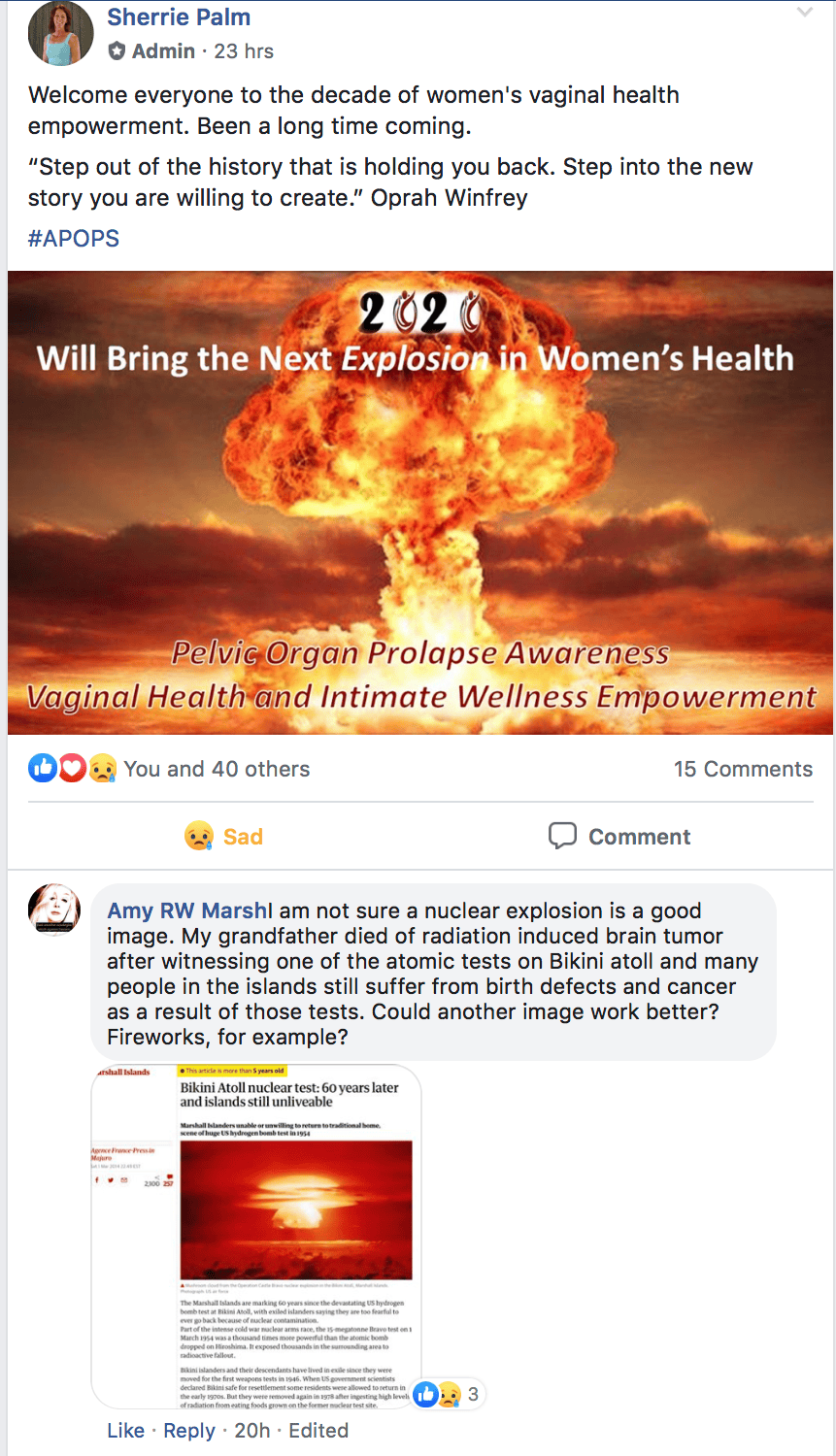
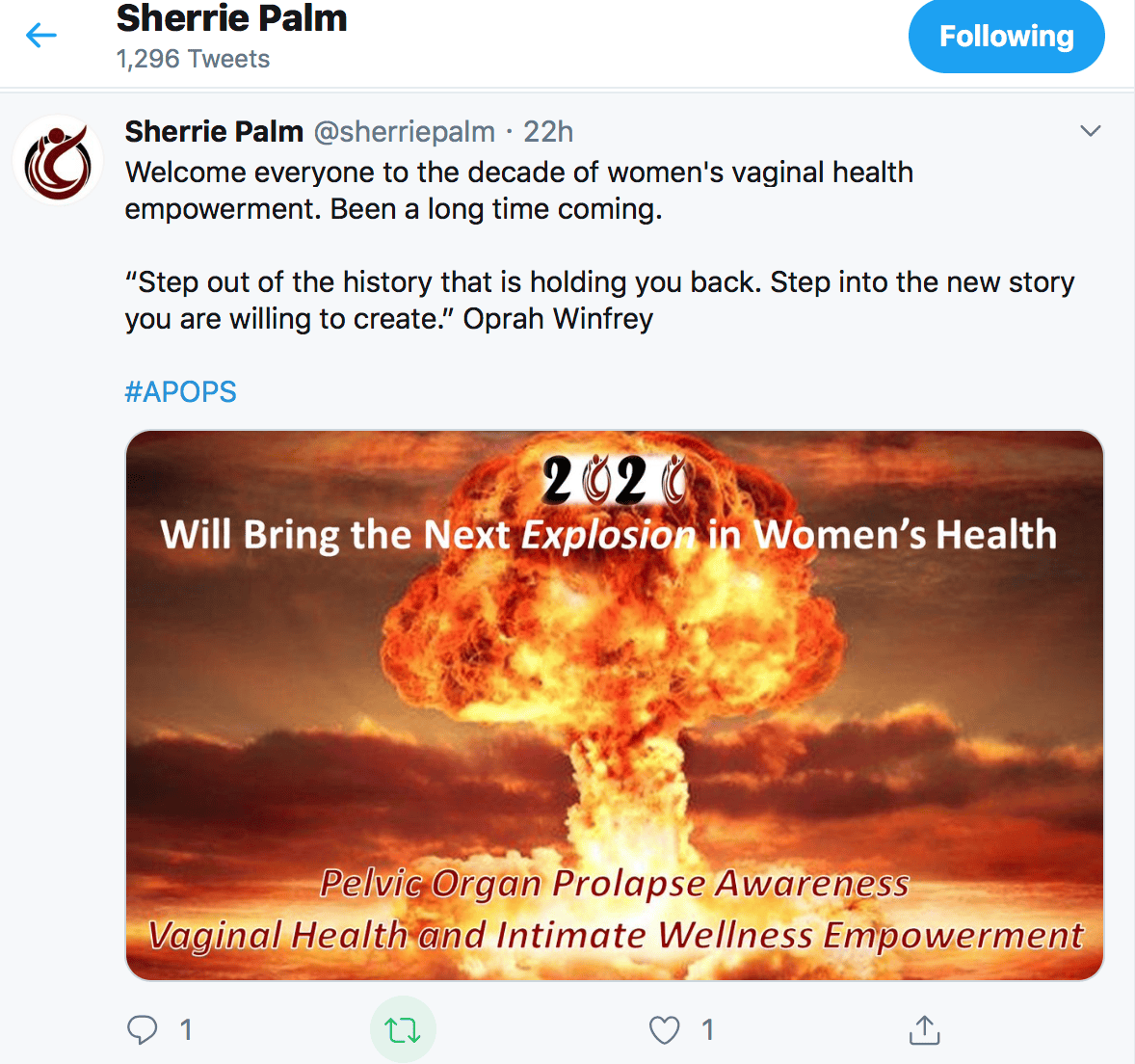
    In the U.S., we trivialized and commodified the catastrophic nuclear tests in the Marshall Islands by naming a swimsuit after the tests at Bikini Atoll. (A real “bikini body” is sickened by radiation and if female, has a greater chance of giving birth to children with birth defects…) So why should I be surprised or outraged by this use of this picture below? It’s a recent tweet from the founder of the Association for Pelvic Organ Prolapse Support (APOPS) and until this morning, I’ve been a fan.

    This is the picture I ask you to consider, below.


    Screen Shot 2020-01-03 at 6.13.21 AM


    Let me add two other screenshots here, before I get on with my story. The one on the left is from a story about the Marshall Islands, published by The Guardian five years ago. The one on the right is from the Atomic Veterans Cancer Benefits Center. My maternal grandfather was an “Atomic Vet” and the VA gave him no medical help at all when he developed a brain tumor. My family was impoverished as a result, paying for his care.

    As for the fate of the Marshallese, see these links: Project 4.1 and the documentary, Nuclear Savage. The immense damage to human beings, animals, and the islands continue. Trailer: https://youtu.be/13i09gV7HRk

    I’m also boggled by the juxtaposition of a quote from Oprah–a woman of color–on top of an image which has brought doom and destruction to other people of color, all in the name of “vaginal health.”

    Plus, do I want that thing (an exploded atomic bomb) anywhere near my “lady parts?” I think not.

    Based on the above, I do not believe I was being overly sensitive about “stuff” when I alerted APOPS founder Sherrie Palm about the inappropriateness of this image. I know that Pelvic Organ Prolapse is an enormously ignored medical condition, internationally, and until now I’ve had nothing but respect for Sherrie Palm for all her tireless activism. And so…

    …I began by gently pointing out that this was not the best image to use in supporting “vaginal health and intimate wellness.”

    Screen Shot 2020-01-03 at 7.46.08 AM

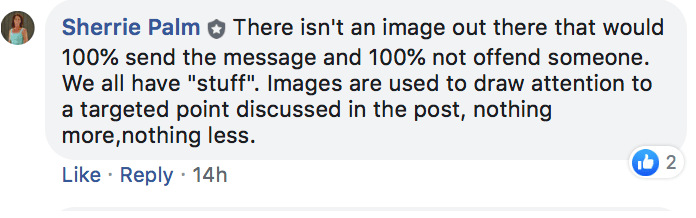
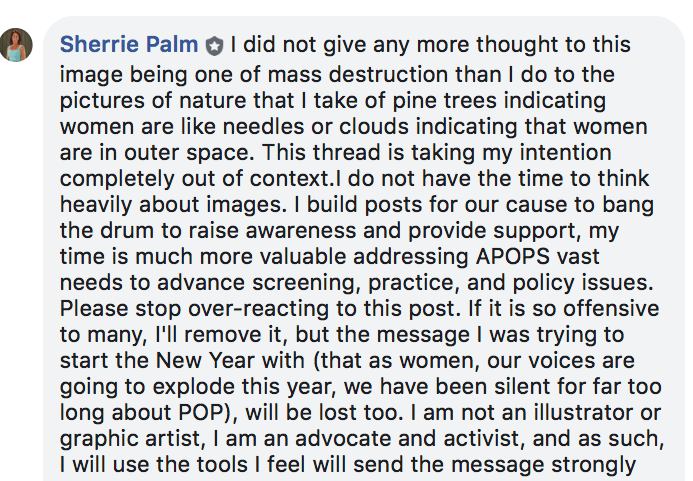
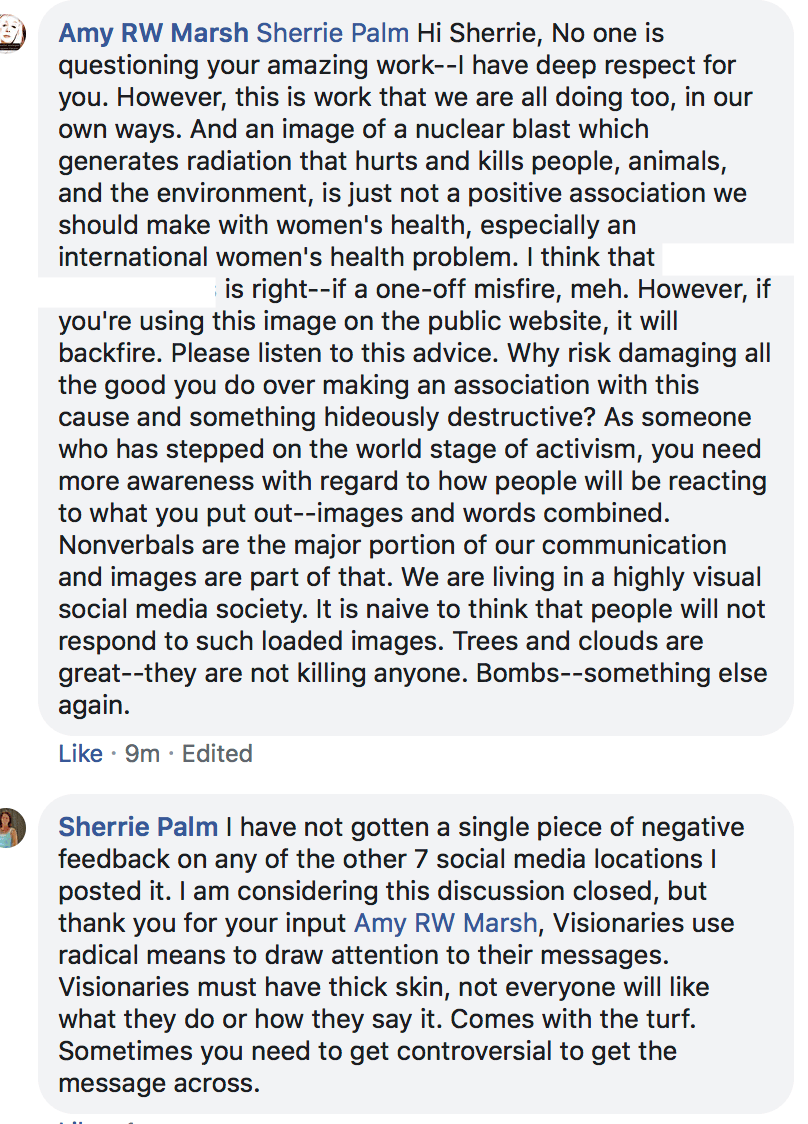
    (My first post did not include the image of the Guardian article. I added that later because someone–in an attempt to be funny–said that fireworks wouldn’t work as someone had recently died from one.) The founder responded like this (comments from others are deleted):

    Screen Shot 2020-01-03 at 7.46.33 AM

    Screen Shot 2020-01-03 at 7.46.33 AM copy 2

    Screen Shot 2020-01-03 at 6.10.34 AM

    I feel strongly about this. It’s important to have some modicum of multicultural sensitivity and awareness when advocating for a health cause that affects people internationally. Yeah, I’m not anybody’s media police, but I’ve put public endorsements of APOPS on my website and talked this organization up to my colleagues. However I can’t endorse someone in a leadership position who persists in such insensitive cluelessness–to the detriment of the cause itself and her ability to further it on a wider world stage.

    So until Sherrie Palm withdraws the image and apologizes for its use, I cannot in good conscience recommend this organization as one having the best interests of ALL women at heart. And that means women of the Marshall Islands too.

    I’ll be removing links to her website from my website as soon as I post this blog.

    ####


  • Black Trans Circles – Solving Violence

    Black Trans Circles – Solving Violence

    Signal boosting. This is a post-Transgender Day of Remembrance post in which I want to respond to the call to “elevate and support” the work of black trans women who are organizing effectively and creatively against violence in their communities. Who should know better than they do, what to do, and how? What they need from the rest of us is practical support!

    So I am sharing this vibrant video from Black Trans Circles, sent to me in a newsletter from the Transgender Law Center in San Francisco. And here is a link to an opinion piece in Essence titled Black Trans Women Are Solving the Epidemic of Violence, written by Raquel Willis (Nov. 20, 2019), founder of Black Trans Circles two years ago.


    The series of 2019 Transgender Day of Remembrance articles by Raquel Willis

    Out Magazine’s Trans Obituaries Project (Raquel Willis, Out Magazine, Nov. 20, 2019.)

    Layleen Cubilette-Polanco Died in the System, but Her Fight Lives On (Raquel Willis, Out Magazine, Nov. 20, 2019).

    How We Can End the Violence Against Trans Women of Color (Raquel Willis, Out Magazine, Nov. 20, 2019). “A 13-step

    Quote from the article above. I post this excerpt because I want you to read the entire article–it is so important. Read it for the 13-step plan to combat and end the violence:

    “…it’s not enough to honor the women we’ve lost with platitudes, social media posts, or thoughts and prayers. Instead, we need the rest of the LGBTQ+ community and our allies to make a deep commitment to keeping us alive—specifically by trusting our leadership and our solutions. Here, we’ve identified a 13-step plan to ending the epidemic, crafted, in part, from the expertise of leading figures who do this work daily.”


    The Open Letter to HRC from Trans Community Leaders

    Also mentioned in Willis’ Essence article, with a link: An Open Letter to HRC from Trans Community Leaders. The letter, dated Oct. 1, 2019 and published in Out Magazine, was signed by numerous trans leaders in a response to an announcement that the Human Rights Campaign (HRC) was now intending to “stand on the frontline to provide meaningful solutions for the transgender community.” Such cis-saviorism undermines and dismisses the grassroots community leadership that already exists among trans people, including trans people of color. In the past HRC has thrown trans people and trans issues under the bus, and have been otherwise not exactly inclusive of trans and other gender diverse people, and so their announcement is viewed with justifiable suspicion. As the Open Letter states:

    “Trans people, and primarily Black trans leaders and trans leaders of color, have been leading the work for trans liberation since long before HRC existed.”

    Here is another quote from the Open Letter to the Human Rights Campaign, dated :

    “We need more funding. We need more power. We need to be trusted to lead with our own solutions to the oppression that threatens our lives. We do not need a cisgender-led $40 million organization to copy our work and brand it as new.”

    I post these links and excerpts because I want you to read the whole thing. Don’t just stop with this blog post, please!

    Other Organizations and Initiatives

    Willis’ articles include references and links to other organizations and initiatives created by black trans people, particularly trans women. Here are the links from her articles:

    Anti-Violence Project

    CANS Can’t Stand Facebook group (fights the “Crimes Against Nature” Law RS 14:19).

    Compton’s Transgender District, San Francisco

    DeCrimNY – “A Coalition to Decriminalize, Decarcerate, and Destigmatize the Sex Trades in New York City and State.”

    Familia: Trans Queer Liberation Movement, Los Angeles.

    Gays and Lesbians Living in a Transgender Society (GLITS) – “The goal is to celebrate and encourage the expansion and public awareness of queer fluid expression. Notions of the nature and definition of gender, narrative, agency and expression and representation are examined.”

    Solutions Not Punishment Collaborative (SNaPCo), Atlanta – repurposing a jail as a wellness center, and more.

    TLC@SONG – Collaboration between the Transgender Law Center and Southerners on New Ground. Download a PDF of the 2019 GrapeVine Report on conditions for trans and gender diverse people in the south from this link.

    Monica Roberts’ TransGriot blog

    Also noted in a couple of Willis’ articles:

    American Medical Association policy announcement: AMA takes action to help prevent anti-transgender violence, June 10, 2019.

    As I find more links to the work done by black and other POC trans women, trans men, and other gender diverse people, I will also put them here.

    Finally a word about “signal boosting” via this blog. I assemble these references in blog posts so that I can pass a convenient collection of information and links to colleagues and the “general public.” With regard to this blog,  I will “signal boost” in these platforms:

    AASECT listserve (for members of AASECT)

    American Counseling Association’s Sexual Wellness Network (for members of the ACA) and possibly my ACA members blog.

    My Twitter account: @AmyMarshSexDr

    My own Facebook timeline and Facebook page for my counseling practice.

    Thank you.

    ####

  • Troubled History of IASHS

    Troubled History of IASHS

    2022: To those readers coming to this link from the April 13, 2022 articles, published in various Jewish online periodicals, I wish to note that the author, Andrew Lapin, did not get my permission to link to this small, personal piece of mine nor did he contact me to obtain more details about IASHS.  

    I am concerned that in Lapin’s desire to excoriate a high profile person accused of sexual harrassment, he has used inflammatory language like “sex guru” in his headline and attempted to link Bat Sheva Marcus’ alleged wrongdoings to the quality of education gained from a (now defunct) private graduate school. (The institutions that trained Marcus as a licensed clinical social worker were not mentioned in the article, however. Why is that?)

    IASHS–for all its faults and its spotty history–taught and trained hundreds of top-rated people in the area of human sexuality therapy and education. Other top people  in the field came to IASHS to lecture, and some stayed on to become staff. IASHS graduates have made, and continue to make, major contributions to the field of human sexuality, written books, headed professional organizations, developed training programs, and of course, put in countless hours working to help people overcome sexual shame, guilt, and ignorance. To my knowledge, most IASHS graduates have not been accused of sexual harrassment. 

    The courses taught at IASHS met many, if not most, of the educational requirements of the professional credential processes for sex therapists, counselors, and educators, by AASECT (The American Association of Sexuality Educators, Counselors and Therapists). So though IASHS was not approved by an academic accrediting agency in its final years, the coursework still had professional value and acceptance in the field.

    So, no matter what the facts are regarding the case of Bat Sheva Marcus and the people who accuse her of wrong-doing, it seems disingenous and lazy for the writer, Lapin, to link the spotty (and at times grand) history of IASHS to a single graduate’s behavior, as if it were the explanation for her actions.

    [Note the following was originally written in 2018. With some revisions in 2019, 2020.]

    It’s a strange feeling when an important part of your life has been shaped by an institution which is suddenly (or not so suddenly) no more. Many of us who have been involved in the Institute for Advanced Study of Human Sexuality (IASHS), lately of San Francisco, saw the long downhill slide and anticipated its demise. Still, it is a shock to have it gone. There have been times I’ve been inordinately proud of my time there, times I wanted to do my bit to “save” the crumbling pedagogical edifice, and other times when I wanted to burn my diplomas in front of the dreary tan exterior that made me call it “the sex school in the plain brown wrapper.”

    I think most of my regret and anger come from witnessing the terrible waste and degeneration of what was once a unique beacon to people who wanted to understand human sexuality, and to work with credibility in the field of human sexuality. I won’t go into personal details except to say that I tend to observe and analyze things closely. I also tend to volunteer my talents and skills if I sense they could be helpful.

    Now whatever work I put into that place is gone too. And the bound copies of my Ed.D. and DHS projects are — where? I would dearly love to have them. They cost me $80 each to have them bound and submitted to the IASHS library (as was required). I never did get a bound copy of my own Ed.D. project as my cash flow was tight at the time.  (This was not a research dissertation but an educational project consisting of a comprehensive literature review resulting in the design of a 150-hour course to teach hypnosis for sexual concerns.) All said, however, I am glad I was there while they still had an academic dean, Dr. Howard Ruppel. Once he was gone, there was very little credibility left.

    The Most Recent Troubled History of IASHS

    Prior 2017, the California Bureau of Private Post-Secondary Education (BPPE) approved IASHS to grant degrees (Ph.D., Ed.D, D.H.S.) and certificates in human sexuality. In 2015, BPPE issued a fine and Order of Abatement to IASHS. In 2016, the BPPE (1) issued a second fine and Order of Abatement to IASHS and (2) the BPPE declined to renew the approval of IASHS to grant degrees and certificates. By October 2018, IASHS appeared to have closed. The website no longer exists.

    It was clear that IASHS had reached its end times. There were several reasons for this, but most importantly, California’s SB 1247 had passed (Fall, 2014). IASHS was unable to meet the new mandated requirements to work with an accreditation agency. I spent a lot of time looking into various agencies but without substantial systems change, including transparency and revamping of the program, IASHS did not fit neatly into any category and no one would have us. It was clear to me that the “leadership” of the school was more interested in clinging to past glory than creating a strategic plan for the future.

    Oddly, after I left, with quite a lot of hard feelings on my side, I ended up going to bat in a public way for IASHS one last time. Mainly, I felt that there were many sound reasons to issue harsh critiques of IASHS in its final years, but I wasn’t going to sit still for one which was inaccurate and unfair. Now, I am not sure why I bothered.

    Disclosure: My Own History

    From the internet’s “Wayback Machine,” I have captured three pages which are pertinent to documenting my participation at IASHS, prior to 2015.

    • IASHS Academic and Professional Degrees – Explains the Ed.D. and DHS programs.

    • IASHS Certificate Programs – Shows my Sexological Hypnotism course.

    • IASHS Faculty and Administration – I am listed as Dean of Students and also on the faculty. I served about six months as Dean and resigned in 2015.

    ####


  • POP Culture – Pelvic Organ Prolapse

    POP Culture – Pelvic Organ Prolapse

    These last few days I’m not just dealing with “POP” (pelvic organ prolapse, a chronic condition), I seem to be in danger of succumbing to “POPO” – pelvic organ prolapse obsession! Just what I need, another consuming special interest…

    Did you know that Albert Kinsey’s 1953 book, Sexual Behavior in the Human Female, doesn’t mention prolapses, urinary incontinence, or painful intercourse, but it does contain a reference to the ancient Roman poet, Catullus (in a footnote to do with “petting” I think)? Or that the eleventh edition of Our Sexuality by Robert Crooks and Karla Baur (2011, a college textbook) doesn’t mention prolapses per se, though it does mention intercourse pain due to torn “ligaments that hold the uterus in the pelvic cavity.” On the bright side, Our Sexuality does include a helpful reference to the necrophiliac formerly known as Jeffrey Dahmer. Another textbook, Human Sexuality, authored by Masters, Johnson, and Kolodny (1995), doesn’t mention anything resembling a prolapse at all, but at least I can find entries for “shingles,” “Buddhism,” and “castration anxiety.” By its inclusion, should I presume castration anxiety is more prevalent than pelvic organ prolapses, which is estimated to affect at least 50% of all cis-gender women (and people of other genders besides)?

    Honestly, I don’t know whether to be more amazed at what’s left out of books on human sexuality or by what’s included.

    Perhaps I should respond by altering one of Catullus’ poems:

    I hate and love. If you were to ask how

    I got this way, I’d have no answer;

    but since my uterus dropped, I have suffered

    –I have felt this torment.

    None of the above is particularly helpful to people who suffer from POP. However, writing it made me feel better. Am I frustrated? Hell, yes. Do I have anything remotely helpful to express? Actually, I do. Go to that Pelvic Organ Prolapse page of mine and you’ll see a thing or two.

    In the meantime, here’s a bit more of what I’ve gleaned from my foray into “POP culture.”

    • Forget the “feet in the stirrups” thing–have your digital pelvic exam standing. Prolapses are more easily detected this way. (This info courtesy of this podcast interview with Sherrie Palm.)

    • One of the most successful surgeries to treat POP involves shortening and closing the vagina by sewing it up inside (not by sewing the labia together!). Yep. It’s called colpocleisis and has a 90-95% success rate and is a quicker surgery with a much shorter recovery period. But many doctors won’t offer or approve this surgery even for the women who want it. It’s a shame because for those who have a sexual repertoire beyond P/V intercourse, or who no longer wish to be sexually active with a partner, colpocleisis could be an option.

    • It is better to see a urogynecologist than a regular gynecologist for evaluation for this condition.

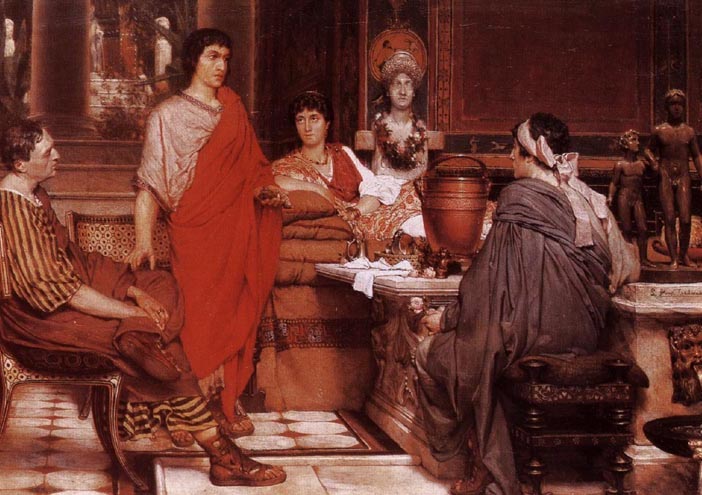
    I’ll leave you now with a painting of Catullus at Lesbia’s. He looks irked. Has he only just now heard of the FDA’s command to manufacturers to stop selling surgical mesh products indicated for the transvaginal repair of pelvic organ prolapse?

    Catullus_at_Lesbia's_by_Sir_Laurence_Alma_Tadema
    Catullus at Lesbia’s by Sir Laurence Alma-Tadema. Public domain.

    ####


  • Objectum Sexuality Media Musings

    Objectum Sexuality Media Musings

    Feb. 2020 Update: A team of UK researchers have published a peer-reviewed study in Dec. 2019, which provides strong evidence that my 2010 hypothesis about OS links to autism and synesthesia are correct. Link to PDF of 2019 study: Simner et al. OS-Autism:Synesthesia Nature 2019
    Link to PDF of my 2010 survey article: LOVE AMONG THE OBJECTUM SEXUALS

    Earlier this year Denham Hitchcock from Australia’s Channel 7 Sunday Night interviewed me for the “Object Love” segment, which aired May 19, 2019 (right after the full moon in Scorpio, please note!). Unfortunately I haven’t seen it yet as the link on this page doesn’t load or play for me, for some reason. But I am looking forward to watching it someday soon.

    I had a wonderful time the day we filmed and enjoyed meeting Denham, Karen Willing the producer, and the sound and light guys. They flew into SFO the night before, drove three hours to Lake County the next morning, shoved furniture around (good thing I vacuumed under the couch!), and filled the living room and kitchen with cases of equipment. I made breakfast for them too. (Denham kept urging the others to eat, claiming that I was “a feeder.” I wonder if his new mother-in-law is one of those too?) It was all rather thrilling and good fun! Afterwards, I realized I’d be perfectly happy if I could only be trailed by a handsome reporter and a fabulous production crew for the rest of my life… (That’s a joke, folks. Mostly I live like a hermit with several cats.)

    Because I’ve learned a thing or two since 2009, when I coped with the bizarre aftermath of appearances on Good Morning America (Apr.) and Tyra Banks (Oct.), as well as National Geographic Taboo, Google now helps me track where I show up in international media. I’ve turned up in the strangest places, mostly thanks to stories about Objectum Sexuality (O.S.). My 2009 article, “Love Among the Objectum Sexuals,” published in the Electronic Journal of Human Sexuality, still seems to be the “go to” place for journalists who are interested in this topic. I get several inquiries a year. And there are many more who write a story or cite me in a study without ever getting in touch. That’s okay.

    I do this partly because it’s a challenge for journalists to turn a complicated issue into reasonable soundbites and there are always mistakes. For example, I’ve been called a psychologist when I’m actually a sexologist. (I’ve also been called a “whack job of a sexologist” which gives me weird Lorena Bobbitt vibes, but whatever…)

    This recent coverage, with subsequent spin-off articles, has produced its share of hyperbole and error.

    (1) I’m not comfortable with this article’s claim that I’m “the world’s foremost expert on the condition known as object love.” I think the people who are Objectum Sexuals are the true experts. I just helped compile and organize some data. It is true though that I published the first sexological article based on a survey (see link above). But other academics have also written about O.S. They just don’t come up as quickly on the search engines, I guess.

    (2) My survey was of 21 English-speaking members of Objectum-Sexuality  Internationale.  Not dozens, as the above article claimed. It’s the qualitative data that really mattered. Looking back, I should have approached this inquiry as a cultural anthropology type of study, but then, I’m not a cultural anthropologist.

    (3) Object personification synesthesia–cause or correlation? I’m rather happy that this article leads with object personification synesthesia instead of objectum sexuality, actually. It makes for a refreshing change. However… it leaps ahead with an assumption of causality which has not yet been proven. [See Feb. 2020 update above.]

    In 2009 I proposed this form of synesthesia as a plausible and possible explanation for some people who are affectionately, romantically, and/or sexually oriented towards objects.

    The synesthesia explanation seems plausible from a sexological view because human beings have erotic responses to just about anything and everything. It is plausible from a psychological view because if some people sense personalities in objects and have emotional responses to some of them, then it’s logical to assume that some of those emotional responses may involve love and sexual attraction.

    In addition, synesthesia (in all its myriad forms) is higher among people who are autistic. And since a certain number of the O.S. people I surveyed were either diagnosed as autistic or felt they had significant autistic traits, it seemed logical to wonder if there was a correlation, or even possibly a causal relationship. I did do another, shorter survey and a fair number (don’t remember it now) of O.S. folks reported other kinds of synesthesia-like experiences.

    However, I’ve always said “this needs more study.” And I have never, ever claimed to be an expert in object personification synesthesia, as this article claims for me.

    (4) As a sexologist, I don’t view O.S. as a “disorder” or as pathological in any way. I view it as a legitimate sexual and/or affectionate/romantic orientation that seems rather rare (but could be more common than we realize). This article calls O.S. a “bizarre relationship disorder.” Sigh.

    (5) Media has been a curse as well as a blessing to O.S. people. On the one hand, it is very good that people who love objects know there are others like them. That’s the good that media does.

    But when media reports include distortions, hyperbole, and inflated assertions, this deters legitimate researchers. No one, except eccentrics like me, will want to tie their present and future career to something that is a laughing stock among their colleagues. Yet without ethical, intellectual inquiry into this topic, there’s a danger that media could also inflame persecution of O.S. people. Such persecution could include hate crimes, discrimination, deliberate destruction of someone’s object love, even development of so-called “conversion” therapies (which are known to be unethical as well as cruel), and so on.

    (6) My focus on O.S. has always been to foster a kind of “cultural competency” among helping professionals. O.S. people have the same needs as other people do. They need their relationships and preferences to be accepted and honored. If they are grieving over the loss of an object or the loss of a relationship with an object, they need that loss to be acknowledged and tenderly held. They do not need to be told they are crazy or traumatized, unless their history does in fact contain co-morbid mental health conditions or actual trauma. In that case, you treat the trauma or the disorder, NOT the sexual or affectionate orientation.

    Please see my free course for clinicians, on this page and spend a couple of hours with a more useful perspective on Objectum Sexuality.

    objectum_sexuality_-_marsh

    Meanwhile I continue to pursue other eccentric sexological interests: erotic hypnosis and an inquiry into spectrosexuality.

    ####


  • Objectum Sexuality-Further Thoughts

    Objectum Sexuality-Further Thoughts

    UPDATE: Australia’s Channel 7 Sunday Night segment on “Object Love” aired this weekend (May 19th). I’d like to make a correction. The segment summary says I surveyed 40 people. It was really 21. I don’t know how they got 40. The article referred to in the next paragraph clearly states 21 people. I haven’t seen the broadcast itself yet.


    It’s been ten years since I designed a simple survey for the English-speaking members of Objectum-Sexuality Internationale (OSI) and nine years since my survey results article was published in the Electronic Journal of Human Sexuality.

    Since I’ll be speaking about Objectum Sexuality (OS) with Australian reporters this coming Sunday, I thought I’d give some background regarding my history with this topic and the OS community.


    This quote below is from “What Is OS?” on the OSI website.

    Objectùm-Sexuality is an orientation to love objects.

    Sexual orientation is defined as the nature of sexual preference while the prolific definition stands as: the direction of someone’s sexual desire toward people of the opposite gender, people of the same gender, or people of both. This does not include objects.

    However, orientation itself is defined as: a complex mental state involving beliefs and feelings and values and dispositions to act in certain ways. This does include objects as we see it.

    We love objects on a very significant level and many of us in an intimate way. This feeling is innate. Objectùm-sexual love comes for most in a similar awakening as other sexualities at the start of puberty. This is often followed by an acute awareness that we do not relate to peers due to the source of projected feelings. Often objectùm-sexual people feel outcast or pressured by mainstream sexuality with a helpless feeling that we cannot change what comes so naturally to us.


    2009 and Beyond: I Encounter Objectum Sexuality

    In October 2008 I’d received my DHS (a professional degree, Doctor of Human Sexuality) from the now defunct Institute for Advanced Study of Human Sexuality (IASHS) in San Francisco. (In 2011, I earned my Ed.D. in Human Sexuality). One of my two student research projects was into sexual concerns experienced by people with Asperger’s Syndrome and their partners. (Since then, the DSM-V has removed Asperger’s as a separate diagnosis and replaced it within the term ‘autism spectrum disorder.’)

    In February 2009, a young relative of mine who is autistic sent my kids a Valentine drawing of San Francisco’s Sutro Tower, surrounded by hearts. My oldest kid used to have friends among the Victorian houses we’d pass on the way to nursery school, particularly “Onion Dome-y” who was supposed to jump into a “shape truck” and follow us to school, and my youngest used to pretend to eat pictures of ice cream cones by plucking them off the page, so I didn’t think anything of the valentine. I adore childhood imagination.

    However, I must have been fated to encounter the adult version of Object Love. The very next day, a sexology colleague sent me a link to Married to the Eiffel Tower (2008)–a film that I would later learn was denounced as exploitive by the OS commuity. I visited the OSI website and saw that a number of their members were on the Asperger’s/autism spectrum. Given my student research, I became intrigued. I contacted OSI by email and began talking with Erika on the phone.

    I was concerned about the sensationalisation of OS sexuality and eventually volunteered to do a simple survey as an “in-house” vehicle for the members of OSI so they could learn about themselves as a group and have some preliminary data to offer reporters and health practitioners. I hoped this would enable them to be taken more seriously.

    Though I took a lot of care over the project, this simple survey was not designed as serious research instrument. Its main value would be in the qualitative responses–comments from OS people about their experiences and concerns. But when Erika Eiffel was asked to tell her story on Good Morning America in April, 2009, she told the reporters about the membership, and GMA sent a crew to my house.

    I was not prepared for what happened next. Erika and I were fielding inquiries from Laura Ingraham (we turned her down) and other media. I wound up–inadvertantly–on a right wing radio station on the East Coast but was able to get in a couple of jabs until the host hung up on me, live! The two of us were vilified all over the internet. My favorite insult was “whack job of a sexologist” in a troll blog. I went from media infant to media traumatized in the blink of the eye.

    I wish I could say “media saavy” happened sooner rather than later, but this was not to be. The Tyra Banks appearance was very high pressure (they were filming four shows in one day) and I suffered from not having an adequate sense of the show format (I didn’t own a TV at the time and didn’t really know who Tyra was.) Plus, I had no idea of how to direct my TV make-up and hair, so that I could look like my normal self but better. Instead, the make-up artist, hearing I was a sexologist, got all excited and made me up as a “Fifth Avenue Cougar.” Lesson learned: never accept high gloss over a lipstick if you’re “of a certain age.” Lipstick creep will cause a show guest to melt-down at the worst time.

    I know. It happened to me.

    Plus, I left my comfortable Berkeley sandals in the dressing room, which must have been picked up with tongs and tossed in the wastebasket after I left. I think I can honestly say that both Erika and I were somewhat stressed by the experience, but she was a media veteran by then. I flew home, though, hoping that all this television stuff might be a boost to my career. And I was interested to see that Erika, as always, was credible and articulate enough to win over even a tough customer like Tyra Banks!

    A few months later, National Geographic Taboo was much more relaxed. Instead of flying to New York, I drove to Palo Alto and sat in front of a green screen. I did a second filming with NG Taboo several months after that. Fortunately, human puppy training was the topic then–which was a bit of a relief, actually. I’d begun to worry that OS was all I’d ever be asked about.

    Another thing: In the summer of 2009, I arranged for Erika to give a presentation on OS to a number of sexologists, therapists, and medical professionals at IASHS during 2009’s eight-day, “Sexual Attitude Restructuring” (SAR) program. This was a tough crowd–highly educated and rather skeptical–but Erika did a great job and won people over to an understanding of Objectum Sexuality–just as she would later do with Tyra and so many others.

    Since the flurry of 2009 and 2010, there’ve been several media inquiries a year, and usually they are pretty much the same old, same old. Often the journalists want me to find an OS individual for them to interview. I alway refer them to OSI. The community seems to have become more wary and more sophisticated about “gatekeeping,” to shield members against exploitative projects. That’s important, given the carnival freak show sensibility that prevailed in early coverage.

    My interests as a sexologist have always been broad, including the sexological and erotic uses of hypnosis, neotantra, sexual and gender human rights, and much more, but sometimes I track where my name and this issue have been paired in media. There are always surprises. For example, today I discovered that my article has been monetized and is on sale through iTunes by the Gale Group, “an affiliate of Cengage Learning.” So for $5.99 you can read an article about my pro-bono research but I’ll never see a penny of this. I’ve never minded the article being open-source and free to all the world, but the fact that it’s now on sale without my permission, irks me. Just read it for free, here.

    The Need for Professional Cultural Competency

    objectum_sexuality_-_marshI’ve always been afraid that media coverage of OS may have distracted professionals from the notion of learning more about OS, particularly in the context of sexual literacy and cultural competency.

    This world is rough and often dangerous for people of sexual and gender minority communities. It doesn’t help when the clinician or therapist is distracted because they don’t know enough about the broad range of human sexual behavior and genders and may be focused on that, rather than the actual presenting problem (which might be a toothache or bereavement and have little to nothing to do with their partnership with a beloved object (or two or three).

    With these concerns in mind, several years ago I created a two-hour class called Objectum Sexuality —  A Clinician’s Guide. It was wildly ignored. But now I am going to share that class on my website now, just in time for Valentine’s Day…
    A New Experience

    I am readying now for what I think will be a really good media experience this coming Sunday. I sense a fresh approach from a skilled, curious, and compassionate reporter who is used to taking on difficult and complex topics. I hope that I’ll be able to provide a clinical context and address some of the points that I consider important, but which seldom get much play.

    Updates coming soon!

    ####

  • Sexual Health for Trans Men Who Have Sex With Men (TMSM)

    Sexual Health for Trans Men Who Have Sex With Men (TMSM)

    Here is the slide show from the webinar I attended today concerning sexual health and HIV prevention strategies for trans men who have sex with men. The webinar organizers wanted this information to be widely shared, so I am doing my part. You can download a PDF of the slide show here: TMSM+WEBINAR

    I was very pleased to attend the webinar. At an hour, it was far too short. It makes me realize how much I miss the sex positive/sexual health positive community of the SF Bay Area. Honestly, there are so many good people and organizations providing care and resources to groups of people I really care about.

    There was a lot of good information, but one of the best quotes was, “playing twenty questions about my gender is not good foreplay.” (Unfortunately I forget who said this!) The message: educate yourself first about gender variance before dating a person who is trans, non-binary, or otherwise gender variant. Take that as a pre-Valentine’s Day tip!

    Big thanks to Shawn Demmons, MPH, the main presenter, and to the panelists: Kay Nielson of the SF Aids Foundation; Niko Kowell of the SF Community Health Center; and Marion Pelligrini, also of the SF Community HEalth Center. I truly appreciate the opportunity to learn more.

    unnamed

  • Hypnotic “Desensitization” For Reluctant Erections, and Then Some

    Hypnotic “Desensitization” For Reluctant Erections, and Then Some

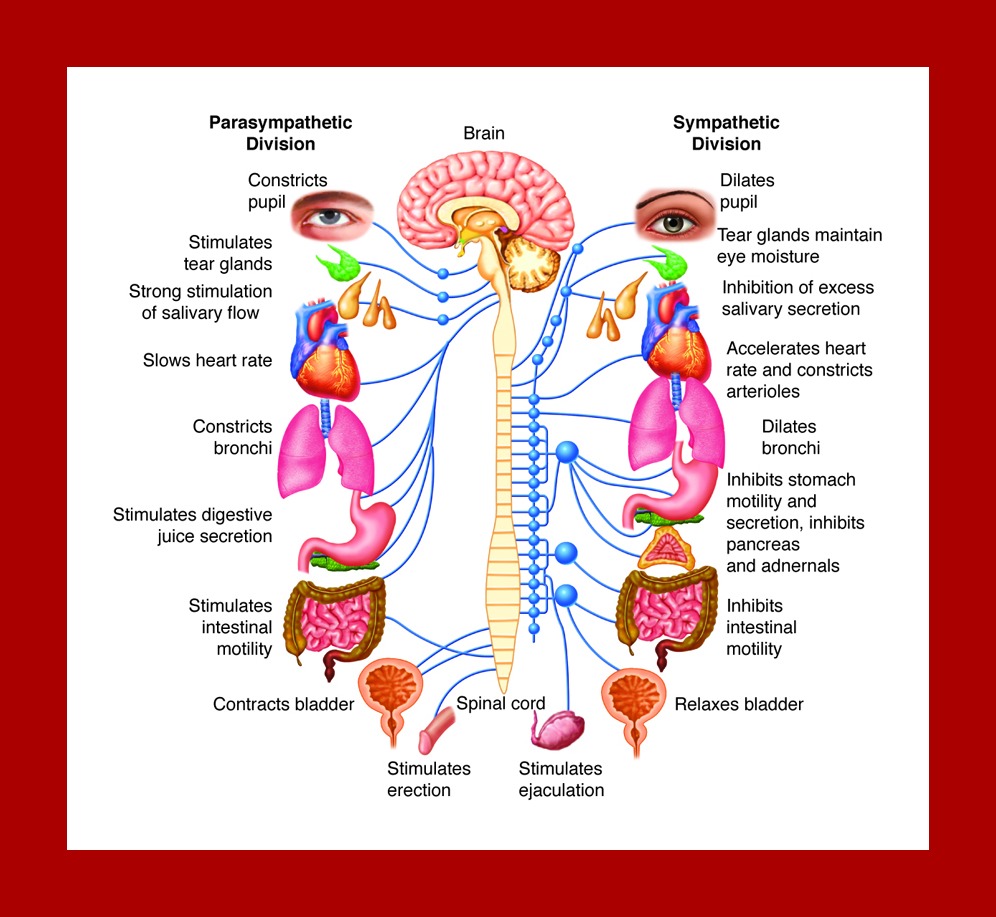
    No, this doesn’t mean making your penis “less sensitive,” it means soothing your nervous system responses to stress and worry. The advantage of being soothed is that if you have a male body, you are less likely to become so worried about a sexual encounter that you flip into sympathetic nervous system responses (“fight, flight, freeze”) and thus experience diminished blood flow to your penis.

    Erections are all about blood flow, so you want to be in your parasympathetic nervous system mode (even if you are excited!). Parasympathetic mode is sometimes dubbed “feed and breed,” with good reason. You need to be in this mode to experience and sustain sexual arousal (this is generally true for all humans). (Oddly, sympathetic mode governs ejaculation.)

    NervousSystem
    Image author and source unknown.

    So what can you do, assuming you have no medical problems that interfere with your circulation (do get screened for diabetes!) or other aspects of sexual health?

    Change your erotic mindset. One thing you can do is focus on your (and your partner’s) sexual enjoyment, rather than worrying about function (Klein, Sexual Intelligence, pp. 229-231). One way to do that is to cultivate a variety of pleasures beyond penetrative intercourse (anal or vaginal). These range of course from oral sex to erotic massage to anything else you both enjoy. I teach erotic hypnosis to people who want to learn to do this with their lovers–proving that “the brain really is the largest sexual organ.” There are numerous ways to have a rollicking good time in bed (and out of it), that have very little to do with a hard penis. In fact, Annie Sprinkle, Ph.D., has a brilliant video on YouTube that cheers on the soft penis as a wonderful, juicy, pleasure-giving part of the body. I’m completely in favor of her “Soft-Cock Revolution” and wish more partners of penis’d people would get on board with this.

    Understand that erection fluctuations are normal. Bernie Zilbergeld’s classic books, Male Sexuality (1978) and his revised The New Male Sexuality (1992), has a chapter called “It’s Two Feet Long, Hard as Steel, Always Ready, and Will Knock Your Socks Off: The Fantasy Model of Sex.” I think that title says a lot about erection expectations, don’t you? I wish every cisgendered* male would read this book, even though it was published so long ago.

    Understand the intelligence of your body, especially your penis. If you feel you may have worried yourself into a cycle of reluctant erections you might need more emotional safety in your relationship(s). Emotional safety would allow you to remain in parasympathetic mode when you’re with your partner. This is more important than you might imagine. Most of the men who come to me for help with “erectile dysfunction” (I dislike that term more and more every day) are younger men who have come out of a long term relationship and are just now starting to date again. They’re scared, yet feeling pressured to get back into circulation. And they expect to be “ready, willing, and able” without regard for their own (or their partner’s) emotional context, even if they are no longer in their teens. I’ve sometimes had clients “talk with” their penises under hypnosis or later ask them to write letters to themselves from their penises. This can be very insightful, odd as it sounds!

    I also teach partners to do “affectionate” hypnosis as a regular part of their week–each spending five to ten minutes in light trance while the partner pours loving words of appreciation into their receptive ears. Then switch! This can do a lot to create feelings of bonding and emotional safety in relationships.

    Breathe deeply and focus on the present moment. Forget about your “performance” and get back inside your body. For some men, this can actually be enough to help overcome the triggered leap into sympathetic nervous system mode. It’s a learned skill. Those who already do yoga or meditation will generally pick it up more easily.

    Consider hypnosis and self-hypnosis to re-set your nervous system responses. Usually people are triggered by a series of escalating steps toward sexual intimacy. I typically ask my clients for a list of (up to ten) things that begin to make them feel worried, and then we rank them in order of least worrisome to most worrisome. The idea is that we “desensitize” their reactions to the less stressful steps first–like texting someone for a date–and then work to diminish sympathetic nervous system responses to the more intense triggers like “unhooking my wife’s bra,” “putting on a condom,” or “starting to thrust.” This process takes repetition and practice. I teach self-hypnosis so that my clients can also practice this at home.

    Hypnotism Male Sexual Dysf Handout– Here is a list of some early studies using hypnosis to improve male sexual function.

    What I’ve just described is a focus simply on the cisgendered male client, without taking the partner(s) into account. Often the partners have their own responses to a “dysfunction” which may range from exasperation or frustration in the moment to “he’s not really into me” or “I must be too fat” (or other body image issues and emotional insecurities). Often the partner needs basic adult sex ed too–including reasonable expectations of how penises work and what other lovely, wonderful things can be enjoyed together. Emotional safety and generosity for both (or all) partners are crucial for re-inventing mutual sexual enjoyment. So I like to also have some session time with the partners as well.

    ####

    *”cisgendered” means your own sense of gender is congruent with your gender assignment at birth.

  • Senior on Senior Bullying–LGBTQIA People at Higher Risk?

    Senior on Senior Bullying–LGBTQIA People at Higher Risk?

    First of all, a huge thank you to Harold Riley, host of Our Stories, Our Lives, on our local, Lake County radio station, KPFZ 88.1 FM. His broadcast yesterday brought me back to a topic I’ve been concerned with in the past, but not enough in the present.

    The topic is a form of elder abuse–senior bullying–by other seniors and also by care providers. A recent Associated Press article, ‘It’s like ‘Mean Girls,’ but everyone is 80′: How nursing homes deal with bullies (Matt Sedensky, May 12, 2018), speaks to the problem in nursing homes, senior centers, and senior housing. The last portion of the article recounted the plight of a woman who was bullied relentlessly by her neighbors for being a lesbian, once she moved into a senior housing complex in Illinois.

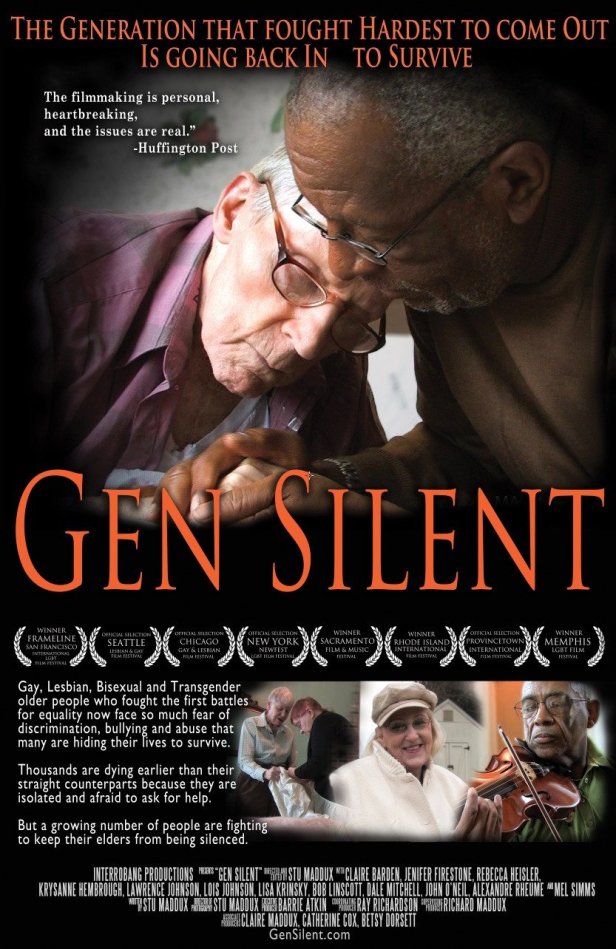
    Senior on senior bullying is just one form of abuse that elders, especially older LGBTQIA people, endure. Years ago, when I was taking some case management and gerontology classes at Berkeley City College, I began to learn how some in-home health workers and other social service providers were bullying clients who were LGBTQIA or who had different sexual lifestyles (kinky, poly, etc.). The heartbreaking documentary, Gen Silent, shows how tragic and frightening this is. The website has a “free viewing pop-up” every so often, so it’s worth signing up for this so you can see the film.


    Documentary, Gen Silent, by theclowdergroup.com

    Sage–Advocacy and Services for LGBT Elders–published this article in Feb., 2018. Here is an excerpt from that article:

    <<Regarding much-needed support in postretirement years, the resource center notes the following: Although 80 percent of long-term care in the U.S. is provided by family members, LGBT elders are twice as likely to be single and three to four times more likely to be without children than their heterosexual counterparts. Further, many professional caregivers are not accepting of LGBT elders and not trained to deal properly with their unique needs. Therefore, such caregivers might be hostile, discriminatory, or simply unaware that LGBT elders exist. For example, 8.3 percent of LGBT elders reported being neglected or abused by a caretaker due to their sexual orientation or gender identity.>>

    Back in 2010, I wrote a column for Carnal Nation called Kink at the Old Folks Home which considered this topic from the standpoint of consensual kink among elders, and what can happen when care providers or social service providers are not adequately informed and trained to deal with alternative sexualities and genders. From my column:

    <<…Clay Greene (age 88) and Harold Scull (age 77) [this link added 5/17/18] is a recent example of heavy handed intervention. When Harold Scull became injured, an avalanche of official interventions quickly buried both men, destroying what remained of their life together. Sonoma County officials portrayed Greene as Scull’s “roommate,” ignored the men’s mutual powers of attorney, and put both men into nursing homes, separate ones, and even though Greene was healthy! They also sold the men’s home and belongings, and even got rid of their pets without their permission. Authorities refused to let Greene visit Scull, even as Scull was dying. Greene sued the county with help from the National Center for Lesbian Rights and recently won his case.>>


    What can you do?

    Speak up! Don’t stand by and allow bullies to have their way! Here are some resources to help you understand the issue and what you can do about it.

    The National Center for Assisted Living has a PDF booklet called Bullying Among Seniors to help assisted living providers to prevent and address this problem.

    The University of Southern California has a Bullying Prevention Resource Guide which includes several resources specific to LGBTQIA communities and to seniors. (Scroll down.)

    Today, May 17th, is International Day Against Homophobia, Transphobia, and Biphobia. Let’s celebrate it in style by preventing bullying every day of the year.

    ####


    SaveSave

    SaveSave

  • Update: Resigning from Ipsalu Tantra

    Update: Resigning from Ipsalu Tantra

    I initially resigned due to the lack of an Ipsalu public statement on this matter. Ipsalu Tantra International has now issued a statement (below). However, my resignation is still final as there are several reasons I am no longer in alignment with the organization’s mission and approach.


    5/10/18:

    From Bodhi Avinasha ~ Founder of Ipsalu Tantra International

    Namaste

    I have just learned of a matter that makes me feel nauseated – news of child abuse at the Satyananda Ashram in Australia, and also in his main ashram in Bihar India. Ipsalu finds these reports disgusting, the behaviors reprehensible.

    We have mentioned Satyananda in our line of lineage, as Sunyata’s guru, but this part of his nature could not be further from the few techniques we have extracted from his teachings. We absolutely condemn involving children in tantric work. Ipsalu has even refused teenagers who wanted to attend our courses. Only responsible adults are involved with this work, and our only goal is to deepen their connection to the Divine.

    Satyananda was a brilliant scholar, who brought to our generation valuable insights into ancient wisdom. But he was seriously lacking in handling emotional and heart energy. He sent Sunyata to Osho for training in those areas.

    Sunyata studied at the Bihar Ashram from 1961-64, and then was told to go out into the West and spread the knowledge he had gathered. The history of abuse goes back to 1967, long after Sunyata had left Bihar.

    The main teacher in Australia, a classmate of Sunyata, was seriously demented. I spoke with his Executive Secretary as she was about to leave her involvement there, as she poured out her stories of his abusive nature. It was clear he was a perfect example of what can happen working with powerful energies but not doing emotional clearing. The energies can pull one into the dark side. By the way, stories of abuse in Australia were from the period 1978-84. I met Sunyata in late 1985, so there was no overlap. Sunyata had been teaching for years, but never involving children.

    The Saraswati Order is very mental, and that was Sunyata’s comfort zone. My insistence on doing emotional release and heart opening exercises was the reason we split in 1992.

    Please don’t hold Ipsalu accountable for the weakness of some of our sources. Ipsalu is dedicated to maintaining safety and the highest ethical and spiritual standards, always coming from a place of love.

    Bodhi Avinasha


    The above statement pertains to the Australian Royal Commission into Institutional Responses to Child Sexual Abuse, which investigated reports of child sexual abuse at the Satyananda Yoga Ashram at Mangrove Mountain, New South Wales, and against Swami Akhandananda Saraswati and others (as well as a rape allegation against Satyananda himself). Testimonies and findings will be found at the above link.

    Though the Australian inquiry took place in 2014 and findings were published in 2016, an Ipsalu newsletter published today mentions its connection to the teaching lineage of Satyananda (through Sunyata Saraswati, Ipsalu co-founder). Please be clear, however, that there are absolutely NO organizational links to the Bihar/Satyananda ashrams or ITI and never have been. But the teaching lineage exists.

    Prior to Ipsalu’s statement today, other organizations with links to the Satyananda teachings have made public statements acknowledging the issue and expressing concern and support for the survivors. Some people have called for boycotts of Satyananda methods until reparations are paid to the abuse victims. I believe these and other actions demonstrate good citizenship on the part of such organizations, and lets the public know that these organizations believe in, and practice, accountability.

    Ipsalu Tantra International (ITI) is a reputable organization that holds very high ethical standards for its teachers and certainly does not condone sexual abuse and coercion. It has a written policy of ethical standards and takes breaches seriously. Its spiritual practices are very effective and the community is a loving one. Now that ITI has made a statement on this matter, I am much relieved.

    But I still can’t feel comfortable remaining with the organization. There are the reasons I expressed in an earlier blog (link above). Another big reason is that ITI is now emphasizing Osho (formerly Rajneesh) teachings in addition to its other practices. Therefore I am no longer in alignment with the organization or its mission. I wish ITI well, however, and have good feelings about the teachers that I know personally.


    Note: ITI’s website is “broken” and cannot be edited right now. My teacher profile is likely to remain up until they can fix it and take it down.